Reed Organ MIDI Conversion Tickles All 88 Keys

What did you do in high school? Chances are it wasn’t anywhere near as cool as turning a reed organ into a MIDI device. And even if you managed to pull something like that off, did you do it by mechanically controlling all 88 keys? Didn’t think so.

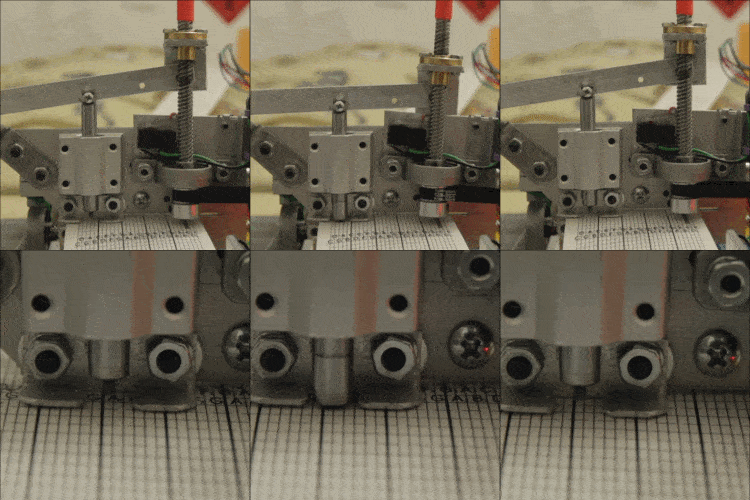
A reed organ is a keyboard instrument that channels moving air over sets of tuned brass reeds to produce notes. Most are fairly complex affairs with multiple keyboards and extra controls, but the one that [Willem Hillier] scored for free looks almost the same as a piano. Even with the free instrument [Willem] is about $500 into this project. Almost half of the budget went to the solenoids and driver MOSFETs — there’s a solenoid for each key, after all. And each one required minor surgery to reduce the clicking and clacking sounds that don’t exactly contribute to the musical experience. [Willem] designed custom driver boards for the MOSFETs with 16 channels per board, and added in a couple of power supplies to feed all those hungry solenoids and the three Arduinos needed to run the show. The video below shows the organ being stress-tested with the peppy “Flight of the Bumblebee”; there’s nothing wrong with a little showing off.

[Willem]’s build adds yet another instrument to the MIDI fold. We’ve covered plenty before, from accordions to harmonicas and even a really annoying siren.

Continue reading “Reed Organ MIDI Conversion Tickles All 88 Keys”

Early Electromechanical Circuits

In the days before semiconductor diodes, transistors, or even vacuum tubes, mechanical means were used for doing many of the same things. But there’s still plenty of fun to be had in using those mechanical means today, as [Manuel] did recently with his relay computer. This post is a walk through some circuits that used those mechanical solutions before the invention of the more electronic and less mechanical means came along.

Continue reading “Early Electromechanical Circuits”

Robo-Flute Whistles MIDI

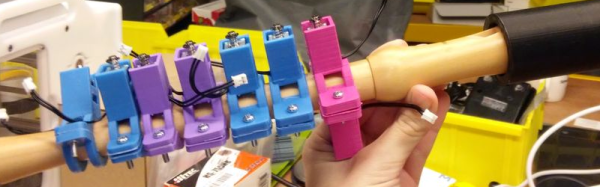
We aren’t sure this technically qualifies as music synthesis, but what else do you call a computer playing music? In this case, the computer is a Teensy, and the music comes from a common classroom instrument: a plastic recorder. The mistaken “flute” label comes from the original project. The contraption uses solenoids to operate 3D printed “fingers” and an air pump — this is much easier with a recorder since (unlike a flute) it just needs reasonable air pressure to generate sound.

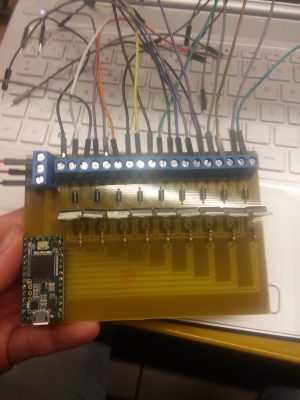
automated-recorder-solenoid-driverA Teensy 3.2 programmed using the Teensyduino IDE drives the solenoids. The board reads MIDI command sent over USB from a PC and translates them into the commands for this excellent driver board. It connects TIP31C transistors, along with flyback diodes, to the solenoids via a terminal strip.

On the PC, a program called Ableton sends the MIDI messages to the Teensy. MIDI message have three parts: one sets the message type and channel, another sets the velocity, and one sets the pitch. The code here only looks at the pitch.

This is one of those projects that would be a lot harder without a 3D printer. There are other ways to actuate the finger holes, but being able to make an exact-fitting bracket is very useful. Alas, we couldn’t find a video demo. If you know of one, please drop the link in the comments below.

We have seen bagpipe robots (in fact, we’ve seen several). We’ve also seen hammering shotguns into flutes, which is certainly more melodious than plowshares.

Modular Tap-Dancing Robot Can Shuffle Ball Change

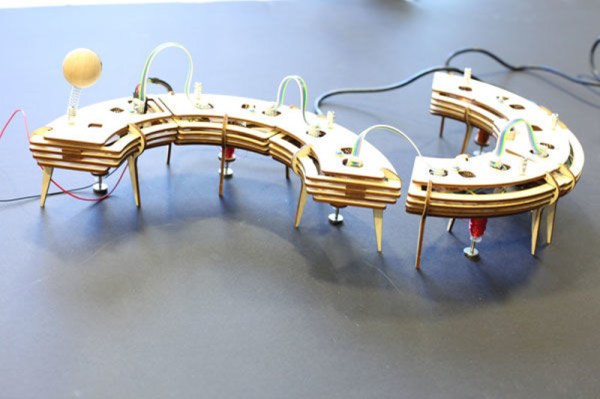
Electromechanical solenoids are pretty cool devices. Move some current through an electromagnet and you can push a load around or pull it. If you’re MIT student [Lining Yao], you can use them to dance. [Lining] built TapBot, a re-configurable set of tap-dancing robots that are both modular and modern. She even rolled her own solenoids.

The one with the eye stalk is the bridge, and it’s connected to a computer over FTDI. The other nodes attach to the bridge and each other with small magnets that are designed to flip around freely to make the connections. These links are just physical, though. The nodes must also be connected with ribbon cables.

Each of the nodes is controlled by an ATtiny45 and has a MOSFET to drive the solenoid at 8-12 V. [Lining] snapped a small coin magnet to the end of each solenoid slug to provide a bigger surface area that acts like a tap shoe. TapBot can be programmed with one of several pre-built tap patterns, and these can be combined to make new sequences. The curtain goes up after the break.

There are other ways to make things dance, like muscle wire. Check out this whiteboard pen that uses nitinol to dance to Duke Nukem.

Continue reading “Modular Tap-Dancing Robot Can Shuffle Ball Change”

Solenoid Engine With Woodworking Chops

Simple, elegant, and well executed. This solenoid engine build is everything we’ve come to love about [Matthias Wandel]’s work. If you don’t recognize his name you probably remember the name of his site: Wood Gears.

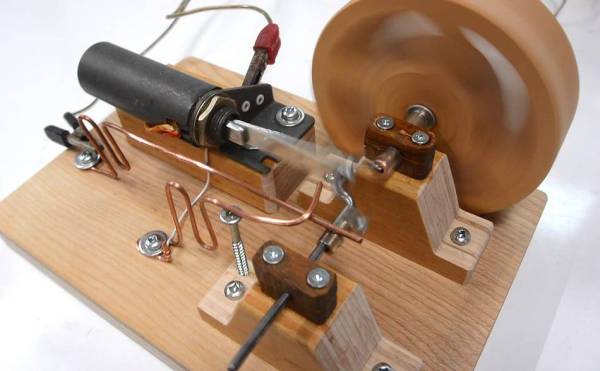
In what feels like an afternoon project he put together a solenoid engine. It translates the linear motion of a small solenoid into the circular motion of a flywheel. The only specialized part in this hack is the solenoid. It has a pretty long throw and includes a hinge pin at the end.

The rest is crafted mostly of wood — it is admirable how he uses that table saw like a surgeon uses a scalpel. The wooden components include a base, flywheel, very interesting bearing blocks, and a few mounting brackets to hold everything in just the right place. Add to this a coat hanger for the cam shaft, the internals of a terminal strip for the cam, some heavy gauge wire, and you’re in business. The latter two make up a clever electrical switch that synchronizes the drive of the solenoid with the flywheel.

It’s amusing to hear [Matthias] mention that this engine isn’t very practical. We still think the project has merit — it’s great for learning about how simple an engine can be, and for developing an intuitive appreciation for how great commercially available motors and engines actually are. Plus, if you can mimic these fabrication techniques you can build anything. Great work on this one [Matthias], another thing of beauty!

Check out his video below, then go back and check out his air-powered engine and of course, a hack that actually uses wood gears.

Continue reading “Solenoid Engine With Woodworking Chops”

Electric Train Demonstrator

If you ever want to pique a kid’s interest in technology, it is best to bring out something simple, yet cool. There was a time that showing a kid how a crystal radio could pull in a radio station from all the way across town fit the bill. Now, that’s a yawner as the kid probably carries a high-tech cell phone with a formidable radio already. Your latest FPGA project is probably too complicated to grasp, and your Arduino capacitance meter is–no offense–too boring to meet the cool factor criterion.

There’s an old school project usually called an “electromagnetic train” that works well (Ohio State has a good write up about it as a PDF file). You coil some bare copper wire around a tubular form to make a tunnel. Then a AAA battery with some magnets make the train. When you put the train in the tunnel, the magnetic forces propel the train through the tunnel. Well, either that or it shoots it out. If that happens, turn the train around and try again. There’s a few of these in Internet videos and you can see one of them (from [BeardedScienceGuy]) below.

Continue reading “Electric Train Demonstrator”

Enjoy The Last Throes Of Summer With A Nice Pool Automation Project

[Ken Rumer] bought a new house. It came with a troublingly complex pool system. It had solar heating. It had gas heating. Electricity was involved somehow. It had timers and gadgets. Sand could be fed into one end and clean water came out the other. There was even a spa thrown into the mix.

Needless to say, within the first few months of owning their very own chemical plant they ran into some near meltdowns. They managed to heat the pool with 250 dollars of gas in a day. They managed to drain the spa entirely into the pool, but thankfully never managed the reverse. [Ken] knew something had to change. It didn’t hurt that it seemed like a fun challenge.

The first step was to tear out as much of the old control system as could be spared. An old synchronous motor timer’s chlorine rusted guts were ripped out. The solar controler was next to be sent to its final resting place. The manual valves were all replaced with fancy new ones.

Rather than risk his fallible human state draining the pool into the downstairs toilet, he’d add a robot’s cold logical gatekeeping in order to protect house and home. It was a simple matter of involving the usual suspects. Raspberry Pi and Arduino Man collaborated on the controls. Import relay boards danced to their commands. A small suite of sensors lent their aid.

Now as the soon-to-be autumn sun sets, the pool begins to cool and the spa begins to heat automatically. The children are put to bed, tired from a fun day at the pool, and [Ken] gets to lounge in his spa; watching the distant twinkling of lights on his backyard industrial complex.