Laptop LCD Reused In Beagleboard Project

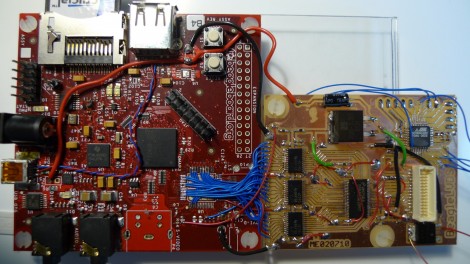
This daughterboard lets [Matt Evans] drive a laptop LCD using a Beagleboard. Apparently the Beagleboard gained a VGA header when it moved to revision C but [Matt’s] working with revision B4 which is why he had to do all of that ninja soldering with the blue wires. The driver board itself is a thing of beauty, hosting a DS90C363 LVDS serialiser as well as some buffer chips that handle level conversion for it. He’s also included an ATmega48 so that he has some options for future improvements.

The LCD is mounted in a custom acrylic case, with Beagleboard and driver board taped to the back of it. There’s RS232 and a USB hub which opens up the possibility of using a WiFi dongle for communications. So far he doesn’t have much functionality other than displaying images on the screen but there is some talk about using a touchpad for control. We’d love to see a touchscreen overlay, transforming the build into a proper ARM-based tablet.
Monocrome To Magnificent: Computer Display Chronology

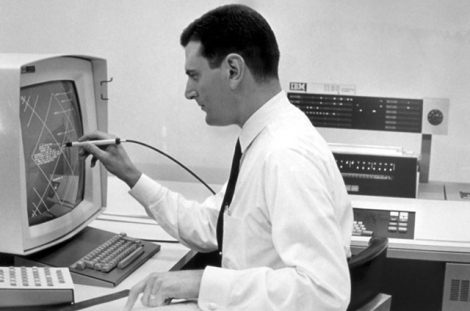
Remember when CGA came out and made monocrome monitors look horrible? Well CGA is crap, VGA is where it’s at. Wait… weren’t there a couple of standards in between those two? Take a walk down memory lane and relive the evolution of computer display technology. You’ll start with displays that are more or less CRT oscilloscopes and end up in better than high-def territory. The article is an interesting read but for those with short attention spans jump to the fourth page and check out the chart of technologies, resolutions, and implementation dates. We’ve come a long way in a few short decades.

Game Boy VGA Using An FPGA

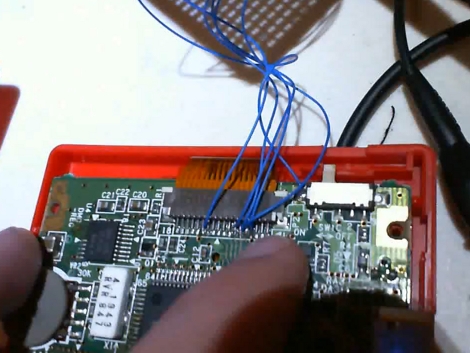
[ViDAR] was looking for a project to keep him occupied and settled on creating a VGA converter for his Game Boy. He had some difficulty finding pinouts for the LCD and CPU but working with what was known, and an oscilloscope, he found the necessary signal. Tap into just a few lines using those thin blue wires; Vsync, Hsync, clock, and two data pins. From there a development board with an Altera Cyclone II field-programmable gate array takes care of the heavy lifting. The board already has hardware for a VGA connection so it was just a matter of processing the incoming signals into the VGA standard. His demo video is embedded after the page break.

Want a dedicated solution? Check out this Game Boy video adapter inside a VHS cassette.

Continue reading “Game Boy VGA Using An FPGA”

VGA Interfacing AVR Microcontrollers

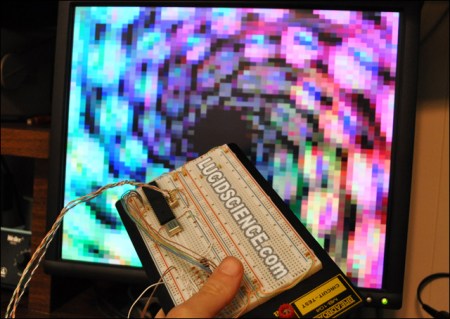
[Lucidscience] is back again, this time showing us how to push data to a VGA monitor from your AVR project.  It turns out that it is pretty simple, requiring only n open port and a few resistors and diodes. Well, it is that simple for the most basic version which gives you 56×60 pixels. Of course he couldn’t live with that and had to expand. Version 2 outputs 240×240 resolution and has additional sram and a double buffer making animations smoother and flicker free. As usual, the project is quite well documented with photos of the entire build process and schematics for you to build your own. A video of version 1 and version 2 are available after the break.

[via HackedGadgets]

Continue reading “VGA Interfacing AVR Microcontrollers”

Propeller-based Terminal

pocketerm

[Vince Briel] has created an embedded device based on the Parallax Propeller chip that acts as a serial terminal. It takes input from a standard PS/2 keyboard and outputs color VGA. It also has a second serial port to connect to a PC for debugging or programming. He is selling kits and has the schematics available. The board has a lot of hacking potential and it could easily be made into a video game or a Wikipedia browser.

[via RetroThing]

Arduino VGA Glitching

glitch

For some people, mistakes or glitches has become an art form. We’ve seen it in circuit bending for a while, but the newest version is in video glitching. [Sebastian] has gone so far as to intentionally set up an Arduino to send a glitched signal to a monitor. His description sounds pretty easy. We’re just assuming this is in motion in some way, a video of it in action would be nice.

USB Power From Your VGA Port

vga_usb

[gmgfarrand] needed an extra USB port to power some devices. Since he just needed power, and no data, he slapped together this quick adapter that pulls power from the vga port instead. While we’re not sure if this could possibly damage your video card if you pull too much power from it, we’re happy to see someone being original. That VGA port goes unused so often, this adapter might just make it a tad more useful.

[thanks Adam]