Robot Arm Is A Fast Learner

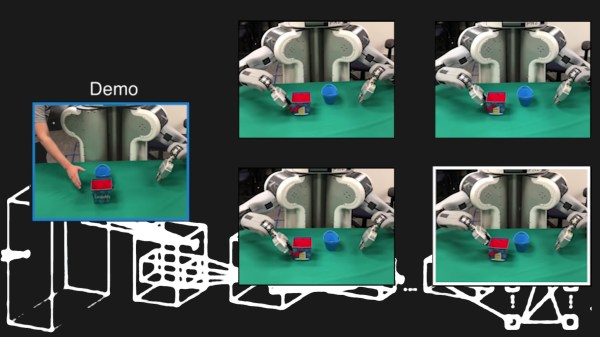
Not long ago, machines grew their skills when programmers put their noses to the grindstone and mercilessly attacked those 104 keys. Machine learning is turning some of that around by replacing the typing with humans demonstrating the actions they want the robot to perform. Suddenly, a factory line-worker can be a robot trainer. This is not new, but a robot needs thousands of examples before it is ready to make an attempt. A new paper from researchers at the University of California, Berkeley, are adding the ability to infer so robots can perform after witnessing a task just one time.

A robotic arm with no learning capability can only be told to go to (X,Y,Z), pick up a thing, and drop it off at (X2, Y2, Z2). Many readers have probably done precisely this in school or with a homemade arm. A learning robot generates those coordinates by observing repeated trials and then copies the trainer and saves the keystrokes. This new method can infer that when the trainer picks up a piece of fruit, and drops it in the red bowl, that the robot should make sure the fruit ends up in the red bowl, not just the location where the red bowl was before.

The ability to infer is built from many smaller lessons, like moving to a location, grasping, and releasing and those are trained with regular machine learning, but the inference is the glue that holds it all together. If this sounds like how we teach children or train workers, then you are probably thinking in the right direction.
Continue reading “Robot Arm Is A Fast Learner”

A Tour Through The Archetypical Asian Factory

Overseas factories can be sort of a mythical topic. News articles remind us that Flex (née Flextronics) employs nearly 200 thousand employees worldwide or that Foxconn is up to nearly a million. It must take an Apple-level of insider knowledge and capital to organize such a behemoth workforce, certainly something well past the level of cottage hardware manufacturing. And the manufacturing floor itself must be a temple to bead blasted aluminum and 20 axis robotic arms gleefully tossing products together. Right?

Well… the reality is a little different. The special sauce turns out to be people who are well trained for the task at hand and it doesn’t require a $1,000,000,000,000 market cap to get there.

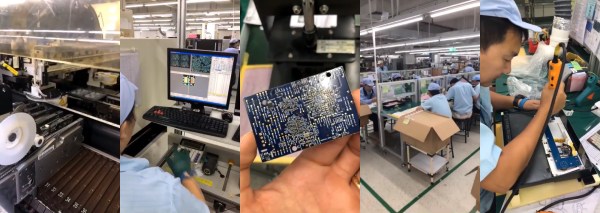
[Adam leeb] was recently overseas to help out with the production ramp for one of his products and took a set of fantastic videos that walk us through an archetypical asian factory.

The Room

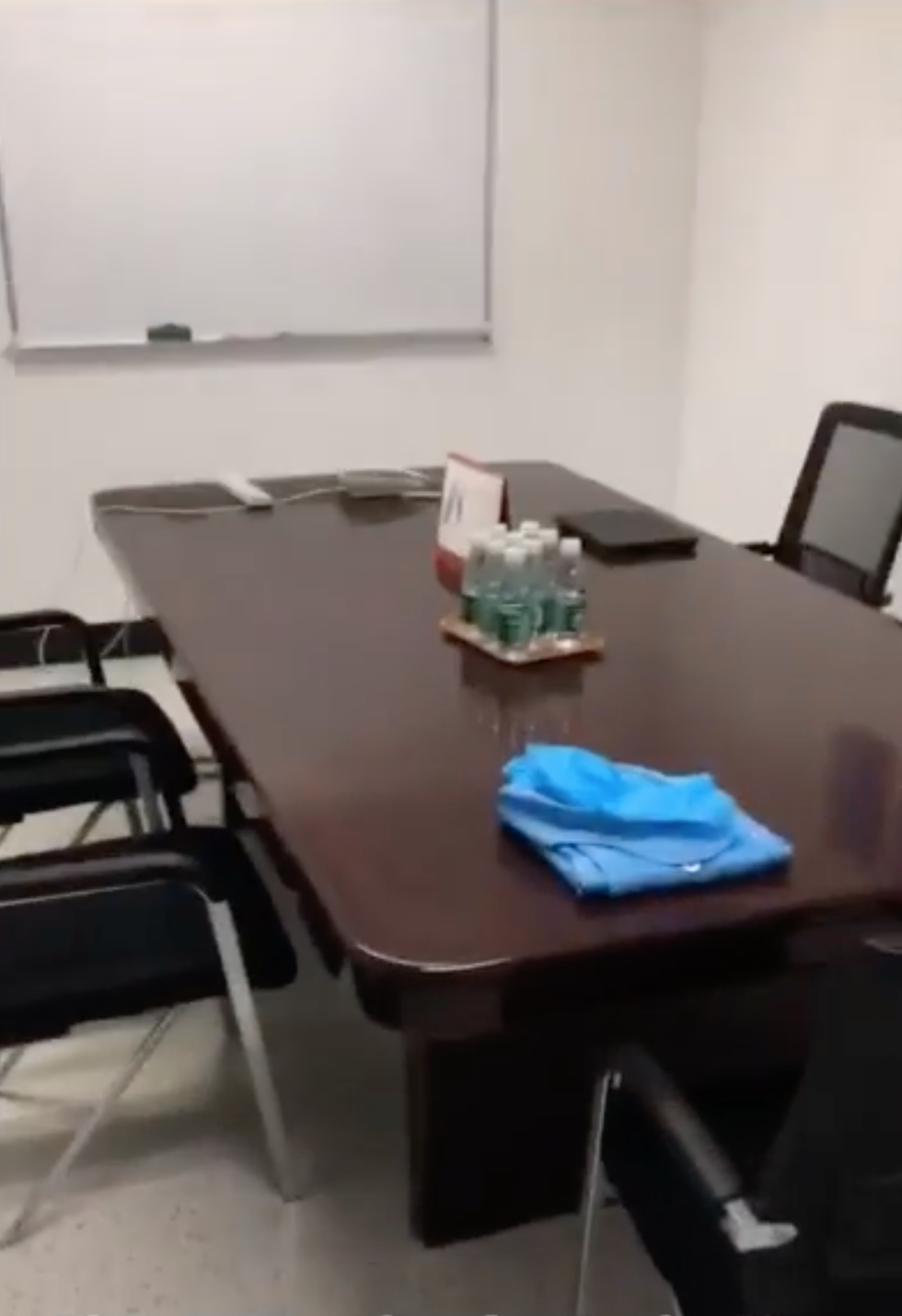
I’ve been to several factories and for me the weirdest part of the archetype is the soul crushing windowless conference room which is where every tour begins. Check out this one on the left. If you ever find yourself in a factory you will also find a room like this. It will have weird snacks and bottles of water and a shiny wood-esque table. It will be your home for many, many more hours than you ever dreamed. It’s actually possible there’s just one conference room in the universe and in the slice of spacetime where you visit it happens to be in your factory.

Ok, less metaphysics. It’s amazing to watch the myriad steps and people involved in taking one product from zero to retail-ready. [adam] gives us a well narrated overview of the steps to go from a single bare board to the fully assembled product. From The Conference Room he travels to The Floor and walks us through rows of operators performing their various tasks. If you’ve been reading for a while you will recognize the pick and place machines, the ovens, and the pogo pin test fixtures. But it’s a treat to go beyond that to see the physical product that houses the boards come together as well.

Check out [adam]’s videos after the break. The first deals with the assembly and test of his product, and the second covers the assembly of the circuit boards inside which is broadly referred to as SMT. Watching the second video you may notice the funny (and typical) contrast between the extremely automated SMT process and everything else.

Continue reading “A Tour Through The Archetypical Asian Factory”

AV Synth Is Psychedelic Analog Mayhem

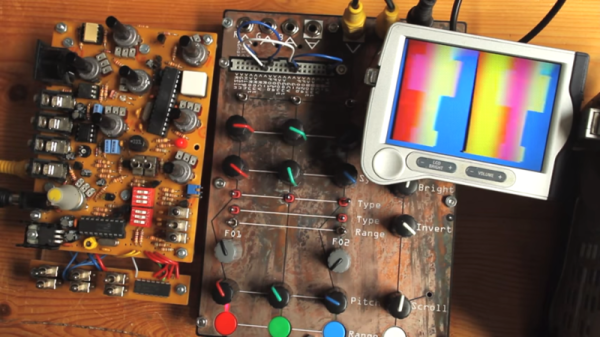
Digital video is cool and all, but it can’t compete with analog in terms of smooth, creamy glitches and distortion. [gieskes] has developed an analog audio-visual synthesizer that is a great example of the old-school retro visuals you can create with a handful of simple components.

Known as the 3TrinsRGB+1c, it’s available both assembled and in kit form. It’s probably best to start with the manual. Synthesis is achieved through the use of a HEF40106 hex inverting buffer – a cheap and readily available part that nonetheless provides for excellent results. Video can be switched between RGB oscillators and a series of inputs, and there are various controls to create those classic scrolling effects and other visual oddities.

Additionally, a series of connections to the underlying circuitry are broken out on a header connector. This allows for extra modules to be plugged in, and several designs are available to expand the unit’s capabilities.

Analog video isn’t used so much on a day-to-day basis anymore, but it’s a great technology to tinker and experiment with. We’ve seen some of [gieskes] experiments in this arena before, too – like this Arduino video sampler. Video after the break.

Continue reading “AV Synth Is Psychedelic Analog Mayhem”

Friday Hack Chat: Visual Synthesis

For this week’s Hack Chat, we’re going to be discussing generating analog video for visual synthesis. What’s on the front porch?

Our guest for this week’s Hack Chat will be Jonas Bers, an audiovisual artist and performer. For their work they used hacked video mixers, a hand-built video synthesizer, and various pieces of restored/modded lab equipment and military surplus devices. Jonas has also developed the CHA/V, the Cheap, Hacky, A/V, an open source, DIY, audiovisual video synthesizer. This video synth has been built by people around the world, and has been the subject of international workshops in fancy art schools. It’s a dirt-cheap video synth, quick and easy to make, expandable and customization as a part in a larger system, and requires no computer, Arduino, microcontroller, or programming.

Jonas will be discussing entry points into hardware-based real-time video synthesis such as their own tutorial for the CHA/V, and the LZX cadet/castle DIY series. If you enjoy making analog audio circuits, and you are interested in video synthesis, they can suggest some good places to start and helpful resources. Jonas’s personal practice involves hardware-based scan-processing (aka Rutt/Etra synthesis) which they can also discuss at length.

For this week’s Hack Chat, we’ll be talking about:

  • Hardware-based video synthesis
  • Real time video synthesis
  • Common visual synthesis practices and variations

You are, of course, encouraged to add your own questions to the discussion. You can do that by leaving a comment on the Visual Synthesis Hack Chat and we’ll put that in the queue for the Hack Chat discussion.

join-hack-chat

Our Hack Chats are live community events on the Hackaday.io Hack Chat group messaging. This week we’ll be sitting down on Friday, October 19th, at noon, Pacific time. If time zones got you down, we have a handy time zone converter.

Click that speech bubble to the right, and you’ll be taken directly to the Hack Chat group on Hackaday.io.

You don’t have to wait until Friday; join whenever you want and you can see what the community is talking about.

Dirty Video Mixing With The Raspberry Pi Zero

Don’t get too excited now, we aren’t talking about that kind of dirty video. There’s plenty of other places on the Internet you can go to find that sort of thing. No, this video mixer is “dirty” because it combines two composite video streams into one garbled up mess that’s best viewed on an old CRT TV. Why, you may ask? Because rock and roll, that’s why.

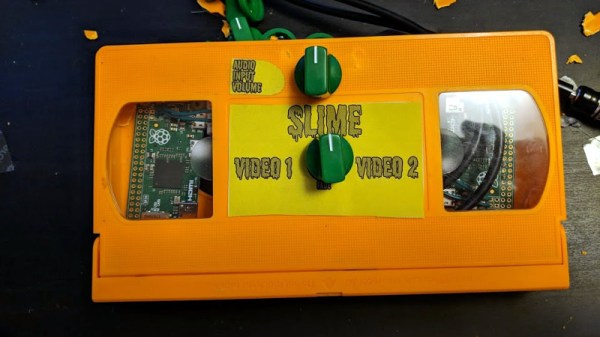
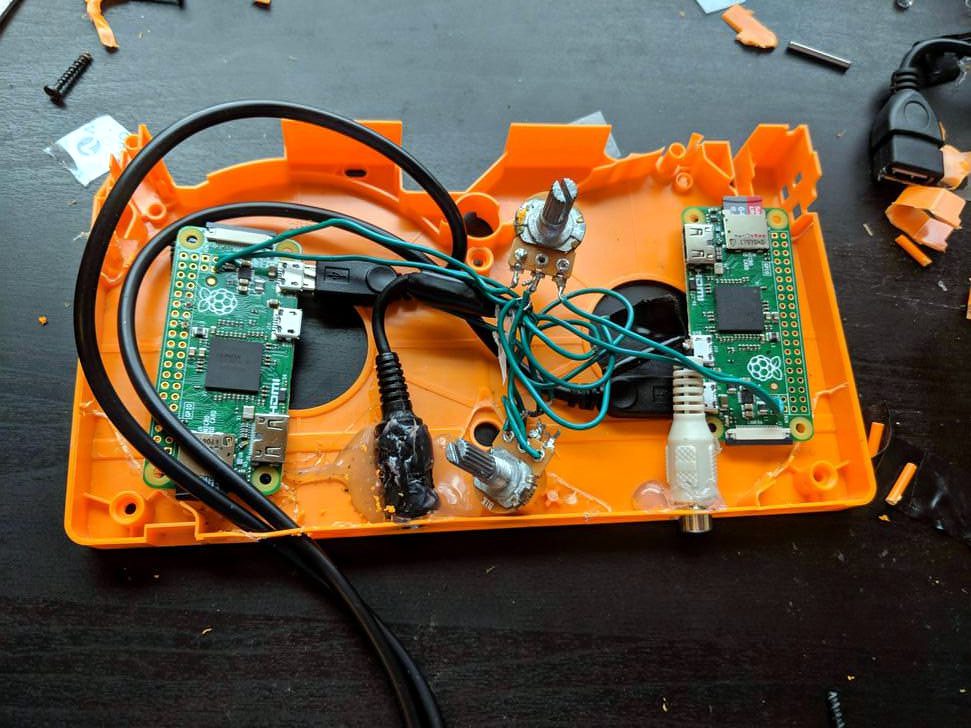
Created by [Luke Blackford] as a visual for his band’s performances, the “Dirty Pi” is an exceptionally simple way to create some wild imagery with two Raspberry Pi Zeros. It might not be the most practical of devices, but if you want so throw some creepy looking video up on screens all over the house (say for an upcoming Halloween party), this is a fantastic way to do it on the cheap.

The idea is simple: connect the oft-forgotten composite video outputs of two Pi Zeros to a potentiometer, which then leads to the display. Play different videos on the Pis with the media player of your choice, and twiddle the potentiometer to create ghosting and interference. If you want to get that true 1980’s retro feel, put the whole thing into an old VHS cassette like [Luke] did, and you’re ready to rock.

Those who’ve been around the block a few times might recognize this trick as a variation of the [Karl Klomp] Dirty Video Mixer, and [Luke] tells us he likes this project because he was able to pull it off without writing any code or even doing any complex wiring, though he does imagine a future version where he adds some remote control functionality.

If you like your video mixers with more smarts and less dirt, we’ve covered a very slick build using the LM1881 in the past.

Continue reading “Dirty Video Mixing With The Raspberry Pi Zero”

The Magic Flute Of Rat Mind Control Aims To Mix Magic And Science

Well this is unusual. Behold the Magic Flute of Rat Mind Control, and as a project it is all about altering the response to the instrument, rather than being about hacking the musical instrument itself. It’s [Kurt White]’s entry to the Musical Instrument Challenge portion of The Hackaday Prize, and it’s as intriguing as it is different.

The Raspberry-Pi controlled, IoT Skinner box for rats, named Nicodemus.

[Kurt] has created a portable, internet-connected, automated food dispenser with a live streaming video feed and the ability to play recorded sounds. That device (named Nicodemus) is used as a Skinner Box to train rats — anywhere rats may be found — using operant conditioning to make them expect food when they hear a few bars of Black Sabbath’s Iron Man played on a small recorder (which is a type of flute.)

In short, the flute would allow one to summon hordes of rats as if by magic, because they have been trained by Nicodemus to associate Iron Man with food.

Many of the system’s elements are informed by the results of research into sound preference in rats, as well as their ability to discriminate between different melodies, so long as the right frequencies are present. The summoning part is all about science, but what about how to protect oneself from the hordes of hungry rodents who arrive with sharp teeth and high expectations of being fed? According to [Kurt], that’s where the magic comes in. He seems very certain that a ritual to convert a wooden recorder into a magic flute is all the protection one would need.

Embedded below is something I’m comfortable calling the strangest use case video we’ve ever seen. Well, we think it’s a dramatized use case. Perhaps it’s more correctly a mood piece or motivational assist. Outsider Art? You decide.

Continue reading “The Magic Flute Of Rat Mind Control Aims To Mix Magic And Science”

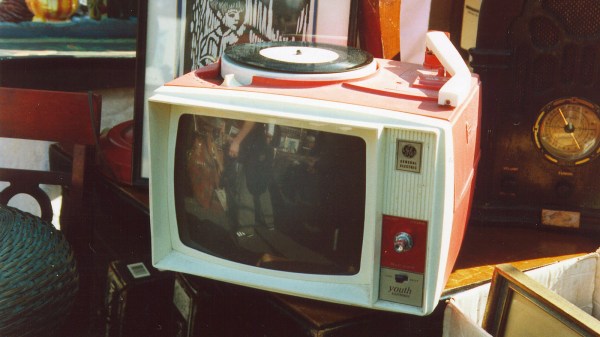
GE Record Player and TV 1600x900

VinylVideo Is Literally Video On Vinyl

It’s often said that the music etched into a vinyl record takes on a transcendent quality that you simply can’t find in a digital recording, but does that still apply when you add motion picture? The collaboration of [Sengmüller and Diamant] sure think so, because they are offering a new experience for the turntable with the introduction of their VinylVideo pre-amplifier. No tape reels here, this project shows the extend of what is possible through analog video.

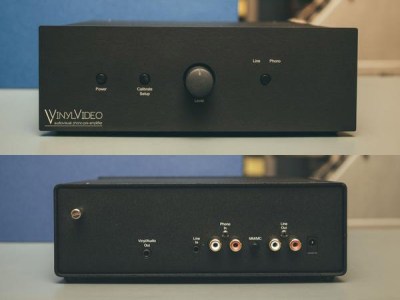
Vinyl Video Amp

While all record players capable of playing back 7 in. 45 RPM are compatible with the system, the VinylVideo records themselves specially cut in order to generate the video signal. Each of the custom records has room for a 4-minute music video on the A-side, and the single on the B-side. Videos play back in black & white, sub-standard definition with mono audio, and run around 12 frames per second. The pre-amp takes in the analog signal from regular audio cables via RCA jacks or 3.5mm headphone jack, and then a Raspberry Pi model A+ handles the analog-to-digital conversion. Video out options include HDMI and composite video via a 3.5mm TRSS jack.

The current VinylVideo pre-amp is actually a refinement of the original project from the mid ’90s where it was a part of folk art exhibits. The legacy website (circa 1999) is still live, so you can give it a visit. However, for the most authentic experience you may want to fire-up a virtual machine with Netscape Navigator and Real Player installed.

For a more in-depth look at the VinylVideo in action there is a great video below from [Techmoan]:

Continue reading “VinylVideo Is Literally Video On Vinyl”