Build A Wireless Keylogger

wireless_keylogger_schematics (Custom)

Hardware Keylogger solutions has released the plans and files for their wireless logger. It has a range of about 50 yard between the transmitting dongle and the receiver. It is based around an Atmel AT91SAM7S64 and the PCB is pretty tiny. In case you hadn’t noticed yet, they sell them as well. The cool thing about this is that key data is transmitted in real time, allowing you to see it as it happens instead of having to go retreive the log physically like you used to.

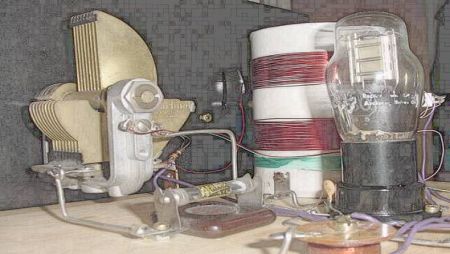
Homemade Regenerative Tube Radio

There are no microcontrollers in this project. In fact you wont find a single transistor. This classic regenerative tube radio, modeled after an early 20th century homebrew is complete with schematic and additional photos. For those who are not familiar with tube designs and for simplicity, the regeneration circuit can be thought of as feedback though this relation may be argued. Read the rest after the break which includes a crash course in tube operation. Continue reading “Homemade Regenerative Tube Radio”

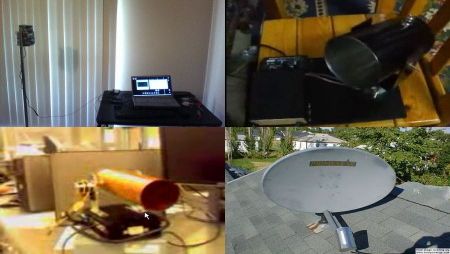
Various Cantenna Builds

Here is a classic project used to increase wireless signal strength. Cantennas focus using a waveguide very much like a magnifying glass focuses light. [Robert] made a Natural Light beer cantenna, pictured in the upper left. His approach used three beer cans, a paper towel holder, and a shower curtain rod. On the tipline, he noted a signal boost from 11Mbps to 54Mbps. This is certainly something we can hack together if our room lacks adequate signal. Read about parabolic and seeking versions after the break.

Continue reading “Various Cantenna Builds”

Crack WEP Using BackTrack

wepcrack04

Lifehacker wrote a guide for cracking a WiFi network’s WEP password using BackTrack. BackTrack is a Linux live CD used for security testing and comes with the tools needed to break WEP. Not just any wireless card will work for this; you need one that supports packet injection. The crack works by collecting legitimate packets then replaying them several times in order to generate data. They point out that this method can be hit-or-miss, especially if there are few other users on the network, as the crack requires authenticated packets. We covered cracking WEP before, but using BackTrack should smooth out compatibility issues.

Firework Ignitors And Controllers Roundup

fireworks ignitor

With the 4th of July around the corner, we thought it would be a good idea to give a controller wrap up and show you how to make some ignitors. Last year we covered a microcontroller based fireworks launcher. If you like the idea of a controller but don’t want to run all the wire, we have the wireless fireworks controller. Adding a little twist to the wireless scene are cell phone triggered fireworks. Maybe controllers are not your cup of tea, you could try to microwave your fireworks. After the break we show you how to make ignitors from a diode and a match.

Continue reading “Firework Ignitors And Controllers Roundup”

Wireless Arduino Cat Food Dispenser

catfooddispenser

Reader, [Andres Leon], has two adorable cats with very specific dietary needs. Instead of altering his schedule, he donned his hacking hat and designed a very solid cat food dispenser. The dispenser consists of a rotating drum with a slot in it and a PVC pipe Y-fitting to distribute the food evenly. The brains of the machine is an Arduino Deumillanove and an XBee module. The unit can be controlled by a web interface or it can run completely standalone. [Andres] ran into a problem where the drum’s resistance to turning varied based on how much food was inside. He solved this with a clever laser position indicator. A piece of plywood is lined up with the slot at the top so that whenever the slot is facing up it keeps the laser from shining on a photoresistor. The cats were afraid of the servo noise at first, but now they run to their bowls whenever they hear it.

Ekahau HeatMapper Maps Out WiFi Signals

see_wireless_configs_large

The term ‘warwalking’ isn’t used very often, but the Ekahau HeatMapper adds a new tool to the pod bound hacker’s arsenal. The tool maps out wireless access points as well as their signal strength within a facility. A test of the HeatMapper on a map made with AutoDesk Dragonfly accurately determined the location of a router within 3 feet and helped tune the angle it needed to be at for maximum range. Ekahau made a fantastically cheesy promotional video for their product, which is viewable after the jump. The program is free of charge, but unfortunately only runs on windows, so mac and *nix users are out of luck, though it might run under wine.

Continue reading “Ekahau HeatMapper Maps Out WiFi Signals”