posted Nov 29th 2011 12:59pm by
Mike Szczys
filed under:
home hacks,
Microcontrollers

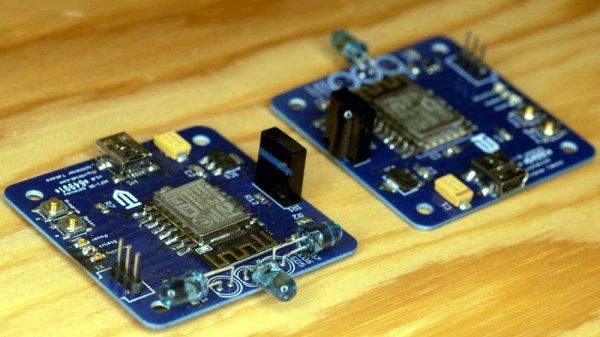
[Dmitry Grinberg] has to walk all the way across his bedroom to switch the lamp on and off. The drudgery of this finally became too much, so he built a remote control and added dimming for good measure. Above you can see the circuitry for the remote and the receiver, as well as the finished remote housed in what he calls a ‘Chinese Altoids tin’.
After the break you’ll find [Dmitry's] demo video. The remote control is quite responsive, and the dimming has great resolution. That’s thanks to a power N-channel MOSFET which switches the AC with the help of a full wave rectifier. The PIC 12F617 that controls the MOSFET is powered separately, and [Dmitry] mentions that you must use a transformer and not a switch-mode power supply to avoid a fire. We’d like to know more about this, so leave a comment if you are able to explain further.
The remote and receiver communicate via Infrared. The protocol is operating with 38 kHz signals using an easily sourced receiver tuned to that frequency. [Dmitry] shares all the details about the encoding scheme that he uses. Recreating this communications pairing is a great way to test your understanding of this technique. But if you need a refresher, here’s a tutorial to push you in the right direction. Read the rest of this entry »
posted Nov 8th 2011 12:51pm by
Mike Nathan
filed under:
home hacks,
Microcontrollers

[Gary] had an RF triggered light switch kicking around, and wanted to find a way to control his lights using a home theater remote. The switch, which he bought from RadioShack years ago, came with a simple remote that uses two buttons to toggle the lights on and off. While you might think that switching from RF to IR control would be a step backwards, [Gary] really just wanted to consolidate remotes more than anything else.
He designed a circuit board specifically for interacting with the remote half of his RF controller. It sports a PIC16F628A micro controller, which is tasked with processing IR commands from his home theater remote and triggering the lights when requested.
The code he developed for the project is relatively simple, but very useful all the same. When his board is powered on, it stores the first IR code it receives, then retains it as long as it stays powered on. This lets [Gary] use any button on his remote to turn the lights on and off, without any IR codes permanently defined in software.
As you can see in the video below, the modified switch works just as intended, saving [Gary] from having to walk all the way to the light switch when it’s time to fire up a movie.
Read the rest of this entry »
posted Nov 7th 2011 6:10am by
Mike Nathan
filed under:
arduino hacks,
toy hacks

Hackaday reader [Kieran] volunteers at an outdoor haunted house attraction called the “Disenchanted Forest”. Attendees are lead through the haunted forest by a volunteer, who helps keep everyone on the predetermined trail. The trail is usually lit by small LED fixtures that the group constructed, but the organizers wanted to make the lights more interactive this time around.
A fellow organizer gave [Kieran] a [Harry Potter] Magic Candle, which allows him to light the toy with the wave of his IR-enabled wand. He was told to “make it do something cool”, so he took a closer look at it to determine how everything worked.
Using an Arduino clone and some borrowed IR code he was able to get the wand to work with the forest’s trail lighting, but there was a lot of lag between waving the wand and triggering the light. Taking a second stab at it, [Kieran] was able to replicate the IR protocol used by the toy, speeding things up and increasing the wand’s range considerably. Now, the tour guides can light and extinguish the trail lighting with a simple flick of the wrist.
Take a look at the video below to see how things worked out for [Kieran], and be sure to swing by his site for more details if you have the urge to modify your Magic Candle.
Read the rest of this entry »
posted Nov 4th 2011 12:00pm by
Mike Szczys
filed under:
digital cameras hacks,
Microcontrollers

Here are the guts of [Lukasz's] infrared camera remote control. He based it off of an existing design, but looked for places where improvements could be made. He felt the ATtiny2313 was a bit wasteful in this case. But further investigation led him to see why it was chosen. If you were to drop down to an ATtiny13 the ability to connect a crystal oscillator is lost (that chip only offers a 1-pin clock signal input) and the internal RC oscillator isn’t quite up to his standards for reliable IR communications.
Instead of driving the IR LED directly from an AVR pin he used a transistor in hopes that it will allow the maximum current to flow through the diode when in use. We’re not sure if it’s necessary, but we can see how it makes sense. Power is received from an unregulated 3 volt coin cell, so maybe as that voltage drops over time this will come into play.
Speaking of that coin cell, battery life is a concern here. [Lukasz] is using the sleep functions of the AVR after three seconds of use. This should keep the cell alive for quite a long time. But his 0 volt measurement is an anomaly with the multimeter he’s using. To get a precise measurement for tiny current flow you need extra equipment, like [Dave Jones'] uCurrent adapter.
The schematic for this Canon camera compatible project is only provided in Eagle format so we’ve embedded an image of it after the break for your convenience. You should have no problem making this work with a Nikon if you swap out some of the code from the TV-B-Gone shutter release we saw on Thursday.
Read the rest of this entry »
posted Oct 31st 2011 2:01pm by
Mike Nathan
filed under:
arduino hacks,
home hacks

After seeing a writeup online that demonstrated how to build an “Emergency Party Button”, [spikec] knew that he had to have one of his own. He happened to have a USAF B-8 stick grip from an A-10A aircraft laying around, and figured it would be perfect for controlling the A/V system in his basement.
The control stick was mounted to the top of a cheap cigar humidor, and crammed full of any electronic component he could get his hands on. It contains not one, but two Arduinos. The first is tasked with reading the flight stick’s inputs and the IR control of his various appliances, while another triggers the overhead lighting in his bar along with the X10 controlled Emergency Party System. He contemplated combining all of the functionality into one device, but splitting the tasks in two was easier for this self-declared electronics novice.
The various buttons on the control stick can be used to power all of his A/V appliances on and off, control volume levels, and select which songs stream from his digital jukebox. If the action ever starts to wind down, a quick turn of his “arming” key and the flick of a switch sends his basement into full-on party mode, which includes more lighting and lasers than any one person should be allowed to own.
[spikec] says that his wife’s eyes were rolling like “uncaged gyros” when he unveiled his controller for the first time – a sign of a job well done. Don’t take our word for it though, check out a video of his control stick and Emergency Party System in action after the jump.
Read the rest of this entry »
posted Oct 12th 2011 10:01am by
Mike Nathan
filed under:
digital audio hacks,
home entertainment hacks

[Ron] was looking for a way to play his MP3s around the house without having to use his computer. He also wanted the ability to remotely control his tunes with an old camcorder remote he had sitting around – not exactly a feature you would find in an off the shelf personal audio player.
Ultimately, he decided to construct his own remote-controlled audio player using a VMUSIC2 audio module, which can decode MP3s from any standard USB drive. The VMUSIC2 is controlled by a Propeller demo board, which also handles receiving and decoding IR signals from his camcorder remote. While he was originally dumping ID3 tag data to his computer for debugging purposes, he recently added an LCD screen for displaying song information in a more useful manner.
The MP3 player seems to work pretty well if the video below is any indication, though it’s begging for a nice enclosure to tie things together. We like the project so far, so we’re sure [Ron] won’t fail to impress when it’s completely finished.
Read the rest of this entry »
posted Oct 8th 2011 12:06pm by
Mike Nathan
filed under:
arduino hacks,
home entertainment hacks

[zmashiah] has a nice Nova tube amplifier in his living room, and he often forgets to turn it off once he’s done listening to music. He feels guilty when this happens, as it not only shortens the lifespan of his stereo, but it’s not exactly the greenest behavior either. Rather than let his receiver idle any longer, he built a simple device that automatically turns it off when he forgets.
He wired an Arduino to the line level output of the receiver, sampling the audio every two seconds. When five minutes pass without an audio signal, the Arduino sends an IR command to the receiver, turning it off.
He says he’s aware that it might be overkill to use an Arduino for this application, but that he would rather fork out an extra dollar or two instead of spending hours poring over AVR assembly code. While we’re all for efficiency, we can’t exactly argue with that logic – time is money!
[zmashiah] is kind enough to include his schematics as well as the code for his project, so be sure to check it out if you occasionally forget to turn off your IR-enabled appliances.
posted Sep 29th 2011 12:04pm by
Mike Szczys
filed under:
android hacks,
arduino hacks,
home entertainment hacks

[James] is one of those guys on a quest to control everything with one device. His tool of choice is an Android phone, which can do quite a lot right out of the box. But he was never satisfied with its lack of IR remote control abilities. He fixed that feature-gap by building a Bluetooth to Infrared translator.
The hardware he used for the prototype is quite simple. A cheap serial Bluetooth modem from eBay lets him connect to his phone. An Arduino board listens for data from the modem and converts incoming commands to flashes on an IR LED. Voila, he can control the tube with his phone.
We love the potential of this hack. The Bluetooth module runs from 3.3V, and reading serial data and flashing an LED is extremely simple. You should be able to use a small uC, say an ATtiny13, and a 3.3V regulator to miniaturize the module. We could see this plugging into the USB port on the back of a TV for power, with a wire extension to put the LED into position. The only shortfall is the inability to turn the TV on remotely when drawing power this way.
Remote codes aren’t particularly large to store either. So this would be pretty easy to extend to full control of all IR-compatible home entertainment devices. You just need a tool to discover the remote control codes.
Read the rest of this entry »