
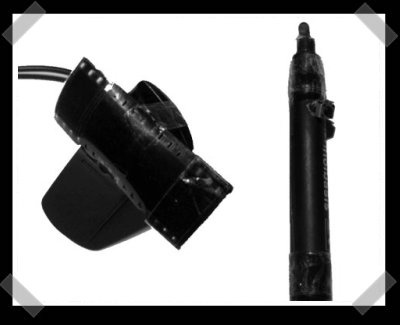
[Eduard] sent in his IR webcam whiteboard project. He wanted something like the Wiimote version, but without the expense of a Wiimote. He added some film negative to the camera to reduce the amount of visible light picked up by the CCD. (He notes that you might need to pull the IR filter from your camera to get a decent signal.) The pen is the usual IR LED with a power supply. To do the actual work, he wrote a custom application in Java.
Year: 2008
Solder Paste Fridge
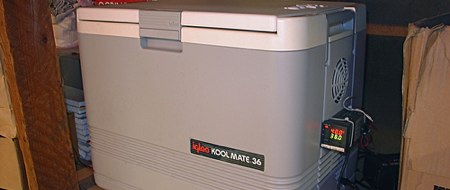
MightyOhm’s laboratories have recently decided to start tackling more surface mount work. As part of this upgrade to SMD hot air reflow stations, they’re handling a lot of solder paste. Solder paste is happy at less than 50degF and above freezing, and [Jeff] didn’t want to chance that lead infiltrating his Manwich, so he built this solder paste fridge. The main unit is a standard 12V peltier based travel cooler. He attached a surplus PID controller with a K-type thermocouple to maintain the temperature while preventing the cooler from being always on. The only adjustment he really had to make was adding a bleed resistor to force the MOSFET to turn off. You can find more pictures of his project on Flickr.

RC Duck Decoys
Here’s something for those of you who always wanted your projects to attract more shotgun blasts. [courtney] built two RC duck decoys. The decoys were only $10 to begin with and the RC submarines were an additional $20 at RadioShack. The construction is fairly clever, using a heat gun to conform the duck body to the submarine. We think the most surprising bit is that this has been done many times over: RC duck with rocket launcher, RC duck cam, and someone is producing commercial ones. Whatever you end up putting in your remotely operated duck, we’ll be sure to include it in our next movie plot threat entry.
Monitoring Home Energy Consumption

Power monitoring and home automation systems are coming to mainstream consumers. The New York Times covers the latest technologies (annoying login required) that improve and monitor energy efficiency in the home. As energy use and costs continue to increase, companies are popping up to offer cheaper solutions that will help consumers monitor energy usage, and decrease it simultaneously. Companies like Zigbee offer wireless protocols to track usage, and “smart metering” systems can communicate with appliances to reduce unnecessary energy usage.
Home automation systems can be set up to control a single system, such as a home theater, or multiple systems throughout a home, like audio, lighting, and temperature. Control4 offers controllers that will allow consumers to regulate their lighting, blinds, and temperature in their homes. Smart meters such as Echelon’s NES system offers users some great features, such as the ability to provide automated reads of electric and gas meters, and enabling load shedding during peak consumption periods, by controlling appliances like air conditioners and water heaters. By allowing the consumers to determine and control how much energy they use, they can successfully reduce their energy consumption levels a significant amount, but whether it’s worth the cost of investment remains to be seen. Although the prices of home automation systems have dropped from over $30,000 to about $5,000, it’s still much more than most consumers can afford.
We’ve covered home automation tools before. We like them because they’re still way more affordable than the offerings available, and the technology is more transparent. If you’ve got a creative and cheap solution to monitoring energy consumption, we’d love to hear it.
[via Waxy]
Synchronizing Fireflies NG
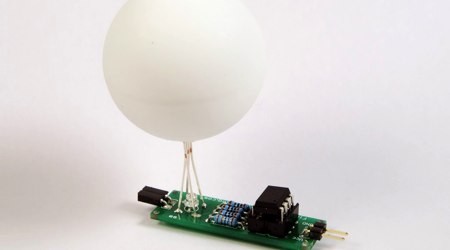
[Alex] from Tinkerlog has revisited an old project with Synchronizing Fireflies NG. Fascinated by how fireflies blink at same rate and synchronize with each other, he built a digital version. Each board has an RGB LED and a phototransistor or photoresistor. A ping-pong ball is used as a diffuser. The blink rate is controlled by an ATtiny13v. The board power can be daisy chained, but each firefly mote operates independently of the others. The microcontroller has a fixed flash rate and monitors for other flashes. It attempts to sync by flashing earlier. The color of the LED expresses how satisfied the firefly is with its current sync. You can see a video of eight fireflies attempting to self organize embedded below.
SONAR Controlled USB Missile Launcher
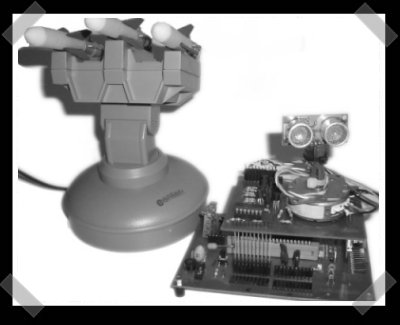
Check out this add on for that cheap USB missile launcher we know you bought last year. It uses ultrasonic sensors to provide sonar feedback for the aiming system. A PIC 18F455 drives a servo to aim the sensor and massage the signal from the sensor. It still depends on a PC application to put everything together. If you’d rather play with faster hardware, keep your eyes open for this years defcon bots contest.
RGB LED Cylinder
[Dave Clausen] from NYC Resistor sent in his open source RGB LED cylinder. We have seen many cubes in the past (even one that display low-res 3D video) so a cylinder is certainly a new concept and the RGB LEDs are a nice upgrade. The LEDs are wired in a 5-way multiplexed grid using four TLC5940NTs (16 channel LED drivers with internal PWM hardware) so each light is individually addressable. The best thing about this project, of course, is that he has source and EAGLE schematics availbale for download and both are licensed under Creative Commons.
[via NYC Resistor]









