Creepy Robot Eye Follows You And Winks In Response


Opto-Isolator is an interesting art installation that was on display at the Bitforms Gallery in NYC. This single movement-tracking eye creates a statement about how we view art and is a response to the question “what if art could view us?”. The somewhat creepy display not only follows the person viewing it, but mimics blinks a second later and averts its gaze if eye contact is kept up for too long. Its creators [Golan Levin] and [Greg Baltus] have done a great job mimicking human behavior with such a simple element and the social implications of it are truly fascinating.

If they wanted to, [Levin] and [Baltus] could possibly crank up the spook factor by adding facial recognition and programming it to remember how certain people interact with it, then tailor its behavior to wink at different rates or become more shy or bold, depending on the personality of the person watching it. Of course, that would require that someone goes back to it more than once…

[via Glass Tumbler]

Watching DVDs On Your Wii


Nintendo Wii Fanboy explains how to watch DVDs on your Wii using the new MPlayer application. Although the reviews are mixed, some claim it works and others claim it doesn’t, most are excited about this new feature which has been missing since the Wii’s launch. To get this working, you need to run the Twilight Hack and get the Homebrew Channel. Then you download the MPlayer software onto your SD card and install that using the Homebrew Channel. From there, you can launch the application and play your DVDs with ease using the minimalistic DVD player interface.

Although this seems like a lot of work just to watch a DVD, especially considering this might not work for you, it is interesting to see people trying to push for media center software on the Wii. Now they only need to find ways to get past the Nintendo’s attempts to stop this Homebrew movement.

New Discovery Channel Show Starring Hackers


A new Discovery Channel show titled Prototype This! will debut on October 15, 2008. Hoping to capture the same demographic as Mythbusters‘ audience, the show is about designing and creating robots, gadgets, and other things that nerds will love. Prototype This! is hosted by four wide-ranging experts: [Zoz Brooks], who’s got a PhD in robotics, [Mike North], who also has a PhD, in material sciences, [Terry Sandin], a special effects veteran of the Hollywood film industry, and [Joe Grand], who we’ve covered recently for his Defcon badge work. [Daniel Terdiman]’s glimpse behind the scenes reveals some interesting projects, from a stair-climbing robot to the creation of a pyro pack. We’ll be sure to set our DVRs to record.

[via Zero Day]

LED Floor Captures Digital Footprints

[youtube=http://www.youtube.com/watch?v=NpRE6CM3oOY&hl=en&fs=1&rel=0&color1=0x3a3a3a&color2=0x999999]
Sensacell created a unique interactive flooring system for the 2008 World Expo in Zaragoza, Spain. Comprised of 1000 LED panels, the 250 foot installation is covered in architectural glass and lights up in response to pressure. We like what different people are doing in this clip; from walking in a line to dragging a mop over the floor, the results are undeniably captivating and ultimately irresistible.

[via Gizmodo]

Modding The Acer Aspire One With Bluetooth


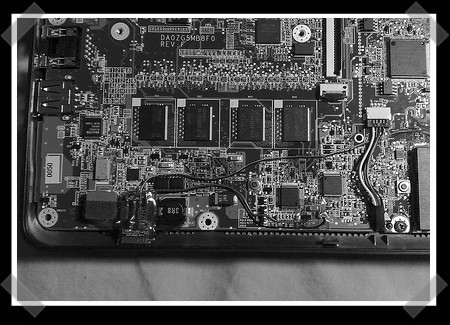
[tnkgrl], a regular around here, is at it again. This time she has modded an Acer Aspire One subnotebook to have internal Bluetooth. She’s released part 1 of a multi part tutorial on beefing up the Aspire One. In this part, she covers disassembly, adding more RAM, and adding the Bluetooth hardware. She suggests that you look at her Bluetooth install on an Asus 701 to find more information as the process is nearly identical.

Part 2 of the tutorial is going to cover upgrading the SSD to a 1.8″ PATA hard drive and putting it back together.

PoiPlay – LED Poi


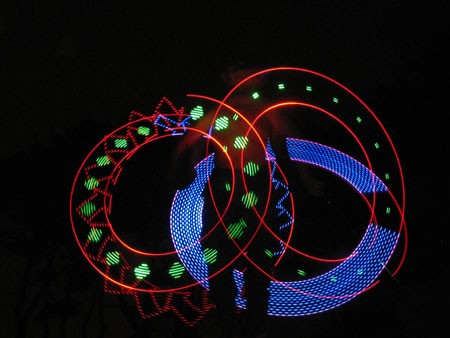
PoiPlay is an elegant mix of new technology and traditional medium. Poi, Maori for ball, is a traditional form of juggling originating in New Zealand. In poi, a ball at the end of a rope or chain is swung in circular motion to develop visual patterns. Often augmented by flame, and more recently LEDs and glow sticks.

The PoiPlay device has 28 RGB LEDs in a 1 foot long enclosure at the end of a rope. They have a 1mbit per second bidirectional wireless interface, three Atmel processors, a lithium ion battery, and a charger. The base station controls not only the PoiPlay but the music as well. All the control software that resides on the PC was written in Perl and communicates via USB port under Cygwin.

They have built the devices to be individually addressable with the capability of being grouped by subnet. This feature isn’t supported by the software yet, but they say it should be done by the next show in 2009.

The site, while pretty offers very little information. Some construction shots would be fantastic. Go check it out though, the pictures are mesmerizing.

[thanks Jm]

Homemade Tube Screamer Clone


[jonboytang] documented his construction of a clone of the famous Tube Screamer overdrive pedal from a set of plans found at tonepad. The tonepad site says you can use the plans to build either a TS-9 or a TS-808, both of which have been classic staples in every guitar player’s setup since the 70s. Although the old parts are no longer available, these new variants still have a really nice sound.

This project is really just a look into [jonboytang]’s etching and enclosure building process, but it may be useful for someone. The build and the circuit look really simple so this would be a great project for guitar players looking to learn how to etch their own PCBs. If you need more information on etching, we would suggest starting out by reading our How-To on etching single sided PCBs. If you are lazy and would rather spend a little money, check out tonepad’s online store. They have a board for this project and many others.