Knit Touchpad

[Plusea] made her own touchpad using some anti-static gloves and an Arduino. This proof of concept is fairly small, but the system could be scaled quite large if you could find the fabric. She cut apart the anti-static glove, mounted it and wired it to the Arduino. A special piece is made to fit over the finger that is also wired to the Arduino. The location of where she touches is determined by the resistance between the finger and each corner. Watch the video on the instructable to see how it measures.

She mentions that there are a few different ways to build it, some which would not require anything on your finger, but would use another piece mounted behind the touchpad. The method she is currently using though, would allow for the fabrick to be any size or shape, even molded around something.

History Hacker Show Pilot Tonight

[Bre Pettis], the former host of the Make podcast and member of NYCResistor has gotten his own show.  Debuting tonight on the History Channel, “History Hacker” will be exploring our technological past through hacking.  He reminds us on his site, this is just the pilot, it has to get ratings to have more episodes. [Bre] suggests watching it with the family as it should be educational and fascinating.  Catch it tonight at 8pm and midnight.

8 Bit Digital Sampler Kit, Bendable Too

No, it’s not flexible, its bendable. As in, you can hack it to sound different by connecting parts in random ways.  “Where’s the Party At?”, or “WTPA” for short is a bendable 8 bit sampler made by [Todd Bailey]. Still curious what it is? Watch his video showing it in action. The video is huge, 93Megs, so be patient. The overall attitude of this project is built around hacking. Consider this quote from his page ” I’ve got lots of things to poke, bend, illuminate, invoke, distrust, regulate, and otherwise get jiggy with. It’s like being 15 at the mall again! “.   Sounds like fun to us.

[via Create Digital Music]

How-To: Web Server On A Business Card (Part 2)

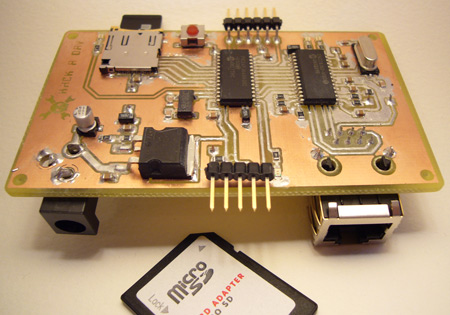
This mini web server is slightly smaller than a business card. There are a lot of tiny one-board servers out there, but this is probably the smallest you can etch and solder at home. Unlike many embedded web servers, files are stored on a PC-readable SD card, not in a difficult-to-write EEPROM. Read on for the web server design, or catch up on PIC 24F basics in the previous article: Web server on a business card (part 1).

Continue reading “How-To: Web Server On A Business Card (Part 2)”

IPhone Forensics 101: Bypassing The Passcode

[youtube=http://www.youtube.com/watch?v=aaxSF9EOjxw]

Watch in wonder as forensics expert [Jonathan Zdziarski] takes you step by step through the process of bypassing the iPhone 3G’s passcode lock. Gasp in amazement as he creates a custom firmware bundle. [Jonathan], creator of NES.app a Nintendo emulator for the iPhone, is well respected for his work on opening the iPhone. In this presentation, he sheds some light on the forensics toolkit he helped develop for law enforcement agencies that we covered earlier.

Arcade Button Monome: Moanonme

[Johan Larsby] built this pretty cool Monome clone. He was starting with a kit to build an Arduinome, but had issues getting his LED matrix to work correctly. After digging around in some old parts and hacking together some custom LED arcade buttons, he ended up with the Moanonme.  Be sure to check out the video after the break.

Continue reading “Arcade Button Monome: Moanonme”

Arduino Solenoid Concert

[youtube=http://www.youtube.com/watch?v=g_hiz-Kx0kM]

[jay] reminded us of this old video of solenoids banging rhythms on furniture and household objects. There’s no schematic, but in the video it looks like an Arduino drives a bunch of solenoids through relays. The PC interface is run on Pure Data, an open source programming environment for audio, video, and graphic processing. Thanks [Jay].