
[vimeo http://vimeo.com/6409575 w=470&h=352]
[Pete], a musician, and the guy behind SparkFun’s pogobeds and locking footprints has a sprinkler hack. He wanted to keep his dog, Choppy, happy with a green lawn while also keeping his sidewalk water free. To solve this problem, he hacked his sprinkler and hose to adjust the sprinkler’s range. He uses an Arduino to read a potentiometer signifying the direction that the sprinkler is facing and a servo to adjust a hose valve that controls the sprinkler’s water flow. Be sure to check out the video above to see it in action.
Year: 2009

Mini MAME Cabinet
[luis] added to the collection of MAME projects we’ve covered with his mini MAME cabinet build. This is his 5th mini cabinet and features a 5″ PlayStation LCD screen, a joystick, four control buttons, player 1 and 2 start buttons, speakers, and a lighted marquee. The controls are interfaced through an I-PAC and the system running the whole thing is a mini-ITX board with an Atom processor and two gigs of RAM. The build log is in Spanish and takes us all the way from a cardboard prototype to the finished particle board cabinet full of high quality artwork.
Tap-controlled Metronome

[Adam] and his buddy [Matthew] sent in their tap-controlled metronome, or as they prefer, “metronome with an attitude.” Using the piezo speaker you can tap patterns and rhythm into the memory and it will repeat it back to you in loop. The two buttons allow you to speed up or slow down the beat which is indicated by an led array. As per their request, we mention its entirely on a PIC 16F, not an Arduino. Perhaps the most interesting part we found that’s definitely worth checking out was their amazingly detailed build process. Check out a quick video of the metronome in action after the break.
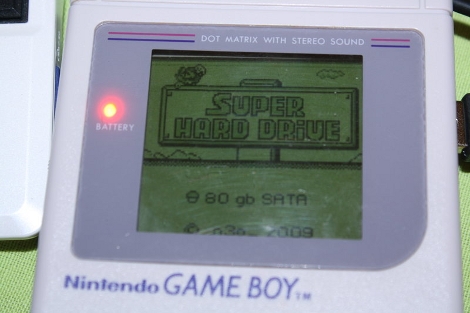
80 Gig Drive Inside A Game Boy
[_n3o_] put together a nice external storage mod by fitting a 2.5″ drive into a broken Game Boy. This mod fooled quite a few people because it appears that the device still plays games with the drive stuffed inside of it. Sadly, this is not the case. The reflective backing has been removed from the screen and replaced by a piece of paper with a graphic printed on it. The LED from the hard drive was moved to the battery indicator for the Game Boy for added realism. There is no build log for this project but [_n3o_] did give a short explanation of it in a forum post. You can see two more pictures of the project after the break. Continue reading “80 Gig Drive Inside A Game Boy”
NES On ZipIt
[youtube=http://www.youtube.com/watch?v=uwxGQhtf4uU]
Going even further back in time than 4th gen, [Kevin] tipped us off to this project by [Hunter Davis]. It is a collection of software mods for Zipit’s Z2 instant messenging device. Some of them include allowing it to run (ports of) the Fluxbox window manager, FCE Ultra NES emulator, and (most impresively) the Java framework. The next leap in development, a SNES emulator optimized for the Zipit, is in the works. The Z2 runs Linux out of the box. This means you no longer have to reflash the device to add software, such as DOSbox (also introduced to the Zipit by [Hunter Davis]). Be sure to check out the video demo of FCE Ultra on the Z2 above.
Arduino Muon Detector

[Sebastian Tomczak] was borrowing a homeade muon detector from his friend, and managed to hook it up to his computer through an Arduino. The detector itself uses 3 fluorescent tubes to detect radiation. Three separate tubes are used in order to filter out terrestrial radiation; cosmic radiation will fall in-line with the tubes and pass through at least two of them, whereas terrestrial radiation will only hit one. There is some basic circuitry to amplify the signal and then perform the OR operation.
[Tomczak] used an Arduino to take the raw data and feed it into his computer. He then used Max/MSP to analyze the data and filter out background noise, leaving only the cosmic ray data. He didn’t mention what he was going to use the data for, though. Maybe he’ll hook it up to a synthesizer.
Related: Digital Geiger counter
[via @littlebirdceo]
700 Lumen LED Bike Lamp

We’ve seen bright bike lamps before. This one caught our eye because it needs a heat sink while in operation. [700lumenLED] built a super bright light for his bike that features an aluminum enclosure and heat sinks to protect the LEDs against overheating. Some nice work was done incorporating the 12v battery into a bike bottle with the power switch and a dimming potentiometer attached to the bottle cap.









