555 Video Game

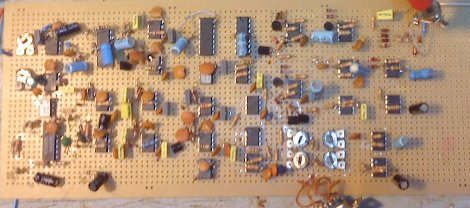
[Thrashbarg] is back up to some 555 timer madness again, this time with his sort of dodge ball video game. Featuring twenty three 555 timers, op amps (the LM324) and atari paddles slightly modded so the pots act as voltage dividers.

Output is on a monochrome composite tv signal, and the game plays like a dodge ball game where the object is to avoid the ball and take out the other player. You can also launch your own ball and deflect the oncoming attack. When hit the defeated player disappears from the screen for 3 seconds and then another round starts.

On a personal note this project hits close to home, as the project I had planned was a 555 based pong game, and just days before the deadline all I have is a wobbly sync generator, so seeing something close to what I had imagined, and working, makes me smile and feel a little better about my mental status.

Check out a short video after the break, and [Thrashbarg’s] previous 555 project, The Synthanola.
Continue reading “555 Video Game”

555 Timer-based Charge Controller

555_charging_controller_circuit

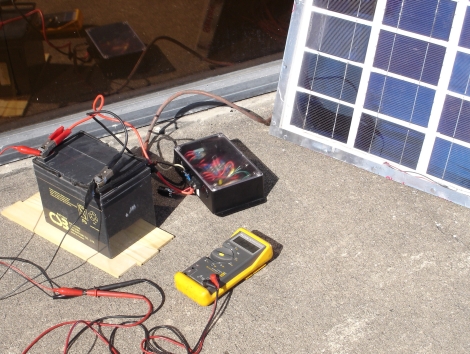
Several years ago [Michael Davis] built a charge controller for his wind turbine and published his construction plans online. This build became quite popular, especially among people that live in remote regions. He states that he is flooded with email each day with questions about his charge controller from people trying to troubleshoot its construction or from people who are unable to source the proper parts.

In order to make things easier for people, he decided to revisit his controller design to see what could be improved, and more importantly, what could be removed. The revision was shelved for awhile, but while in the process of working on another project, he realized that most of his original circuit could be easily replaced with a 555 timer. Since the 555 chip is so ubiquitous, he figured it was a fantastic way to simplify his charger, even if he wasn’t using the chip in the manner for which it was originally designed.

He continued revising his charger, sourcing very basic components and simplifying the circuitry enough that even he was able to build it correctly the first time around. Needless to say, this charging circuit will be his entry in the 555 Design Contest.

Be sure to keep reading for a quick video of his charger in action.

Continue reading “555 Timer-based Charge Controller”

Reverse Engineering A Mobile Phone E-paper Display

msp430_epaper_display

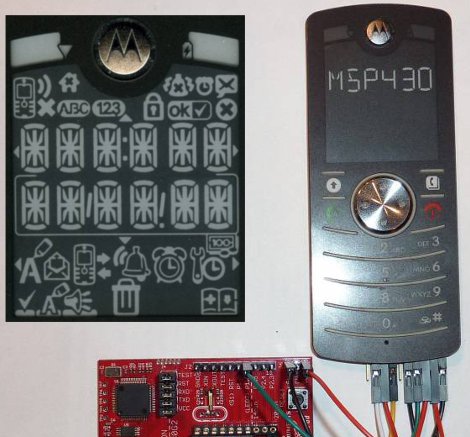
While e-paper is common among e-readers, there are very few, if any phones other than the MOTOFONE that exclusively use an e-paper display. [Steve] had one of these phones sitting around and thought it could be used to build a low-power clock. Since the bistable e-paper display can retain the currently active content even when power is removed, he would only need to update the clock once a minute, when the time changed.

Unfortunately for him, very little publicly-available documentation exists for the display controller Motorola used. To get an idea of how the display was driven, he had to sniff the SPI communications between the processor and the display. Once he had the basic commands down, he spent quite a bit of time figuring out how to activate the different segments of the display, due to what seems to be a rushed design process on Motorola’s part.

Now that [Steve] had reverse-engineered just about everything, he connected the phone to a TI MSP430 to drive the display. He programmed the LaunchPad to serve as a basic clock with great results, as you can see in the video below.

If your interest in e-paper hacking has been piqued, be sure to check out our previous e-paper coverage here.

Continue reading “Reverse Engineering A Mobile Phone E-paper Display”

Self-regulating Water Heater

netduino_controlled_energy_saving_water_heater

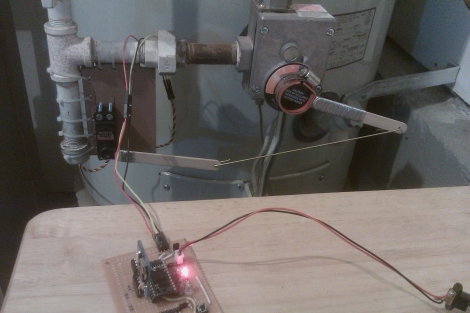
Most everyone is looking to live a little greener these days, with motivating factors typically being the preservation of the environment or financial considerations. [Fabien] fit into the latter category after realizing that about 25% of his monthly gas bill went to heating the water he and his family use each day. After a few calculations, he found that they only required hot water 68 of the 168 hours per week that the water heater was typically running. He figured the best way to save a few dollars was to rig the water heater to turn itself down when it wasn’t being used.

He connected a servo to the temperature control knob on his water heater, allowing it to be adjusted by a microcontroller. Having a rough idea as to the schedule his family keeps during an average week, he wrote an application for his Netduino that would actuate the servo when needed. A DS1307 real-time clock was wired to the Netduino for accurate timekeeping, so as to ensure [Fabien’s] wife never had to endure a cold shower.

It’s a shame that most water heaters don’t ship with some sort of programmable thermostat like you see with newer HVAC systems, but this hack is definitely a step in the right direction.

Continue reading to see his power-saving water heater in action.

Continue reading “Self-regulating Water Heater”

Repair Stuck IPod Nano Buttons

A system is only as strong as its weakest link and [Roberto Barrios] found that on the sixth generation iPod nano the buttons are the problem. It makes sense that the buttons would be exposed to wear since they’re movable parts. The issue isn’t one of contacts or springs wearing out, but how the buttons are assembled. Each consist of a couple of parts; the tactile piece that you see and press, the electrical switch which converts that force into an electrical signal, and a shim that bridges the gap between the two.

After two months of use the iPod [Roberto] was fixing had stopped responding to presses of the Power button. It turns out that the shims are attached with double-sided tape. Inspection of the internals revealed that the shim had slid to one side and no longer made contact with the electrical system. His solution was to remove the tape and clean off the goo, then reattach the shims using “two-part metal cement”.

With the shim back in place all is well but he made sure to execute this fix on all of the buttons before reassembly.

Force Feedback Rig

Strap yourself in, it’s going to be a bumpy ride. No really, if you don’t believe us, check out the video after the break of this bouncing and rolling game system. [Shawn McGrath] built it to compliment the gaming experience for Dyad, an indie game for which he is a developer. His wife was kind enough to demonstrate the machine, which utilizes one motor to rotate the display and cockpit, and another to add vibration to the experience. The parts for the system were mostly salvaged, with the addition of a projector for the display and a PlayStation SixAxis controller to sense the motion of the rig. The motors are powered by a 600W computer PSU and controlled by an Arduino. It helps that [Shawn’s] a developer because he was able to add feedback hooks to sync with the gameplay.

It’s not as intricate as the best flight simulators we’ve seen, but it will be fun for that next kegger.

Continue reading “Force Feedback Rig”

Gauss Weapons

This collection of gauss weapons use rare earth magnets to accelerate projectiles to damaging speeds. They work using the same concepts as a coil gun, but instead of just one projectile travelling along a length of guide track, there are many projectiles that work in a chain reaction. A series of magnets are placed at equal distances along the track. Each has a couple of large ball bearings on the muzzle side of the magnet. The first ball bearing is fired using mechanical force – like a spring mechanism – and accelerates as it approaches the magnet due to the attractive force of that magnetic field. When it impacts the magnet it sends one of the ball bearings on the opposite side down the track where it will accelerate when it nears the next magnet in the chain. The weapon above achieves a final projectile speed of about 68 miles per hour, breaking six fluorescent tubes in a row on at the right side of the apparatus.

Still prefer rail guns that use electromagnets? Check out this gauss pistol kit that is about as powerful as a BB gun.