The Music Of A Sunset

What would you do if you suddenly went blind and could never again see the sun set? How would you again experience this often breathtaking phenomenon? One answer is music, orchestrated by the sun and the Weather Warlock.

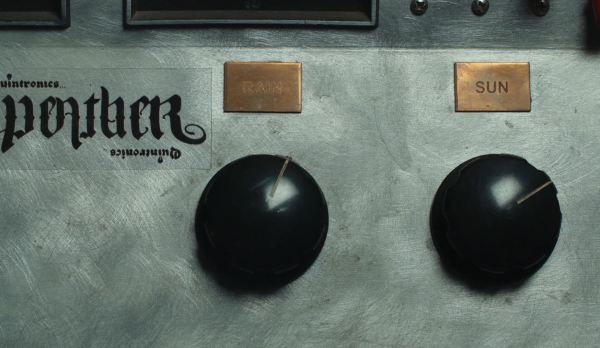
Built by the musician [Quintron] (builder and inventor of insane electronic instruments), the Weather Warlock is an analog synthesizer controlled by — you guessed it — the weather. It translates temperature, moisture, wind and sunlight into tones and harmonics with an E major root chord. UV, light, moisture, and temperature sensors combined with an anemometer set up outside feed the weather data to a synthesizer that has [Quintron] dialing knobs and toggling switches. The Weather Warlock steams 24/7 to the website weatherfortheblind.org so that the visually impaired are able to tune in and experience the joy of sunrise and sunset through music. Continue reading “The Music Of A Sunset”

The Onion Omega2: The Latest Router Dev Board

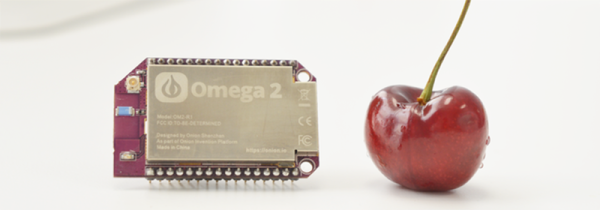
A few years ago, the best way to put a device or project online was by hacking a router. With an inconspicuous Linksys WRT54G held onto a project with baling wire, anything can connect to the Internet. A lot has changed in a few years, and now those routers are development boards themselves. The latest of these is the Onion Omega2, a follow-up crowdfunding campaign to the very popular original Omega. Now, this tiny dev board is faster, more capable, and now it’s giving the Raspberry Pi Zero a run for its money.

The original Onion Omega was released last year with specs you would expect from an Internet of Things development board designed upon a chip for a cheap router. The original Onion used an Atheros AR9331 SOC running at 400 MHZ, had 64MB of RAM and 16MB of storage – enough to run a lightweight Linux distro – and also included USB, 802.11b/g/n, and a handful of GPIOs and a single UART. The Omega2 is a vast improvement over the original Omega, featuring a CPU that is 45% faster. The upgraded version of the Omega sports twice as much RAM, twice as much storage, and a MicroSD slot. This enables some Linux distros with a little more oomph behind them, and of course the SD card allows for local storage.

The original Onion Omega was funded through a crowdfunding campaign, with a single Onion Omega and dock available for a pledge of $19. Taking a lesson from the C.H.I.P. and the Pi Zero, the team at Onion have slashed the price. The Omega2 is only five dollars. If you want more RAM, storage, and an SD card socket, that price goes up to $9 USD. That’s amazing, and just goes to show how far hardware designed to service the Internet of Things has come in just a few short years.

Formlabs Form 1+ API Now Available On Github

Since 2014, the Form 1+ has been serving a faithful community of avid resin-oriented 3D printer enthusiasts. With an API now released publicly on Github, it’s time for the Form 1+ to introduce itself to a crew of eager hardware hackers.

Exposing an interface to the printer opens the door to a world of possibilities. With the custom version of PreForm that arrives with this release, a whopping 39 different properties are open for tuning, according to the post on Reddit. Combining these newly-accessible parameters with a sufficient number of hackers, odds are good that the community will be able to quickly converge on stable settings for 3rd party resins. (We’re most excited to see the Homebrew PCBs community start exposing their UV-sensitive PCBs with this hardware setup.)

Heads-up: poking around in this brave new world is almost certain to void your warranty, but if you’re eager to get SpacewΛr up-and-running, it might just be worth it.

Books You Should Read: Instruments Of Amplification

Psst… Wanna make a canning jar diode? A tennis ball triode? How about a semiconductor transistor? Or do you just enjoy sitting back and following along an interesting narrative of something being made, while picking up a wealth of background, tips and sparking all sorts of ideas? In my case I wanted to make a cuprous oxide semiconductor diode and that lead me to H.P. Friedrichs’ wonderful book Instruments of Amplification. It includes such a huge collection of amplifier knowledge and is a delight to read thanks to a narrative style and frequent hands-on experiments.

Friedrichs first authored another very popular book, The Voice of the Crystal, about making crystal radios, and wanted to write a second one. For those not familiar with crystal radios, they’re fun to make radios that are powered solely by the incoming radio waves; there are no batteries. But that also means the volume is low.

Readers of that book suggested a good follow-up would be one about amplifier circuits, to amplify the crystal radio’s volume. However, there were already an abundance of such books. Friedrichs realized the best follow-up would be one on how to make the amplifying components from scratch, the “instruments of amplification”.  It would be unique and in the made-from-scratch spirit of crystal radios. The book, Instruments of Amplification was born.

The Experiments

Microphonic relays
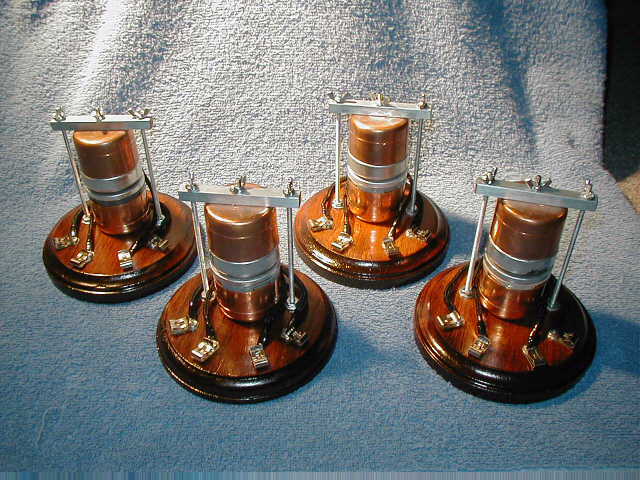
Microphonic relays, via H.P. Friedrichs Homepage

The book includes just the right amount of a history, giving background on what an amplifier is and how they first came in the electrical world. Telegraph operators wanted to send signals over greater and greater distances and the solution was to use the mix of electronics and mechanics found in the telegraph relay. This is the springboard for his first project and narrative: the microphonic relay.

The microphonic relay example shown on the right places a speaker facing a microphone; the speaker is the input with the microphone amplifying the output. He uses a carbon microphone salvaged from an old telephone headset, housing everything in an enclosure of copper pipe caps, steel bar stock, nuts and bolts mounted on an elegant looking wood base. All the projects are made with simple parts, with care, and they end up looking great.

Continue reading “Books You Should Read: Instruments Of Amplification”

Bunnie And EFF Sue US Government Over DMCA 1201

This morning Bunnie Huang wrote about his reasons for suing the US Government over Section 1201 of the Digital Millennium Copyright Act (DMCA).

The DMCA was enacted in 1996 and put in place far-reaching protections for copyright owners. Many, myself included, think these protections became far-overreaching. The DMCA, specifically section 1201 of the act which is known as the anti-circumvention provision, prohibits any action that goes around mechanisms designed to protect copyrighted material. So much has changed since ’96 — software is now in every device and that means section 1201 extends to almost all electronics sold today.

So protecting copyright is good, right? If that were the only way section 1201 was enforced that might be true. But common sense seems to have gone out the window on this one.

If you legally purchase media which is protected with DRM it is illegal for you to change the format of that media. Ripping your DVD to a digital file to view on your phone while on the plane (something usually seen as fair use) is a violation. Want to build an add-on for you home automation system but need to reverse engineer the communications protocol first? That’s a violation. Perhaps the most alarming violation: if you discover a security vulnerability in an existing system and report it, you can be sued under DMCA 1201 for doing so.

Cory Doctorow gave a great talk at DEF CON last year about the Electronic Frontier Foundation’s renewed push against DMCA 1201. The EFF is backing Bunnie on this lawsuit. Their tack argues both that section 1201 is stiffling innovation and discouraging meaningful security research.

If it’s illegal to write about, talk about, or even privately explore how electronics are built (and the ecosystem that lets them function) it’s hard to really master creating new technology. A successful lawsuit must show harm. Bunnie’s company, Alphamax LLC, is developing hardware that can add an overlay to an HDMI signal (which sounds like the continuation of the hack we saw from him a few years ago). But HDCP would prevent this.

Innovation aside, the security research angle is a huge reason for this law (or the enforcement of it) to change. The other plaintiff named in the suit, Matthew Green, had to seek an exemption from the DMCA in order to conduct his research without fear of prosecution. Currently there is a huge disincentive to report or even look for security vulnerabilities, and that is a disservice to all. Beneficial security research and responsible disclosure need to be the top priority in our society which is now totally dependent on an electronically augmented lifestyle.

Ever Buy Music From Apple? Use Linux? You Need This Tool

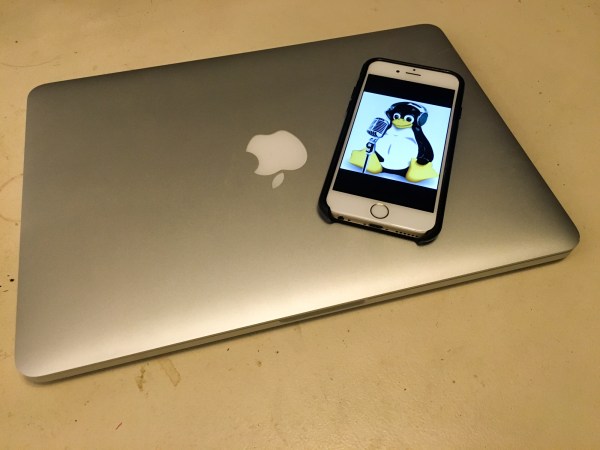
Sure, you’re a hardcore superuser, but that doesn’t mean you don’t enjoy the finer things in life — like shiny squircles and getting every new app first. But, what’s an OS-indiscriminate person like yourself going to do when it comes time to purchase music? That’s where the recover_itunes tool shines, and if you’re a Linux user with an iPhone, it might just be your new best friend.

Continue reading “Ever Buy Music From Apple? Use Linux? You Need This Tool”

MicroPython On The ESP8266: Kicking The Tires

Scripting languages are for large computers, right? “Real” embedded device work is a hellish, never-ending cycle of code, compile, and re-flash. Well, I used to think so too, but with the proliferation of scripting and other interactive languages to microcontrollers over the last few years, the hurdle to interactive development on the small chips has gotten a lot lower.

On the ESP8266 platform, I’ve tried out NodeMCU’s Lua and ESP8266 BASIC. (For the last half-year, I’ve been using the awesome Mecrisp-Stellaris almost exclusively on the STM32F1xx and F4xx chips, but haven’t dipped into ESP8266 Forth yet.)

NodeMCU is great because it’s got everything you could want built in, and through cloud services it’s easy to get a tailored build made that maximizes free flash memory for your projects. I just don’t dig the asynchronous Lua thing (you might, try it!). ESP BASIC has a different set of libraries, and is missing MQTT for my purposes. Still it’s pretty slick, and worth a look.

So when the MicroPython folks announced that they were releasing the binary builds for the ESP, I thought it was time to give it a spin. I’ve used Python for nearly twelve years now, so it’s like a comfortable shoe for me. Would MicroPython be the same on the ESP8266? The short answer is yes and no.

Continue reading “MicroPython On The ESP8266: Kicking The Tires”