Cheap Flamethrower Is Predictably Worrying

We’d never criticize somebody for coming up with a creative way to save a few bucks. In truth, pickings would be pretty slim around here if we deleted every project or hack where cost savings was a prime motivator. That being said, there’s still some things you should probably spend a few extra dollars on. You know, the essential things in life that you need to know will be safe and reliable, like your car and…your flamethrower.
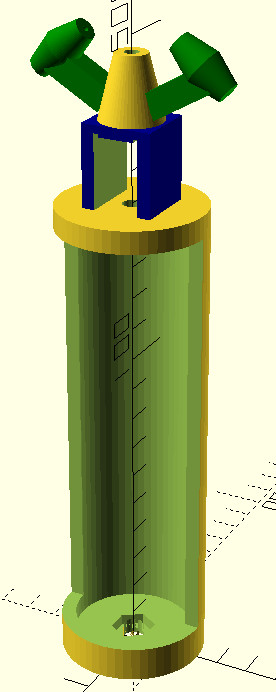
While we don’t have any information about what kind of car [Steve Hernandez] is driving, but over on Hackaday.io, he’s posted some info about his 3D printed wrist-mounted flamethrower. The final result does look pretty impressive, but given the subject matter and the lack of any safety gear, we would firmly plant it in the “Don’t try this at home” category.

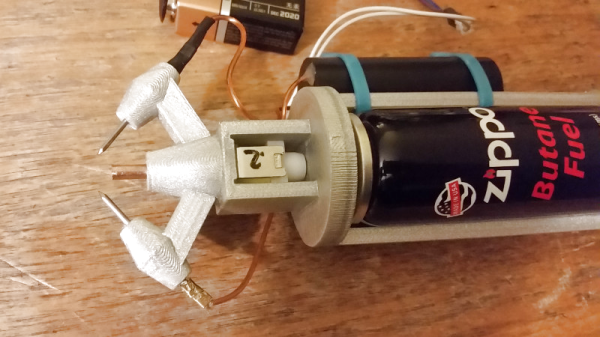
At the heart of this flamethrower is a solenoid valve recovered from a Glade air freshener. Rather than spraying out the smell of lilacs, this valve has found a new purpose in life by squirting out butane from a pressurized can. The butane is then ignited by a spark gap made up two nails connected to a 300 kV boost coil.

[Steve] designed the frame of this creation in OpenSCAD, and printed it out in a single piece. It holds the butane can and solenoid in position, as well as keeping the nails in the proper orientation for the spark gap to function. Admittedly the head of his printed flamethrower does look very cool, but if there was ever a situation where you should be suspect of the heat tolerance of 3D printed plastic, a flamethrower is probably it.

What’s noticeably lacking of course is any method to keep the flame from potentially traveling back up through the valve and into the butane can. The high-speed flow coming out of the nozzle is probably enough to keep that from happening, but we still wouldn’t feel comfortable strapping his device to our wrist as-is.

You may be surprised to find that wrist-mounted flamethrowers are a relatively popular project here at Hackaday. We’ve covered quite a few over the years, but still aren’t convinced this is something we personally need to add to our collection of gear.

Mega Game & Watch Octopus

Mega Game & Watch: True Multiplayer Game

Today we’re used to handheld game consoles like the Nintendo Switch, that let you roam around in 3D worlds which include not only 3D players but more terrain than many people walk around in real life in a week. But back in the early 1980s Nintendo’s handheld offering was the Game & Watch, which used a segmented LCD display. An entire segment could be used to represent the player, with player segments spread throughout the display. To move the player, the previous player segment would be turned off while another adjacent one would be on. That also meant that a console could play only one game. Despite these limitations they were very popular for their time.

[Thomas Tilley] decided to improve on the old Game & Watch in a different way, by making it bigger, much bigger. So big in fact that even many teenage players can’t reach both the button to move left and the button to move right in time, turning it into a highly co-operative two-player game. Judging by the video below, that made playing it double the fun. The game he chose to tackle is the Game & Watch Octopus, or Mysteries of the Sea and Mysteries of the Deep in the UK.

Continue reading “Mega Game & Watch: True Multiplayer Game”

Sensing Soil Moisture: You’re Doing It Wrong!

If you compulsively search online for inexpensive microcontroller add-ons, you will see soil moisture measurement kits. [aka] built a greenhouse with a host of hacked hardware including lights and automatic watering. What caught our attention among all these was Step 5 in their instructions where [aka] explains why the cheap soil sensing probes aren’t worth their weight in potting soil. Even worse, they may leave vacationers with a mistaken sense of security over their unattended plants.

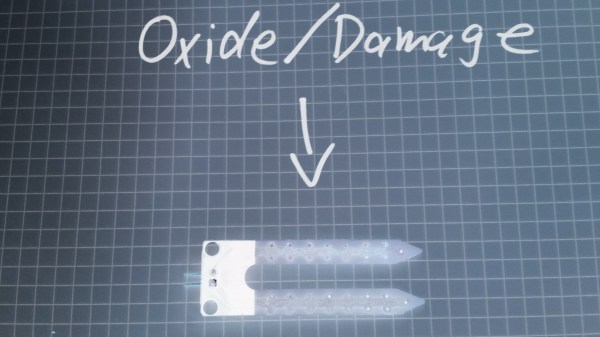
The sensing stakes, which come with a small amplifier, work splendidly out of the box, but if you recall, passing current through electrodes via moisture is the recipe for electrolysis and that has a pretty profound effect on metal. [Aka] shows us the effects of electrolysis on these probes and mentions that damaged probes will cease to give useful information which could lead to overworked pumps and flooded helpless plants.

There is an easy solution. Graphite probes are inexpensive to make yourself. Simply harvest them from pencils or buy woodless pencils from the art store. Add some wires and hold them with shrink tube, and you have probes which won’t fail you or your plants.

Here’s some garden automation if this only whet your whistle, and here’s a robotic friend who takes care of the weeds for you.

Servo-Controlled Eyeball Makes A Muggle Moody

Even when you bear a passing resemblance to the paranoid Auror of the Harry Potter universe, you still really need that wonky and wandering prosthetic eye to really sell that Mad-Eye Moody cosplay, and this one is pretty impressive.

Of course, there’s more to the [daronjay]’s prosthetic peeper than an eBay doll’s eye. There’s the micro-servo that swivels the orb, as well as a Trinket to send the PWM signal and a pocket full of batteries. The fit and finish really tie it together, though, especially considering that it’s made from, well, garbage — a metal food jar lid, a yogurt cup, and the tube of a roll-on antiperspirant. Some brass screws and a leather strap evoke the necessary Potter-verse look, and coupled with what we assume are prosthetic scars, [daronjay] really brings the character to life. We think it would be cool to have the servo eye somehow slaved to the movements of the real eye, with a little randomness thrown in to make it look good.

Marauder’s maps, wand duels, Weasley clocks — the wizarding world is ripe for creative hacking and prop making. What’s next — a Nimbus 2000 quadcopter? Please?

Continue reading “Servo-Controlled Eyeball Makes A Muggle Moody”

Get You An E-Textiles Sensor That Can Do Both

[Admar] is a software developer who was introduced to e-textiles in 2011. The bug firmly took hold, and these days he gives e-textile workshops at Eindhoven University of Technology. Here, students learn to build a single e-textile sensor that detects both presence and pressure. The workshop presentations are available on his site, which is itself a window into his e-textile journey.

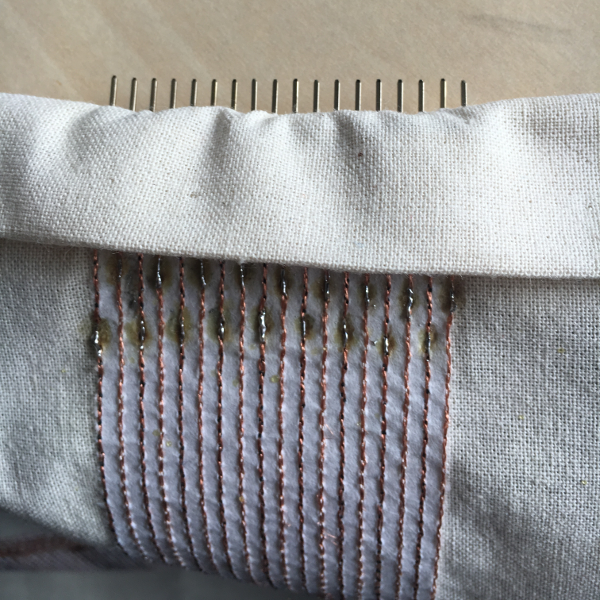
Over the years, [Admar] has discovered that any e-textile project requiring more than a few connections is ripe for some kind of textile-friendly multi-point connector. Through trial and error, he designed a robust solution for use with an embroidery machine. The wires are made from conductive thread and soldered to a row of male header pins to make the transition out of fiber space. This transition requires solder, which quickly gets interesting when coupled with a fabric substrate and no solder mask. We wonder if spraying on mask beforehand would help, or if it would just soak in and stain and get in the way.

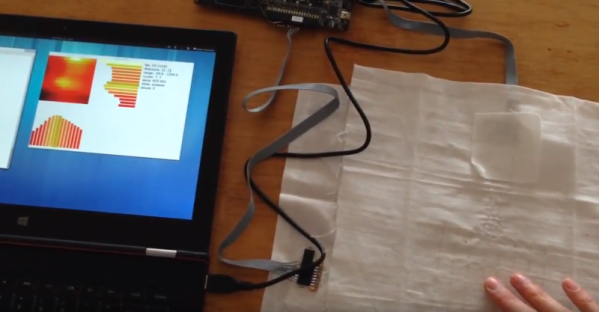
You can see the connector in practice in [Admar]’s capacitive multi-touch demo video after the break. He has stacked two pieces of fabric, each with a wire bus made of conductive threads, with the traces at right angles. Both sensors are wired to a Cypress PSoC5 to create a sensor matrix, and then to a laptop for visualization purposes. As his fingers approaches the fabric, the bar graphs roar upward to show increased capacitance. Once he makes contact, each finger appears as a yellow dot illustrating pressure.

E-textile projects aren’t limited to traces sewn by hand or embroidery machine. Circuit boards can be knitted, too.

Thanks for the tip, [Melissa]!

More Homemade PCB Tinning

[Marko] styles himself as a crazy chemist. His video showing a fast tin plating solution for PCBs (YouTube, see below) doesn’t seem so crazy. We will admit, though, it uses some things that you might have to search for.

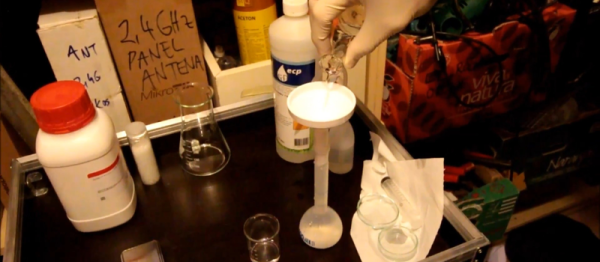
The formula calls for stannous chloride — you could probably make this by dissolving tin in hydrochloric acid. There’s also thiourea — the main chemical in silver-cleaning dips like Tarn-X. Sulphuric acid and deionized water round out the recipe.

Continue reading “More Homemade PCB Tinning”

Radio Apocalypse: The Emergency Broadcast System

Some sounds are capable of evoking instant terror. It might be the shriek of a mountain lion, or a sudden clap of thunder. Whatever your trigger sound, it instantly stimulates something deep in the lizard brain that says: get ready, danger is at hand.

For my part, you can’t get much scarier than the instantly recognizable two-tone alert signal (audio link warning) from the Emergency Broadcast System (EBS). For anyone who grew up watching TV in the 60s and 70s in the US, it was something you heard on at least a weekly basis, with that awful tone followed by a grave announcement that “the broadcasters of your area, in voluntary cooperation with the FCC and other authorities, have developed this system to keep you informed in the event of an emergency.” It was a constant reminder that white-hot death could rain from the sky at any moment, and the idea that the last thing you may ever hear was that tone was sickening.

While I no longer have a five-year-old’s response to that sound, it’s still a powerful reminder of a scary time. And the fact that it’s still in use today, at least partially, seems like a good reason to look at the EBS in a little more depth, and find out the story behind the soundtrack of the end of the world.

Continue reading “Radio Apocalypse: The Emergency Broadcast System”