The Legacy Of The Floppy Still Looms Over Windows

We no longer use floppy disks on the vast majority of computers, but a recent Old New Thing blog post from Microsoft sheds light on one of their possible unexpected legacies. It seems Windows disk cache items expire after two seconds, and as the post explains this has its origin in the development of MS-DOS 2.0.

Disks, especially floppy disks, are slow compared to computer memory. A disk cache is a piece of memory into which the operating system puts frequently loaded items to speed up access and avoid its having to repeatedly access the disk. They have an expiry time to ensure that the cache doesn’t become clogged with data that hasn’t been needed for a while.

IBM PC floppy drives didn’t implement any form of notification for a disk eject, so it became quite possible for a disk to be ejected while the operating system still believed cached data from it to be valid. Thus a pair of Microsoft engineers tried their hardest to swap floppy discs as fast as they could, and it was discovered to be an impossible task in under two seconds. This became the cache expiry time for a Microsoft OS, and thus we’re told the floppy’s legacy lives on as more than just the ‘save’ icon.

As this is being written the Internet is abuzz with a viral Tweet about railroad gauges having an origin in the width of a Roman horse, that rail historians are debunking with a reference to the coal tramways of [George Stephenson’s] Northern England. It’s thus sometimes dangerous to take simple soundbite origin stories at face value, but since in this case our source is Microsoft themselves we think we can take it as being close to the horse’s mouth. Even if it isn’t a Roman horse.

IBM floppy drive image: Michael Holley [Public domain].

What On Earth Is A Pickle Fork And Why Is It Adding To Boeing’s 737 Woes?

It’s fair to say that 2019 has not been a good year for the aircraft manufacturer Boeing, as its new 737 MAX aircraft has been revealed to contain a software fault that could cause the aircraft to enter a dive and crash. Now stories are circulating of another issue with the 737, some of the so-called “Pickle forks” in the earlier 737NG aircraft have been found to develop cracks.

It’s a concerning story and there are myriad theories surrounding its origin but it should also have a reassuring angle: the painstaking system of maintenance checks that underpins the aviation industry has worked as intended. This problem has been identified before any catastrophic failures have occurred. It’s not the story Boeing needs at the moment, but they and the regulators will no doubt be working hard to produce a new design and ensure that it is fitted to aircraft.

The Role of the Pickle Fork

For those of us who do not work in aviation though it presents a question: what on earth is a pickle fork? The coverage of the story tells us it’s something to do with attaching the wing to the fuselage, but without a handy 737 to open up and take a look at we’re none the wiser.

Fortunately there’s a comprehensive description of one along with a review of wing attachment technologies from Boeing themselves, and it can be found in one of their patents. US9399508B2 is concerned with an active suspension system for wing-fuselage mounts and is a fascinating read in itself, but the part we are concerned with is a description of existing wing fixtures on page 12 of the patent PDF.

A cross-section of the aircraft wing fixing, in which we've highlighted the role of the pickle forks. (Boeing)
A cross-section of the aircraft wing fixing, in which we’ve highlighted the role of the pickle forks. (Boeing)

The pickle fork is an assembly so named because of its resemblance to the kitchen utensil, which attaches firmly to each side of the fuselage and has two prongs that extend below it where they are attached to the wing spar.

For the curious engineer with no aviation experience the question is further answered by the patent’s figure 2, which provides a handy cross-section. The other wing attachment they discuss involves the use of pins, leading to the point of the patented invention. Conventional wing fixings transmit the forces from the wing to the fuselage as a rigid unit, requiring the fuselage to be substantial enough to handle those forces and presenting a problem for designers of larger aircraft. The active suspension system is designed to mitigate this, and we’d be fascinated to hear from any readers in the comments who might be able to tell us more.

We think it’s empowering that a science-minded general public can look more deeply at a component singled out in a news report by digging into the explanation in the Boeing patent. We don’t envy the Boeing engineers in their task as they work to produce a replacement, and we hope to hear of their solution as it appears.

[via Hacker News]

[Header image: AMX Boeing 737 XA-PAM by Jean-Philippe Boulet CC-BY 3.0]

Using PoE With A Raspberry Pi 3 For About Two Bucks

When the Raspberry Pi 3 Model B+ was announced in March of 2018, one of its new features was the ability to be (more easily) powered via Power-over-Ethernet (PoE), with an official PoE HAT for the low price of just twenty-one USA bucks. The thing also almost worked as intended the first time around. But to some people this just isn’t good enough, resulting in [Albert David] putting out a solution he calls “poor man’s PoE” together for about two bucks.

His solution makes it extra cheap by using so-called passive PoE, which injects a voltage onto the conductors of the network cable being used for PoE, without bothering with any kind of handshake. In general this is considered to be a very reliable (albeit non-standard) form of PoE that works great until something goes up in smoke. It’s also ridiculously cheap, with a PoE injector adapter (RJ-45 plug & 2.1×5.5 mm power jack to RJ-45 jack) going for about 80 cents, and a DC-DC buck converter that can handle the input of 12V for about 50 cents.

The rest of the $2 budget is mostly spent on wiring and heatshrink, resulting in a very compact PoE solution that plugs straight into the PoE header on the Raspberry Pi 3 board, with the buck converter outputs going into the ground and +5V pins on the Raspberry Pi’s GPIO header.

A fancier solution would implement any of the standard PoE protocols to do the work of negotiating a suitable voltage. Maybe this could be the high-tech, $5 solution featuring an MCU and a small PCB?

The Clickspring Playing Card Press Is A Work Of Art

We have no idea what a playing card press is, nor do we care. All we know is that after watching [Chris] from Clickspring make his playing card press, we want it.

Digging a little deeper, [Chris] offered to make this card press for [Chris Ramsay], a magician who specializes in cardistry, or the art of illusions with cards. The feel of playing cards is crucial to performing with them, and a card press keeps a deck of cards in shape. Not a commonly available device, [Clickspring Chris] designed one in an elaborate style that brought in elements from [Chris Ramsay]’s logo.

Like all Clickspring videos, this one is a joy to watch, but in a departure, there’s no narration — just 30 minutes of precision machining and metal finishing. [Chris] has gotten into metal engraving in a big way, and used his skills to add details to everything from the stylized acorn at the top to the intricate press plate, all of which was done freehand. And those snakes! Made from brass rod and bent into shape by hand, they wrap around the side supports to form [Chris Ramsay]’s logo. All the brass ended up gold plated, while all the screws ended up with a heat-blued finish. Settle in and enjoy the video below.

It’s been a while since the Clickspring skeleton clock was finished, in which time [Chris] has been working on a reproduction of the Antikythera mechanism. His video output slowed considerably, though, when he made a new finding about the mechanism, an observation worthy of writing up as a scholarly paper. We can’t begrudge him the time needed to pursue that, and we’re glad he found time for this project too.

Continue reading “The Clickspring Playing Card Press Is A Work Of Art”

USB Armory MkII: A USB-C Thumb Drive Based Linux Computer For Pentesters

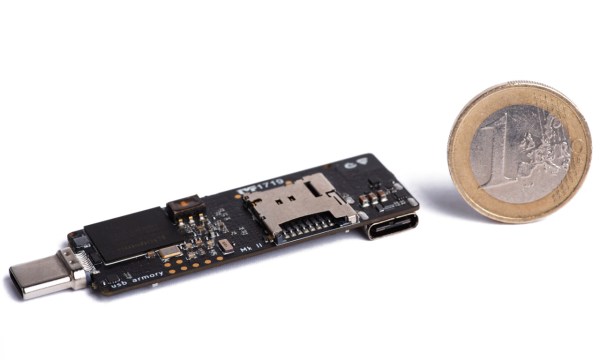
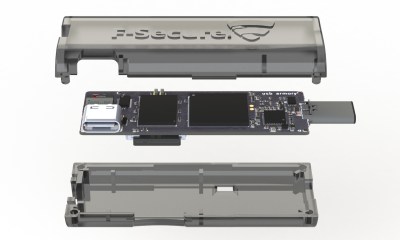
While it might look like a disrobed flash drive or RTL-SDR dongle, the USB Armory Mk II is actually a full-fledged open hardware computer built into the ubiquitous USB “stick” format. But more than just that, it’s optimized for security research and boasts a list of features that are sure to get the attention of any pentesters in the audience. Fine tuned thanks to the feedback developer [Inverse Path] received about the original version of the hardware, the Mk II promises to be the last word in secure mobile computing.

Compared to the original hardware, the most obvious change is the switch to USB-C. The previous USB Armory used traces on the PCB to plug directly into a USB Type-A port, but this time around [Inverse Path] has put a proper male connector on the front of the board. Nominally, the USB Armory is plugged into a host computer to provide it with power and a network connection, though it also has the ability to disguise itself as a storage or input device for more stealthy applications. There’s also a female USB-C port on the Mk II, which can be used to connect additional devices, a feature the previous version lacked.

The USB Armory Mk II is powered by an upgraded 900 MHz ARM Cortex-A7 processor, though it retains the same 512 MB of RAM from the previous version. Like the original, there’s a micro SD slot to hold the Linux operating system, but this time it’s supplemented with an onboard 16 GB eMMC chip. There’s even a physical switch that allows the user to choose which storage device they want to boot from. Other additions for the Mk II include Bluetooth connectivity, and a hardware true random number generator (TRNG).



We first brought you word of the original USB Armory back in 2014, and it’s always good to see an open hardware project thriving and iterating years later. While the $149 price tag arguably puts the MKII out of the tinkering budget for many of us, there’s clearly a market for niche devices like this and we can’t wait to see what [Inverse Path] comes up with next.

Pie Face Game Rigged To Throw Pie At Anyone But You

Pie Face is a game that does pretty much what you’d expect from the title. Players sit in front of a spring loaded arm, taking turns to twist a crank. Eventually, one unlucky player will release the arm and be splattered with whipped cream to the enjoyment of the group. [Harrison] wasn’t one to leave things to chance, however, so decided to rig the game.

Instead of allowing the spring-loaded arm to be released by the internal rotating drum, [Harrison] had a better idea. The drum was sanded smooth, to remove the teeth used by the release mechanism. Then, the release mechanism was replaced with a servo, controlled by an Arduino Nano fitted with a Bluetooth module. With just a tap on his smart phone, [Harrison] can trigger the game, guaranteeing his friends get the cream every time.

It’s a tidy build, and one that takes care to avoid detection with subtle design. Had he not released a Youtube video on the build, [Harrison]’s friends would likely be none the wiser. If your thirst for cheating is still unsated, consider loading your dice for a round of Settlers of Catan. Video after the break.

Continue reading “Pie Face Game Rigged To Throw Pie At Anyone But You”

Hackaday Links Column Banner

Hackaday Links: September 29, 2019

In a sure sign that we’ve arrived in the future, news from off-world is more interesting this week than Earth news. When the InSight probe landed on Mars last year, it placed the first operating magnetometer on the Red Planet. Since then, the sensitive instrument has been logging data about the planet’s magnetic field, and now there are reports that researchers have discovered a chain of pulsations in the magnetic field. Pulsations in planetary magnetic fields aren’t all that strange; pulse trains that occur only at Martian midnight are, though. Researchers haven’t got a clue yet about what this means. We assume they’ve eliminated artifacts like something on the lander being turned on at local midnight, so when they figure it out it should be fascinating.

In more news from the future, Boston Dynamics is trolling us again. We covered the announcement early this week that they’re putting their Spot quadruped robot on sale – sort of. Turns out you need to be selected to qualify based on the application you have in mind, plus have several Ferraris full of cash to spend. While everyone was watching the adorable antics of Spot as it wandered through improbably industrial vignettes, Boston Dynamics also released this slightly terrifying video of their Atlas robot running through a gymnastics routine.  It starts with a headstand and a front roll and ends with a slipt leap and whatever the gymnastics equivalent of a figure skating axel jump is. Yes, it has a special roll cage attached to make the tumbles a bit smoother, but it’s still some remarkable stuff.

How are your RF design skills? If they’re good enough to design an RF power amp, you might want to check out this homebrew RF design challenge. Put on by NXP Semiconductors, the design must use one of their new LDMOS RF power transistors. They’ll send you samples so you can build your design, and you stand to win up to $3000 plus $1000 worth of NXP products. The contest opened back in May but is running through the middle of November, so you’d better hurry.

Speaking of RF, wouldn’t it be interesting to see a snapshot of the RF spectrum over the entire planet? ElectroSense thinks so, and they’re working on a crowdsourcing model to set up a globe-spanning network of connected RF sensors. The idea is similar to what FlightAware does for monitoring the locations of aircraft with a distributed network of ADS-B receivers. But where FlightAware only monitors a narrow slice of spectrum, ElectroSense wants it all – DC to 6 GHz. You can build a sensor from an SDR and a Raspberry Pi and start contributing to the effort, which only has a handful of sensors at the moment.

Has affordable metal 3D-printing finally arrived? For certain values of affordability, it soon will, when One Click Metal launches their new selective laser melting printer. Thomas Sanladerer did a video with the principals, and the prototype looks promising. SLM is not a new process, but patents on the core process recently ran out, so startups like One Click Metal are jumping into the market. Their printer won’t be cheap — you’ll still need to write a check with many zeroes — but with more players, the price should come down.

And finally, what’s this world coming to when a startup specializing in building giant fighting robots can’t make a go of it? MegaBots is shutting down, and while that’s certainly bad news for its founders and employees, it’s great news for anyone in the market for used battle bots. The company’s flagship bot, the 15-ton Eagle Prime, is currently up for auction on eBay. Bidding started at $1 with no reserve, but if you were looking for a steal, you’re a bit late. The high bid is currently $100,100, which is still an incredible buy considering it cost $2.5 million to build. You’ll have to pay for shipping, but you’ll have a super-destructive mecha of your own to drive around. And think how cool you’ll look rolling into some kid’s backyard birthday party. Presumably one you’ve been invited to.