Samsung NX300 Gets Rooted

sammy

[Ge0rg] got himself a fancy new Samsung NX300 mirrorless camera. Many of us would just take some pretty pictures, but not [Ge0rg], he wanted to see what made his camera tick. Instead of busting out the screwdrivers, he started by testing his camera’s security features.

The NX300 is sold as a “smart camera” with NFC and WiFi connectivity. The NFC connectivity turns out to be just an NXP NTAG203 tag embedded somewhere in the camera. This is similar to the NFC tags we gave away at The Gathering in LA. The tag is designed to launch an android app on a well equipped smartphone. The tag can be write-locked, but Samsung didn’t set the lock bit. This means you can reprogram and permanently lock the tag as a link to your favorite website.

[Ge0rg] moved on to the main event, the NX300’s WiFi interface. A port scan revealed the camera is running an unprotected X server and Enlightenment. Let that sink in for a second. The open X server means that an attacker can spoof keystrokes, push images, and point applications to the camera’s screen.

In a second blog post, [Ge0rg] tackled attaining root access on the camera. Based on the information he had already uncovered, [Ge0rg] knew the camera was running Linux. Visiting Samsung’s open source software center to download the open source portions of the NX300 confirmed that. After quite a bit of digging and several red herrings, [Ge0rg] found what he was looking for. The camera would always attempt to run an autoexec.sh from the SD Card’s root folder at boot. [Ge0rg] gave the camera the script it was looking for, and populated it with commands to run BusyBox’s telnet daemon.  That’s all it took – root shell access was his.


[Image via Wikimedia Commons/Danrok]

A Quadcopter From Scratch

Quadcopter

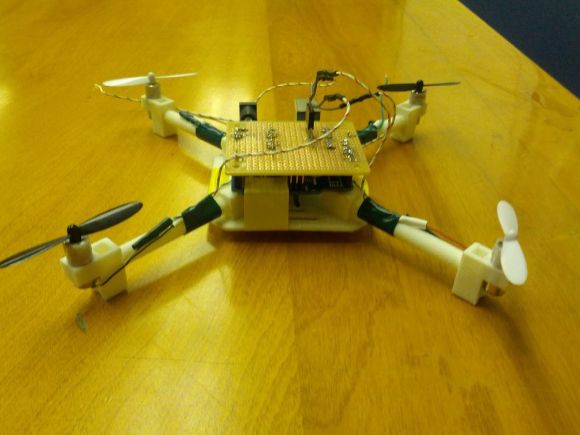
[AwesomeAwesomeness] wanted a low cost quadcopter, so he built one from scratch. Okay, not quite from scratch. [AA’s] cookie mix came in the form of an Arduino Uno and some motors. He started with motors and propellers from a Hubsan X4 quadcopter. Once the power system was specified, [AA] designed a frame, arms, and motor pods in Solidworks. He printed his parts out and had a sweet quadcopter that just needed a brain.

Rather than buy a pre-made control board, [AA] started with an Arduino Uno.  An Arduino alone can’t source enough current to drive the Hubsan motors. To handle this, [AA] added a ULN2003A  Darlington transistor array. The 2003A did work, but [AA] had some glitching issues. We think FETs would do much better in this application, especially when running PWM.

On the control side of things, [AA] added an MPU-6050 Triple Axis Accelerometer and Gyro breakout from SparkFun. The 6050 has 3 gyros and 3 accelerometers in one package. Plenty for a quadcopter.

All this left was the coding. Multicopters generally use Proportional-Integral-Derivative (PID) control loops to maintain stability in the air. [AA] used the Arduino PID library for his quadcopter. He actually created two PID instances – one for pitch and one for roll.

[AA] doesn’t have any videos of his quadcopter in action yet, and we’re guessing this is due in part to weight. Lifting an Uno, a perfboard, and a frame is a tall task for those motors. Going with a one of the many tiny Arduino’s out there would help reduce weight. In addition, [AA] could use a gear system similar to what is used in the Syma X series quadcopters. Stick with it – you’re on the right track!


Quadcopter Built From Recycled Motherboards

A quadcopter built from a motherboard

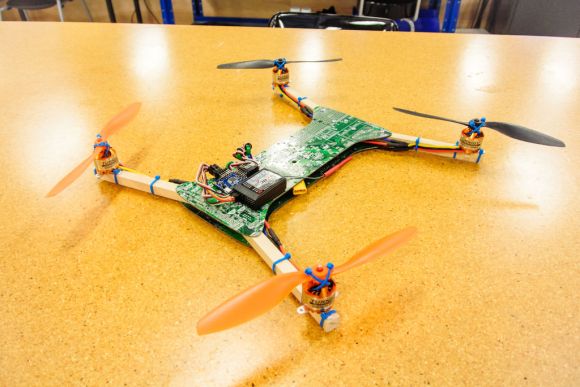
[Eric] has figured out a great way to build quadcopters out of recycled computer motherboards. Multicopters come in all shapes and sizes these days. As we mentioned in the last issue of Droning On, they can be bought or built-in a multitude of materials as well. Drones have been built using materials as varied as wood, PVC pipe, carbon fiber, and aluminum.

One of the more common commercial materials is G10 fiberglass sheet. It’s stiff, strong, and relatively light. Printed circuit boards are generally made of FR-4 fiberglass, G10’s flame resistant cousin. It’s no wonder [Eric] had quadcopters in his eyes when he saw a pile of motherboards being thrown out at his university.

[Eric] used a heat gun and a lot of patience to get all the components off the motherboard. With a bit of care, most of the components can be saved for future hardware hacks. This is one step that’s best performed outside. Hot melting plastics, metals, and resin fumes aren’t the greatest things to inhale.

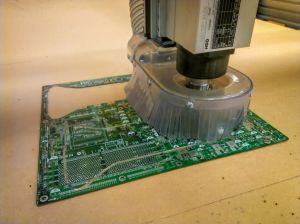
Computer motherboards being cut on a shopbotClean PCBs in hand, [Eric] headed to his local TechShop. He drew his dead cat style frame in SolidWorks and cut it out on a ShopBot. While a high-end CNC cutter is nice, it’s not absolutely necessary. The fiberglass sheets could be cut with a rotary tool or a jigsaw. No matter how you cut it, be sure to wear a mask rated for fiberglass resins and some protective clothing. Fiberglass plate is nasty stuff to cut.

Once the upper and lower frame plates were cut, [Eric] completed his quad frame with some square wooden stock for arms. The final quad is a great flier, and spare parts are easy to source. Nice work on the recycling, [Eric]!

Continue reading “Quadcopter Built From Recycled Motherboards”

Two Wheeler Is Gyroscope Stabilized

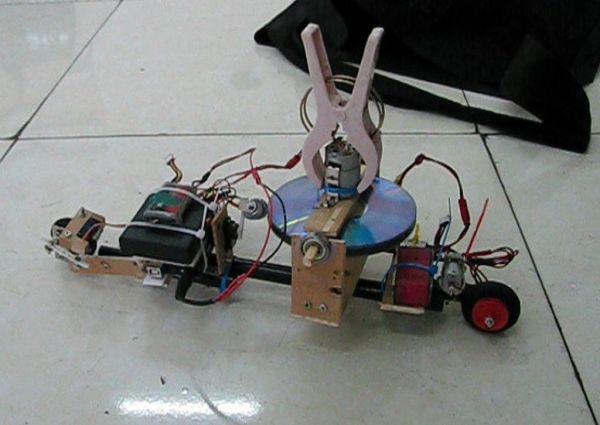
[Jim] loves gyros – not those newfangled MEMS devices, but old-fashioned mechanical gyroscopes. His obsession has pushed him to build this gyro stabilized two wheeler. We love watching hacks come together from simple basic materials and hand tools, with liberal amounts of hot glue to hold everything in place.  That seems to be [Jim’s] philosophy as well.

This is actually the fifth incarnation of [Jim’s] design. Along the way he’s learned a few important secrets about mechanical gyro design, such as balancing the motor and gyro assembly to be just a bit top-heavy. [Jim’s] gyro is a stack of CDs directly mounted to the shaft of a brushed speed400 R/C airplane motor. The motor spins the CDs up at breakneck speed – literally. [Jim] mentions that they’ve exploded during some of his early experiments.

The gyroscope is free to move in the fore-aft direction. Side to side balance tilting is on the wheels themselves. The wheels are model airplane wheels, which have a curved tread. No cheating by using flat LEGO wheels in [Jim’s] lab! A potentiometer measures the tilt angle of the gyro. The voltage from the pot is fed into an Arduino Uno which closes the loop by moving a servo mounted counterweight.

The vehicle is controlled with a regular R/C plane radio. A servo steers the front wheel while another DC motor drives the rear wheel. Not only is [Jim’s] creation able to balance on its own, it can even make a U-Turn within a hallway.

Continue reading “Two Wheeler Is Gyroscope Stabilized”

Dual Port RAM Teaches An Old NES New Tricks

nesDPR

[Andrew] is developing a game for the Nintendo Entertainment System (NES). Emulators are great for this, but [Andy] loves running on the real iron. To help, he’s created a dual port RAM interface for his NES. As the name implies, a dual port RAM is a memory with two separate data and address buses. The Cypress Semiconductor CY7C136 [Andy] used also includes arbitration logic to ensure that both ports don’t attempt to access the same memory cell and cause data corruption. In [Andy’s] case the NES was on one side, oblivious to the new hardware. On the other side of the dual port RAM, [Andy] installed an ATmega164 running his own custom firmware.

The new hardware gives [Andy] a live view of what’s going on in the NES’s memory. He added a live memory view/edit screen similar to the FCEUX emulator. The window runs on a PC while the game itself is running on an NES. [Andy] was even able to add rudimentary break and step features by connecting his circuit to the Non Maskable Interrupt (NMI) line of the NES. By holding the NMI asserted, the ATmega can essentially freeze the game in progress.

[Andy] has even used his circuit to teach the NES some new tricks. By reading the timer and score memory locations on Ice Hockey, he was able to create a scoreboard and goal light. Similar techniques were used to give Contra a muzzle flash light which puts Ambilight systems to shame.

We don’t know what [Andy] is planning next, but we hope it’s a source release so we can start hacking some some games ourselves!

Click past the break to see a couple of [Andy’s] Vine videos.

Continue reading “Dual Port RAM Teaches An Old NES New Tricks”

Restoring A Violin With 3D Printed Parts

Violin


Every family has an heirloom. It might be a watch, a book, or a stuffed pet. [Mike’s] family heirloom was an antique violin. Well, not an entire violin. This particular violin consisted of a detached neck, a body, and one tuning peg. As far as [Mike] knows, no living member of his family has heard it played.  [Mike] decided to restore it to playable condition.

[Mike’s] violin had been brought over to America when his family emigrated from France. The primary reason it has been saved is because it bears the name Stradivarius.  Stradivarius copies and tributes are plentiful in the wild. Many of the copies are now antiques and good playing instruments in their own right, though not nearly as revered as the real thing. [Mike’s] first step was to determine if his violin was a real Strad, or a copy. Luckily he was able to get in touch with the caretaker of a real Strad in Milwaukee. It turns out that the label on his violin marks it as a copy. According to the caretaker, genuine Stradivarius instruments were signed directly on the wood. The caretaker was further able to identify that [Mike’s] violin was about 100 years old, and a relatively cheap model for the time.

While it wasn’t a real Stradivarius, the violin was still an important part of [Mike’s] family history, and deserved to be played again. Rather than re-create the missing parts to perfectly match the originals, [Mike] decided to use the resources of the Milwaukee Makerspace to create 3D printed parts.

Similar violin parts were scanned at the Makerspace. The final .stl files were sent to Shapeways for printing. [Mike] sent all the parts to a luthier for final fitting and assembly. [Mike’s] family heirloom is no longer an item to be hidden away, but a living breathing instrument for a new generation to enjoy.


Jackal Takes It To The Streets

[Nick Thatcher] is becoming the world’s authority on self-balancing unicycles.  He’s unveiled The Jackal, his new single wheel vehicle. The Jackal is an upgrade to The Raptor, [Nick’s] 2012 machine. The wheelbarrow wheel has been replaced with a much more fitting model sourced from a motorcycle. The 19″ motorcycle wheel improved balancing quite a bit. Wheelbarrow wheels were not exactly quality components, so they definitely made balancing the unicycle more difficult.

[Nick] upgraded his power system as well. The Jackal is powered by a 450 Watt 1020z geared motor. The 1020z is often found on scooters imported from the Far East. The motor controller  is the same SyRen 50 Amp continuous / 100 Amp peak  model used in the Raptor.

The Jackal’s frame has also seen some changes. It’s now sporting quite a bit of machined aluminum as well as [Nick’s] standby PVC.  The upgrades have paid off in performance. The Jackal can reach about 20 MPH, however the top safe speed is closer to 15 MPH.

Click past the break to see [Nick] demonstrating The Jackal at Makerfaire UK.

Continue reading “Jackal Takes It To The Streets”