Why Aren’t We Arguing More About Mr Robot?

Editor’s note: Thar be spoilers below.

Showing any sort of ‘hacking’ on either the big screen or the small often ends in complete, abject failure. You only need to look at Hackers with its rollerblading PowerBooks, Independance Day where the aliens are also inexplicably using PowerBooks, or even the likes of Lawnmower Man with a VR sex scene we keep waiting for Oculus to introduce. By design, Mr Robot, a series that ended its first season on USA a month ago, bucks this trend. It does depressed, hoodie-wearing, opioid-dependant hackers right, while still managing to incorporate some interesting tidbits from the world of people who call themselves hackers.

Desktop Environments

In episode 0 of Mr Robot, we’re introduced to our hiro protagonist [Elliot], played by [Rami Malek], a tech at the security firm AllSafe. We are also introduced to the show’s Macbeth, [Tyrell Wellick], played by Martin Wallström]. When these characters are introduced to each other, [Tyrell] notices [Elliot] is using the Gnome desktop on his work computer while [Tyrell] says he’s, “actually on KDE myself. I know [Gnome] is supposed to be better, but you know what they say, old habits, they die hard.”

[Elliot], running Kali with Gnome
[Elliot], running Kali with Gnome
While this short exchange would appear to most as two techies talking shop, this is a scene with a surprisingly deep interpretation. Back in the 90s, when I didn’t care if kids stayed off my lawn or not, there was a great desktop environment war in the land of Linux. KDE was not free, it was claimed by the knights of GNU, and this resulted in the creation of the Gnome.

Subtle, yes, but in one short interaction between [Elliot] and [Tyrell], we see exactly where each is coming from. [Elliot] stands for freedom of software and of mind, [Tyrell] is simply toeing the company line. It’s been fifteen years since message boards have blown up over the Free Software Foundation’s concerns over KDE, but the sentiment is there.

Biohacking

There’s far more to a hacker ethos than having preferred Linux desktop environments. Hacking is everywhere, and this also includes biohacking, In the case of one Mr Robot character, this means genetic engineering.

In one episode of Mr Robot, the character Romero temporarily gives up his power in front of a keyboard and turns his mind to genetics. He “…figured out how to insert THC’s genetic information code into yeast cells.” Purely from a legal standpoint, this is an interesting situation; weed is illegal, yeast is not, and the possibilities for production are enormous. Yeast only requires simple sugars to divide and grow in a test tube, marijuana actually requires a lot of resources and an experienced staff to produce a good crop.

Life imitates art, but sometimes the reverse is true. Just a few weeks after this episode aired, researchers at  Hyasynth Bio announced they had genetically modified yeast cells to produce THC and cannabidiol.

The promise of simply genetically modifying yeast to produce THC is intriguing; a successful yeast-based grow room could outproduce any plant-based operation, with the only input being sugar. Alas, the reality of the situation isn’t quite that simple. Researchers at Hyasynth Bio have only engineered yeast to turn certain chemical precursors into THC. Making THC from yeast isn’t yet as simple as home brewing an IPA, but it’s getting close, and a great example of how Mr Robot is tapping into hacking, both new and old.

Why Aren’t We Arguing More About This?

The more we ruminate on this show, the more there is to enjoy about it. It’s the subtle background that’s the most fun; the ceiling of the chapel as it were. We’re thinking of turning out a series of posts that works through all the little delights that you might have missed. For those who watched and love the series, what do you think? Perhaps there are other shows worthy of this hacker drill-down, but we haven’t found them yet.
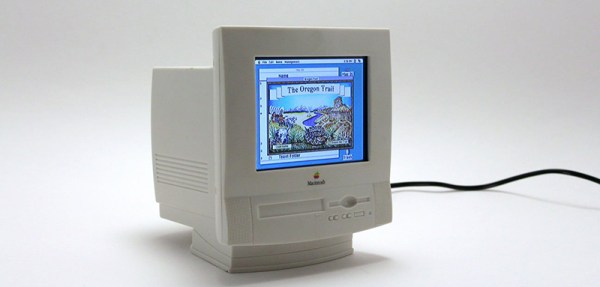
A Third Scale Mini PowerMac

We’re surrounded by tiny ARM boards running Linux, and one of the most popular things to do with these tiny yet powerful computers is case modding. We’ve seen Raspberry Pis in Game Boys, old Ataris, and even in books. [Aaron] decided it was time to fit a tiny computer inside an officially licensed bit of miniature Apple hardware and came up with the Mini PowerMac. It’s a 1/3rd scale model of an all-in-one Mac from 1996, and [Aaron] made its new hardware fit like a glove.

Instead of an old Mac modified with an LCD, or even a tiny 3D printed model like Adafruit’s Mini Mac Pi, [Aaron] is using an accessory for American Girl dolls released in 1996. This third-scale model of an all-in-one PowerPC Mac is surprisingly advanced for something that would go in a doll house. When used by American Girl dolls, it has a 3.25″ monochrome LCD that simulates the MacOS responding to mouse clicks and keypresses. If you want to see the stock tiny Mac in action, here’s a video.

The American Girl Mini Macintosh is hollow, and there’s a lot of space in this lump of plastic. [Aaron] tried to fit a Raspberry Pi in the case. A Pi wouldn’t fit. An ODROID-W did, and with a little bit of soldering, [Aaron] had a computer far more powerful than an actual PowerMac 5200. Added to this is a 3.5″ automotive rearview display, carefully mounted to the 1/3rd size screen bezel of the mini Mac.

The rest of the build is exactly what you would expect – a DC/DC step down converter, a USB hub, and a pair of dongles for WiFi and a wireless keyboard. The software for the ODROID-W is fully compatible with the Raspberry Pi, and a quick install of the Basilisk II Macintosh emulator and an installation of Mac OS 7.5.3 completed the build.

Arduino’s Long-Awaited Improved WiFi Shield

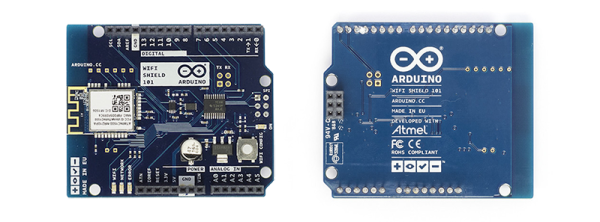
Announced at the 2014 Maker Faire in New York, the latest Arduino WiFi shield is finally available. This shield replaces the old Arduino WiFi shield, while providing a few neat features that will come in very handy for the yet-to-be-developed Internet of Things.

While the WiFi Shield 101 was announced a year ago, the feature set was interesting. The new WiFi shield supports 802.11n, and thanks to a few of Atmel’s crypto chip offerings, this shield is the first official Arduino offering to support SSL.

The new Arduino WiFi Shield 101 features an Atmel ATWINC1500 module for 802.11 b/g/n WiFi connectivity. This module, like a dozen or so other WiFi modules, handles the heavy lifting of the WiFi protocol, including TCP and UDP protocols, leaving the rest of the Arduino free to do the actual work. While the addition of 802.11n  will be increasingly appreciated as these networks become more commonplace, the speed offered by ~n isn’t really applicable; you’re not going to be pushing bits out of an Arduino at 300 Mbps.

Also included on the WiFi shield is an ATECC508A CryptoAuthentication chip. This is perhaps the most interesting improvement over the old Arduino WiFi shield, and allows for greater security for the upcoming Internet of Things. WiFi modules already in the space have their own support for SSL, including TI’s CC3200 series of modules, Particle‘s Internet of Things modules, and some support for the ESP8266.

Open Source ESC Developed For Longboard Commute

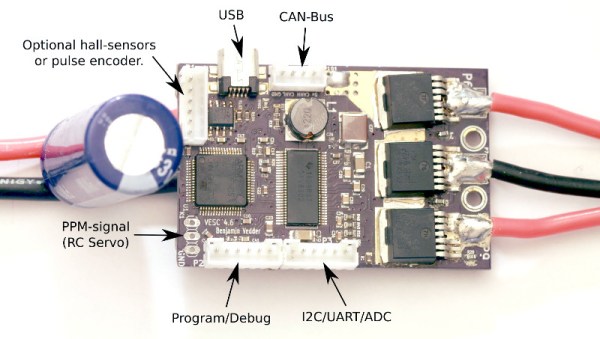
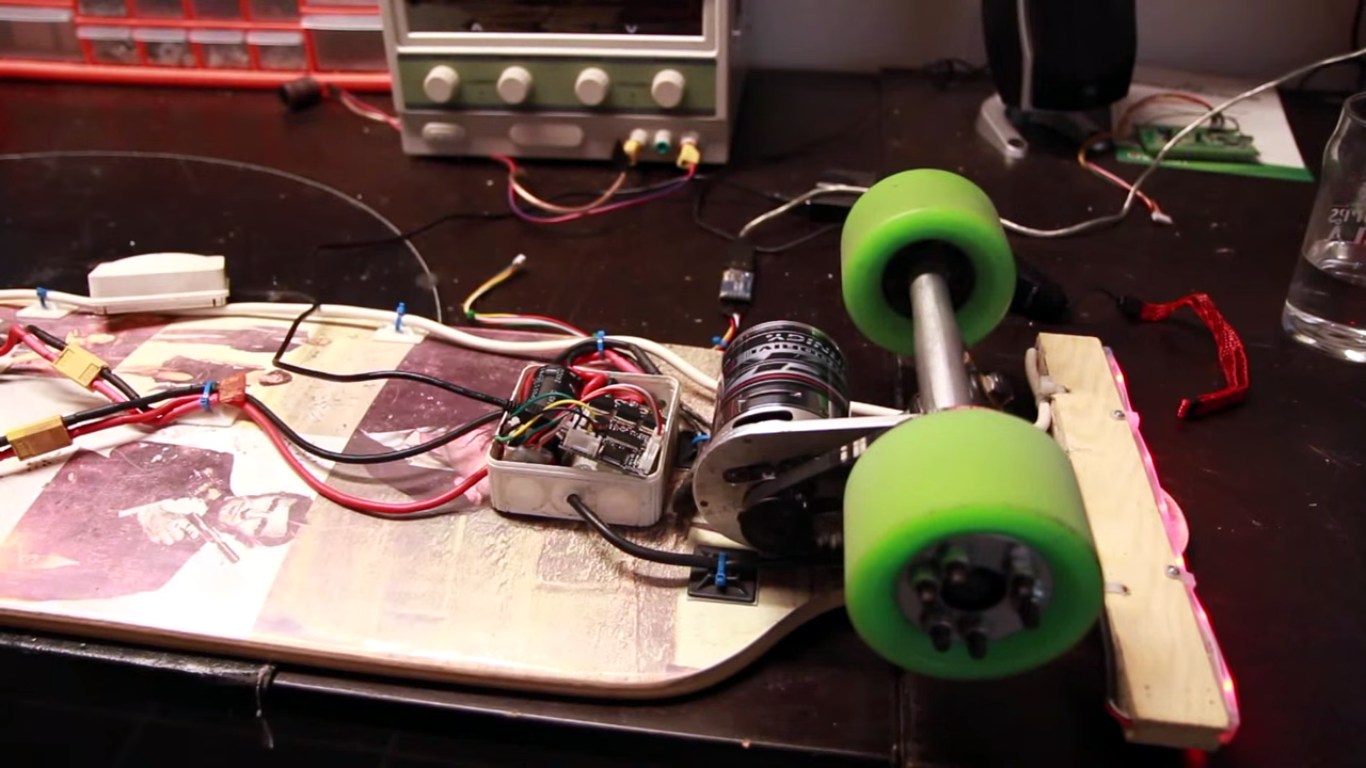
For electric and remote control vehicles – from quadcopters to electric longboards – the brains of the outfit is the Electronic Speed Controller (ESC). The ESC is just a device that drives a brushless motor in response to a servo signal, but in that simplicity is a lot of technology. For the last few months, [Ben] has been working on a completely open source ESC, and now he’s riding around on an electric longboard that’s powered by drivers created with his own hands.

esc-for-longboardThe ESC [Ben] made is built around the STM32F4, a powerful ARM microcontroller that’s able to do a lot of computation in a small package. The firmware is based on ChibiOS, and there’s a USB port for connection to a sensible desktop-bound UI for adjusting parameters.

While most hobby ESCs are essentially black boxes shipped from China, there is a significant number of high performance RC pilots that modify the firmware on these devices. While these new firmwares do increase the performance and response of off-the-shelf ESCs, building a new ESC from scratch opens up a lot of doors. [Ben]’s ESC can be controlled through I2C, a UART, or even a CAN bus, greatly opening up the potential for interesting electronic flying machines. Even for ground-based vehicles, this ESC supports regenerative braking, sensor-driven operation, and on-board odometry.

While this isn’t an ESC for tiny racing quadcopters (it’s complete overkill for that task) this is a very nice ESC for bigger ground-based electric vehicles and larger aerial camera platforms. It’s something that could even be used to drive a small CNC mill, and certainly one of the most interesting pieces of open source hardware we’ve seen in a long time.

Continue reading “Open Source ESC Developed For Longboard Commute”

Ask Hackaday: I Love The Smell Of Burnt Hair In The Morning

At the end of the 19th century, [King Camp Gillette] had the idea of creating a disposable razor blade that didn’t need sharpening. There was one problem with this idea: metallurgy was not yet advanced enough to produce paper-thin carbon steel blades and sharpen them for a close shave. In 1901, [William Nickerson] solved this problem, and the age of disposable razors began.

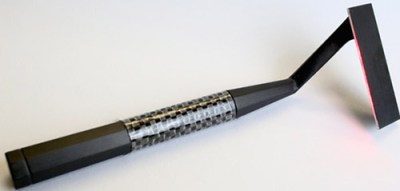
The Skarp laser razor. Source
The Skarp laser razor

This Kickstarter would have you believe there is a new era of beard technology dawning. It’s a laser razor called Skarp, and it’s on track to become one of the most funded Kickstarters of all time. The only problem? Even with relatively good documentation on the Kickstarter campaign, a demo video, a patent, and an expert in the field of cosmetic lasers, only the creators can figure out how it works.

Instead of using technology that has been tried and tested for thousands of years, the Skarp uses a laser to shave hairs off, right at the surface of the skin. You need only look at a billboard for laser hair removal to realize this is possible, but building a laser razor is something that has eluded us for decades. This patent from 1986 at the very least demonstrates the beginnings of the idea – put a laser beam in a handheld package and plunge it into a beard. This patent from 2005 uses fiber optics to send a laser beam to a handheld razor. Like anything out of the sci-fi genre, a laser razor is a well-tread idea in the world of invention.

But Skarp thinks it has solved all of the problems which previously block lasers from finding a place in your medicine cabinet.

Continue reading “Ask Hackaday: I Love The Smell Of Burnt Hair In The Morning”

Because Burning Man Needed More LEDs

There are a lot of blinky glowy things at Burning Man every year, and [Mark] decided he would literally throw his hat into the ring. He built a high visibility top hat studded with more RGB LEDs than common sense would dictate. It’s a flashy hat, and a very good example of the fashion statement a few hundred LEDs can make.

[Mark]’s top hat has 481 WS2812b addressable LEDs studded around the perimeter, a common LED choice for bright and blinky wearables. These LEDs are driven by a Teensy 3.1, with a Bluetooth transceiver, a GPS module, a compass, and gyro/accelerometer attached to the microcontroller. That’s a lot of hardware, but it gives [Mark] the capability of having the hat react to its own orientation, point itself North, and allow for control via a modified Nintendo NES controller.

The WS2812 LEDs draw a lot of power, and for any wearable project having portable power is a chief concern. [Mark]’s original plan was to use an 8x battery holder for the electronics enclosure, and use five AA batteries to power the hat. The total idle draw of the LEDs was 4.5 Watts, and with even a few LEDs blinking colors there was a significant voltage drop. The idea of powering the hat with AA batteries was discarded and the power source was changed to a 195 Watt-hour lithium ion battery bank that was topped off each day with a solar panel.

The hat is awesome, exceedingly bright, and something that gets a lot of attention everywhere  it goes. For indoor use, it might be too bright, but this could be fixed with the addition of a bit of black stretchy fabric, like what our own [Mike Szczys] did for his DEF CON hat. [Mark]’s hat is just version 1, and he plans on making a second LED hat for next year.

New Part Day: Tiny, Tiny Bluetooth Chips

The future of tiny electronics is wearables, it seems, with companies coming out with tiny devices that are able to check your pulse, blood pressure, and temperature while relaying this data back to your phone over a Bluetooth connection. Intel has the Curie module, a small System on Chip (SoC) meant for wearables, and the STM32 inside the Fitbit is one of the smallest ARM microcontrollers you’ll ever find. Now there’s a new part available that’s smaller than anything else and has an integrated Bluetooth radio; just what you need when you need an Internet of Motes of Dust.

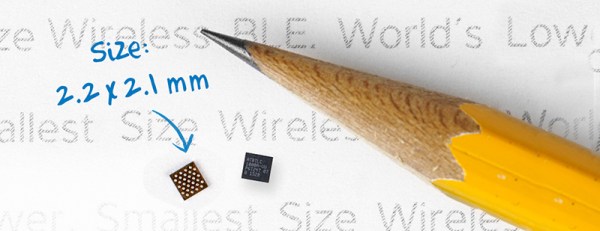
The Atmel BTLC1000 is a tiny SoC designed for wearables. The internals aren’t exceptional in and of themselves – it’s an ARM Cortex M0 running at 26 MHz. There’s a Bluetooth 4.1 radio inside this chip, and enough I/O, RAM, and ROM to connect to a few sensors and do a few interesting things. What makes this chip so exceptional is its size – a mere 2.262mm by 2.142mm. It’s a chip that can fit along the thickness of some PCBs.

To provide some perspective: the smallest ATtiny, the ‘tiny4/5/9/10 in an SOT23-6 package, is 2.90mm long. The smallest PICs are similarly sized, and both have a tiny amount of RAM and Flash space. The BTLC1000 is surprisingly capable, with 128kB each of RAM and ROM.

The future of wearable devices is smaller, faster and more capable devices, and with a tiny chip that can fit on the head of a pin, this is certainly an interesting chip for applications where performance can be traded for package size. If you’re ready to dive in with this chip the preliminary datasheets are now available.