Illustrated Kristina with an IBM Model M keyboard floating between her hands.

Keebin’ With Kristina: The One With The Duplex Typewriter

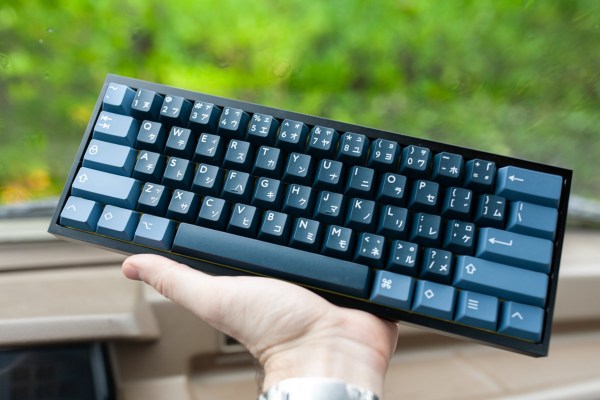
The Coleco Adam? A not-so-great home computer that likely contributed to the downfall of the company. The keyboard, however, is a different story, and worth repurposing.

[Nick Bild] has created a USB adapter that uses a Teensy 4.1 and an RJ-12 breakout board. Now this wasn’t just a simple matrix to decode. No, the fine folks at Coleco rolled their own communications protocol called AdamNet.

The keyboard uses an RJ-12 connector and a single data line to communicate over a 62.5 kbit/s, half-duplex serial bus. Inside the keyboard is a Motorola 6801 that caches the key presses and sends them to the computer. So the BOM is limited to what you see above — an RJ-12 breakout and a Teensy 4.1. It’s great to see old keyboards come alive again, especially one with such cool sci-fi keycaps. Want to hear it clack? Of course you do.

Continue reading “Keebin’ With Kristina: The One With The Duplex Typewriter”

Hackaday Podcast 244: Fake Chips, Drinking Radium, And Spotting Slippery Neutrinos

This week, Editor-in-Chief Elliot Williams and Kristina Panos met up to discuss the best hacks of the previous week, at least in our opinions.

After chasing the angry bird away from Kristina’s office, we go to the news and learn that we’re in the middle of a solar conjunction Essentially, the Sun has come between Earth and Mars, making communication impossible for about another week. Did you know that this happens every two years?

Then it’s time for a new What’s That Sound, and although Kristina had an interesting albeit somewhat prompted guess, she was, of course, wrong.

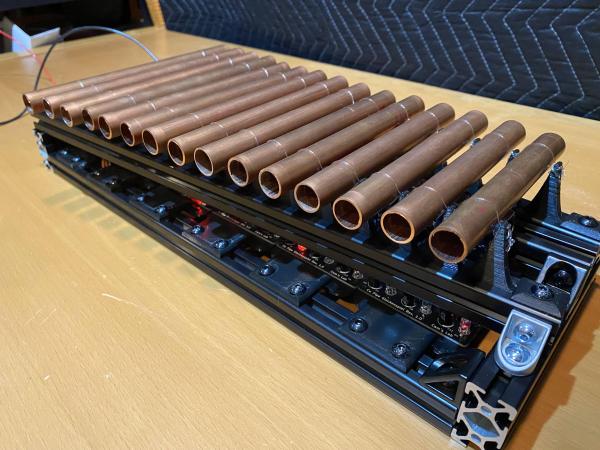
And then it’s on to the hacks, beginning with a really cool digital pen that packs all the sensors. We learned about the world’s largest musical instrument, and compared it to the Zadar Sea Organ in Croatia, which if you’ll recall was once a What’s That Sound.

From there we take a look at fake buck converters, radioactive water as a health fad, and a garage door company that has decided to take their ball and go home. Finally we talk about how slippery neutrinos are, and discuss Tom’s time at JawnCon.

Check out the links below if you want to follow along, and as always, tell us what you think about this episode in the comments!

Download and savor at your leisure.

Continue reading “Hackaday Podcast 244: Fake Chips, Drinking Radium, And Spotting Slippery Neutrinos”

ColorReplica Is A Rainbow At Your Fingertips

Have you ever wanted to match paint to the color of a pillow, or make a website where the primary color matches your favorite shade of electrolytic capacitor? Then ColorReplica is the project for you.

At the heart of this build are two ESP32s, one of which controls the color picker, and the other lights up the 18 WS2812 LEDs and displays information on the OLED screen.

ColorReplica has two modes, ColorPicker and ColorCube. In ColorPicker mode, you just choose what color you want, adjust the brightness level, and choose between static and dynamic modes for the LEDs. [CiferTech] used the ESP32 touch pins extended to pads on the PCB to control different menu variables, which is a nice touch.

In ColorCube mode, there’s a secondary circuit with a color sensor an another ESP32. Once detected, it transmits the color data to the main device at the push of a button. The RGB LEDs turn that color, and shows the RGB, HEX, and HSV values on the OLED screen. If you’d like to make one of these yourself, everything is available on GitHub.

Want something a big more tangible? Check out this color picker that types HEX codes for you.

Continue reading “ColorReplica Is A Rainbow At Your Fingertips”

Backyard UFO Is Out Of This World

Halloween may be over for another year, but UFOs in your yard are cool year-round. This one might take the cake. [frydom.john]’s excellent UFO is fully programmable and contains about 2000 addressable RGB LEDs, smoke, a laser-lit ramp, and of course, an alien crew.

Under the hood of the wooden frame, you’ll find a Teensy 4.1 running the blinkenlights. There’s also a hacked smoke machine, because what’s a UFO without smoke or fog emanating from underneath? There are six PC fans to blow it around and recycle it, and the ramp runs on a linear actuator.

[frydom.john]’s project notes (PDF), which they refer to as ‘scrappy/hacky’ are also available. We beg to differ a bit on the scrappy/hacky part; it’s 60 pages long and full of photos and diagrams and charts. Even so, it may not be enough for you to replicate this extraterrestrial vehicle, so [frydom.john] is open to questions. Be sure to check this thing out after the break.

Want to have your UFO lift off of the ground? It’s possible with the Coandă effect.

Continue reading “Backyard UFO Is Out Of This World”

Num Pad Reborn As Stream Deck

Stream decks are cool and all, but they are essentially expensive, albeit sorta cool-looking macro pads. So why not try to make your own? You don’t necessarily have to start from scratch.

It all started when [dj_doughy] found an extremely clicky num pad in a recycle pile. It was so clicky, in fact, that even though [dj_doughy] didn’t need an external num pad, they wanted to keep it around as a fidget toy. From the video after the break, they look to be white ALPS switches. The only problem? It had a PS/2 connector.

Well, okay, there was another problem. The chip inside seemingly has no datasheet available. [dj_doughy] took to Discord for help, and was advised to just have the thing use extended keys, like F13-F24, and assign those as hotkeys in OBS.

In order to make it USB, [dj_doughy] need a microcontroller capable of acting as a Human Interface Device (HID). While [dj_doughy] tested using an Arduino Leonardo, they ended up using an Arduino Beetle due to its diminutive size. [dj_doughy] had a bit of trouble with the code sending two key presses, but found out they were just missing some variables. Now it works like a charm.

Would you like a macro pad that lets you physically reassign macros? Then check out this tile-based macro pad.

Arduino Sticker Dispenser Saves Time

What’s the worst part about packaging up a whole lot of the same basic thing? It might just be applying the various warning stickers to the outside of the shipping box. Luckily, [Mr Innovative] has built an open-source automatic sticker dispenser that does the peeling for you, while advancing the roll one at a time quite satisfyingly.

This tidy build is made primarily of 20×20 extruded aluminium and stainless steel smooth rod. All the yellow bits are 3D printed. The brains of this operation is an Arduino Nano, with an A4988 stepper motor driver controlling a NEMA17.

Our favorite part of this build is the IR sensor pair arranged below the ready sticker. It detects when a sticker is removed, then the stepper advances the roll by one sticker height. The waste is collected on a spool underneath.

Between the video and the instructions, [Mr Innovative] has made it quite simple to build one for yourself. Definitely check this one out after the break.

[Mr Innovative] may as well go by [Mr. Automation]. Check out this automated wire prep machine from a few years ago.

Continue reading “Arduino Sticker Dispenser Saves Time”

We Like Big Keyboards And We Cannot Lie

So, let’s say you’re good at DOTA. Like, world-class good. How good do you think you’d be on a keyboard that’s 16 feet long, with a space bar the size of a person? Well, you’d need the rest of your team, that’s for sure.

Alienware have created the world’s largest mechanical keyboard and mouse, which are working, 14:1 scale representations of their AW420K keyboard and AW720M mouse. And they got Team Liquid to try it out.

While this may be a marketing ploy, it took quite a lot of work and weeks of 3D printing to faithfully reproduce those peripherals on that scale.

What’s really impressive are the custom key switches, which are described early on in the video after the break. They are nearly a foot wide with the keycap on, and they have an incredible four inches of travel.

Each of the 87 key switches is made with two snugly-fitting pieces of PVC, a thick rubber band, and of course, an actual, regular-size key switch to register the presses. Not satisfied with that, the team added a small piece of measuring tape to produce a nice clicky, tactile feedback. And, oh yeah, that space bar? The stabilizer is made from a 1″ copper pipe. Be sure to check it out in action after the break.

This just so happens to be the same size as the last keyboard we saw claiming to be the world’s largest, which was rejected from the Guinness Book because it’s not an exact replica of an existing keyboard. So, somebody call Guinness, we suppose.

Continue reading “We Like Big Keyboards And We Cannot Lie”