MIT’s Knitted Keyboard Is Quite A Flexible MIDI Controller

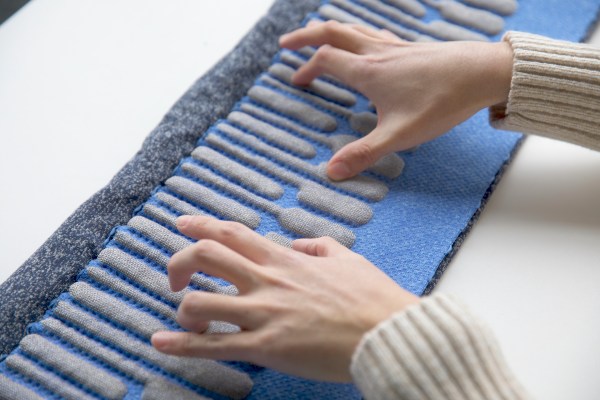
There are only so many ways to make noise on standard instruments such as acoustic pianos. Their rigidity and inputs just don’t allow for a super-wide range of expression. On the other hand, if you knit your interface together, the possibilities are nearly endless. MIT’s new and improved knitted keyboard is an instrument like none other — it responds to touch, pressure, and continuous proximity, meaning that you can play it like a keyboard, a theremin, and something that is somewhere in between the two. Because it’s a MIDI interface, it can ultimately sound like any instrument you’ve got available in software.
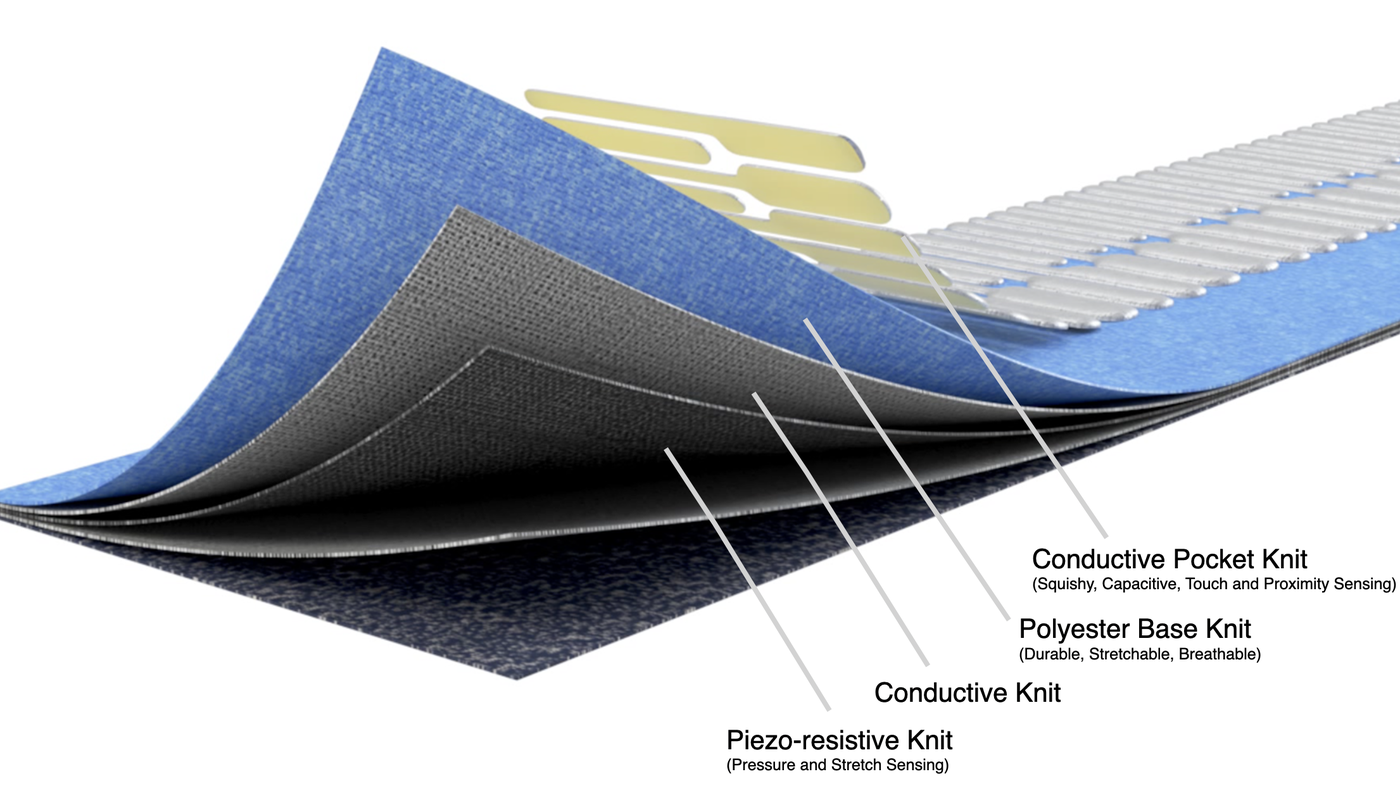
The silver keys of this five-octave interface are made of conductive yarn, and the blue background is regular polyester yarn. Underneath that is a conductive knit layer to complete the key circuits, and a piezo-resistive knit layer that responds to pressure and stretch. It runs on a Teensy 4.0 and uses five MPR121 proximity/touch controllers, one per octave.

The really exciting thing about this keyboard is its musical (and physical) versatility. As you might expect, the keyboard takes discrete inputs from keystrokes, but it also takes continuous input from hovering and waving via the proximity sensors, and goes even further by taking physical input from squeezing, pulling, stretching, and twisting the conductive yarns that make up the keys. This means it takes aftertouch (pressure applied after initial contact) into account —  something that isn’t possible with most regular instruments. And since this keyboard is mostly yarn and fabric, you can roll it up and take it anywhere, or wrap it around your neck for a varied soundscape.

If you’re looking for more detail, check out the paper for the previous version (PDF), which also used thermochromic yarn to show different colors for various modes of play using a heating element. With the new version, [Irmandy Wicaksono] and team sought to improve the sensing modalities, knitted aesthetics, and the overall tactility of the keyboard. We love both versions! Be sure to check it out after the break.

Want to play around with capacitive touch sensors without leaving the house for parts? Make your own from paper and aluminum foil.

Continue reading “MIT’s Knitted Keyboard Is Quite A Flexible MIDI Controller”

Kathleen Lonsdale Saw Through The Structure Of Benzene

The unspoken promise of new technologies is that they will advance and enhance our picture of the world — that goes double for the ones that are specifically designed to let us look closer at the physical world than we’ve ever been able to before. One such advancement was the invention of X-ray crystallography that let scientists peer into the spatial arrangements of atoms within a molecule. Kathleen Lonsdale got in on the ground floor of X-ray crystallography soon after its discovery in the early 20th century, and used it to prove conclusively that the benzene molecule is a flat hexagon of six carbon atoms, ending a decades-long scientific dispute once and for all.

Benzene is an organic chemical compound in the form of a colorless, flammable liquid. It has many uses as an additive in gasoline, and it is used to make plastics and synthetic rubber. It’s also a good solvent. Although the formula for benzene had been known for a long time, the dimensions and atomic structure remained a mystery for more than sixty years.

Kathleen Lonsdale was a crystallography pioneer and developed several techniques to study crystal structures using X-rays. She was brilliant, but she was also humble, hard-working, and adaptable, particularly as she managed three young children and a budding chemistry career. At the outbreak of World War II, she spent a month in jail for reasons related to her staunch pacifism, and later worked toward prison reform, visiting women’s prisons habitually.

After the war, Kathleen traveled the world to support movements that promote peace and was often asked to speak on science, religion, and the role of women in science. She received many honors in her lifetime, and became a Dame of the British Empire in 1956. Before all of that, she honored organic chemistry with her contributions.

Continue reading “Kathleen Lonsdale Saw Through The Structure Of Benzene”

You Can’t Put The Toothpaste Back In The Tube, But It Used To Be Easier

After five years of research, Colgate-Palmolive recently revealed Australia’s first recyclable toothpaste tube. Why is this exciting? They are eager to share the design with the rest of the toothpaste manufacturers and other tube-related industries in an effort to reduce the volume of plastic that ends up in landfills. It may not be as life-saving as seat belts or the Polio vaccine, but the move does bring Volvo and OG mega open-sourcer Jonas Salk to mind.

Today, toothpaste tubes are mostly plastic, but they contain a layer of aluminum that helps it stay flattened and/or rolled up. So far, multi-layer packaging like this isn’t accepted for recycling at most places, at least as far as Australia and the US are concerned. In the US, Tom’s of Maine was making their tubes entirely out of aluminum for better access to recycling, but they have since stopped due to customer backlash.

Although Colgate’s new tubes are still multi-layered, they are 100% HDPE, which makes them recyclable. The new tubes are made up of different thicknesses and grades of HDPE so they can be easily squeezed and rolled up.

Toothpaste Before Tubes

Has toothpaste always come in tubes? No it has not. It also didn’t start life as a paste. Toothpaste has been around since 5000 BC when the Egyptians made tooth powders from the ashes of ox hooves and mixed them with myrrh and a few abrasives like powdered eggshells and pumice. We’re not sure what they kept it in — maybe handmade pottery with a lid, or a satchel made from an animal’s pelt or stomach.

The ancient Chinese used ginseng, salt, and added herbal mints for flavoring. The Greeks and Romans tried crushed bones, oyster shells, tree bark, and charcoal, which happens to be back in vogue. There is evidence from the late 1700s showing that people once brushed with burnt breadcrumbs.

Continue reading “You Can’t Put The Toothpaste Back In The Tube, But It Used To Be Easier”

Flexible Prototyping For E-Textiles That Doesn’t Cost An Arm And A Leg

Let’s face it: pretty much everything about e-textiles is fiddly. If wearables were easy, more people would probably work in that space. But whereas most circuit prototyping is done in two dimensions, the prototyping of wearables requires thinking and planning in 3D. On top of that, you have to figure out how much conductive thread you need, and that stuff’s not cheap.

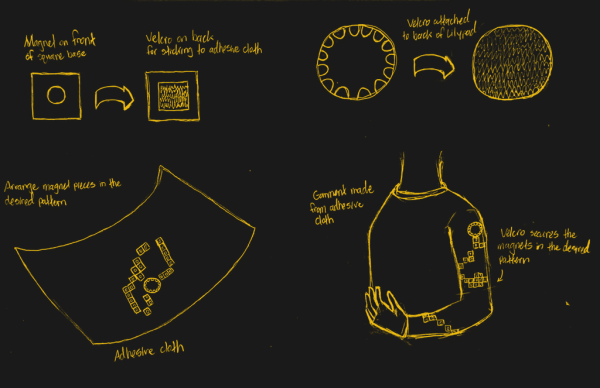
[alch_emist] has a method for arranging circuits in 3D space that addresses the harsh realities of trying to prototype wearables. There’s that whole gravity thing to deal with, and then of course there are no straight lines anywhere on the human body. So here’s how it works: [alch_emist] made a bunch of reusable tie points designed to work with an adhesive substrate such as felt. They laser-cut a set of acrylic squares and drilled a hole in each one to accommodate a neodymium magnet. On the back of each square is a small piece of the hook side of hook-and-loop tape, which makes the tie points stay put on the felt, but rearrange easily.

We love the idea of prototyping with felt because it’s such a cheap and versatile fabric, and because you can easily wrap it around your arm or leg and see how the circuit will move when you do.

Not quite to this planning stage of your next wearable project? Magnets and conductive thread play just as well together in 2D.

Illustrated Kristina with an IBM Model M keyboard floating between her hands.

Keebin’ With Kristina: The One With The Chinese Typewriter

As much as I’d like to devote an article to each and every bit of keyboard-related what-have-you that I come across in my travels through the intertubes, there just aren’t enough hours. And after all, this isn’t Clack-a-Day. To that end, I gained editorial approval to bring you a periodic round-up of news and other tidbits on the keyboard and keyboard accessories front, and here we are. So let’s get to it!

Continue reading “Keebin’ With Kristina: The One With The Chinese Typewriter”

Compact M&M Sorter Goes Anywhere

Let’s face it — eating different colored candy like M&Ms or Skittles is just a little more fun if you sort your pile by color first. The not-fun part is having to do it by hand. [Jackofalltrades_] decided to tackle this time-worn problem for engineering class because it’s awesome and it satisfies the project’s requirement for sensing, actuation, and autonomous sequencing. We’d venture to guess that it satisfies [Jackofalltrades_]’ need for chocolate, too.

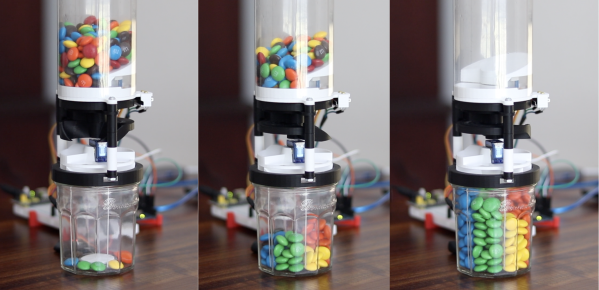
Here’s how it works: one by one, M&Ms are selected, pulled into a dark chamber for color inspection, and then dispensed into the proper cubby based on the result. [Jackofalltrades_] lived up to their handle and built a color-detecting setup out of an RGB LED and light-dependent resistor. The RGB LED shines red, then, green, then blue at full brightness, and takes a voltage reading from the photocell to figure out the candy’s color. At the beginning, the machine needs one of each color to read in and store as references. Then it can sort the whole bag, comparing each M&M to the reference values and updating them with each new M&M to create a sort of rolling average.

We love the beautiful and compact design of this machine, which was built to maximize the 3D printer as one of the few available tools. The mechanical design is particularly elegant. It cleverly uses stepper-driven rotation and only needs one part to do most of the entire process of isolating each one, passing it into the darkness chamber for color inspection, and then dispensing it into the right section of the jar below. Be sure to check out the demo after the break.

Need a next-level sorter? Here’s one that locates and separates the holy grail of candy-coated chocolate — peanut M&Ms that didn’t get a peanut.

Continue reading “Compact M&M Sorter Goes Anywhere”

Wood And Brass Drink Temperature Monitor Looks Good, Has Class

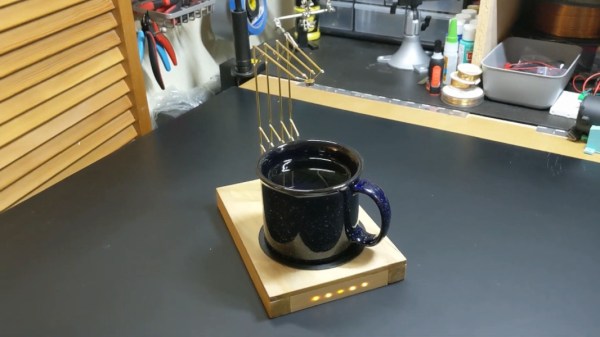
We’ve all been there. Your current project has hit a wall, or the next step will take days to complete, and you need something to do in the meantime. So you start a project that you envision will fit nicely in the gap, and then, inevitably, it doesn’t. Maybe it even takes so long that the original project gets finished first. So what? There’s nothing wrong with that, especially when the filler project turns out as well as this drink temperature monitor disguised as a circuit sculpture (video, embedded below). Just put your mug on the coaster, and the weight of it activates a hidden switch, which causes the sculpture to display its secret LEDs.

[MakeFunStuff] wanted to make something that looked less like a circuit and more like art, while building a tool that could determine the relative hotness of a beverage. Such a a useful circuit sculpture sounds like a tall order to us, but [MakeFunStuff] pulled it off with finesse and style.

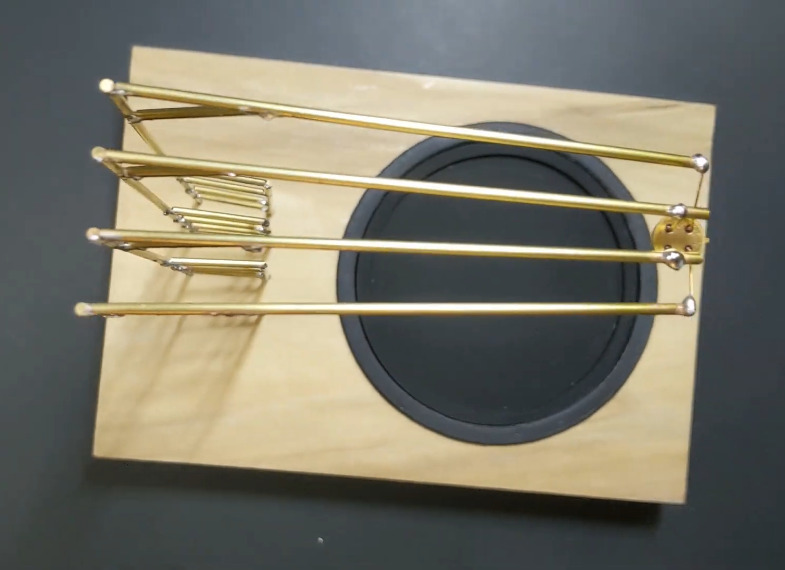
The circuit is based around this Sputnik-looking standalone IR temperature sensor which, as [MakeFunStuff] aptly describes, is “a single-pixel infrared camera that picks up everything in a 90° cone starting at the sensor.”

[MakeFunStuff] paired this easy-to-use sensor with an Arduino Nano and five LEDs that show how hot a beverage is on a scale from 1 to 5. The sensor is hidden in plain sight, suspended from the top of the brass rod sculpture and blending in perfectly. We love that the LEDs are hidden behind a thin layer of carefully-drilled wood and agree that a drill press would have been much easier.

The code is set up for just about every temperature scale from Celsius to Rømer, so that solves that argument. [MakeFunStuff] went with the Kelvin scale because science. Our favorite thing about this video is that [MakeFunStuff] shared their failures and fixes as they built their way toward answering the questions of how to suspend the sensor over the drink, and how best to display the heat level while hiding the electronics. Go grab a hot cup of something and check it out after the break while you let it cool off the normie way.

We admit that we would likely zone out while waiting for the LEDs to disappear. Here’s a smart coaster that uses an ESP8266 to send a message to Discord when your beverage has reached the perfect drinking temperature.

Continue reading “Wood And Brass Drink Temperature Monitor Looks Good, Has Class”