Cyberdeck

This End Times Cyberdeck Is Apocalypse-Ready

In the cyberdeck world, some designs are meant to evoke a cyberpunk vibe, an aesthetic that’s more lighthearted than serious. Some cyberdecks, though, are a little more serious about hardening their designs against adverse conditions. That’s where something like the ARK-io SurvivalDeck comes into play.

Granted, there does seem to be at least a little lightheartedness at play with the aptly named [techno-recluse]’s design. It’s intended to be an “Apocalypse Repository of Knowledge”, which may be stretching the point a bit. But it does contain an impressive amount of tech —  wide-band software defined radio (SDR) covering HF to UHF, GPS module, a sensor for air pressure, temperature, and humidity, and a Raspberry Pi 3B running Kali Linux. Everything is housed in a waterproof ammo can; a 3D printed bezel holds an LCD touchscreen and a satisfying array of controls, displays and ports. The lid of the ammo can holds a keyboard, which was either custom-made to precisely fit the lid or was an incredibly lucky find.

There’s a lot to like about this build, but our favorite part is the external dipole for receiving NOAA weather satellite imagery. The ability to monitor everything from the ham bands to local public service channels is a nice touch too. And we have no complaints about the aesthetics or build quality either. This reminds us of an earlier cyberdeck with a similar vibe, but with a more civilian flavor.

Thanks to [Kate] for the tip.

[via Tom’s Hardware]
Wire EDM

Bringing The Power Of EDM To The Home Shop

When you see something made from metal that seems like it would be impossible to manufacture, chances are good it was made with some variety of electrical discharge machining. EDM is the method of choice for hard-to-machine metals, high aspect ratio hole drilling, and precise surface finishes that let mating parts slip together with almost zero clearance. The trouble is, EDM is a bit fussy, and as a result hasn’t made many inroads to the home shop.

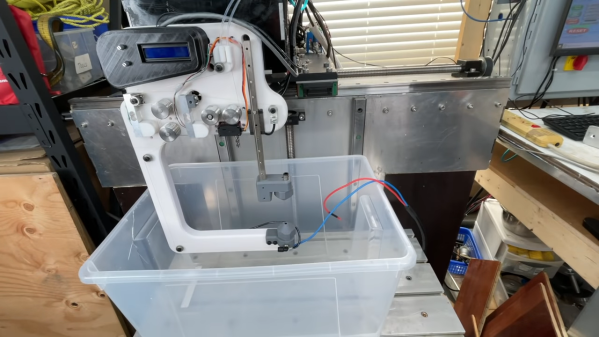
[Action BOX] aims to change that with a DIY wire EDM machine. In wire EDM, a fine brass wire is used as an electrode to slowly erode metal in a dielectric bath. The wire is consumable, and has to constantly move from a supply spool through the workpiece and onto a takeup spool. Most of the build shown in the video below is concerned with the wire-handling mechanism, which is prototyped from 3D-printed parts and a heck of a lot of rollers and bearings. Maintaining the proper tension on the wire is critical, so a servo-controlled brake is fitted to the drivetrain, which itself is powered by a closed-loop stepper. Tension is measured by a pair of strain gauges and Arduinos, which control the position of the shaft brake servo and the speed of the motor on the takeup spool.

Unfortunately, in testing this setup proved to live up to EDM’s fussy reputation. The brass wire kept breaking as soon as cutting started, and [Action BOX] never made any actual cuts. There’s certainly promise, though, and we’re looking forward to developments. For more on EDM theory, check out [Ben Krasnow]’s look at EDM hole-drilling.

Continue reading “Bringing The Power Of EDM To The Home Shop”

High temperature 3D printer

Extreme Thermal Mods For 3D Printing Exotic Materials

For general everyday use, there’s nothing wrong with the standard selection of plastics that most 3D printer filaments are available in. PLA, ABS, PETG — they’ve all got their place, and they’re all pretty easy to work with. But if you need to work with more exotic materials, you might need to go to extremes and modify an off-the-shelf printer for high-temperature work.

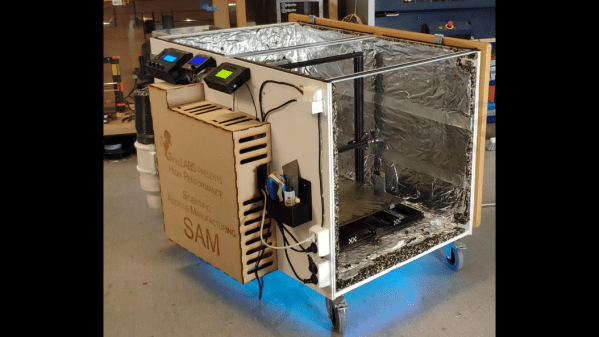
For the team led by [Andreas Hagerup Birkelid] at the Norwegian University of Science and Technology, the standard menu of printer chow wasn’t up to the jobs they had in mind. They wanted to print using polyether ether ketone, or PEEK, a high-performance thermoplastic with useful mechanical and thermal properties, in addition to chemical resistance. Trouble is, the melting point of PEEK is a whopping 343°C (649°F), making it necessary to turn up the heat — a lot. A standard Creality CR-10 printer was upgraded to withstand not only the 500°C max temperature of the new hot end and 200° printed bed, but also to survive operating in what amounts to an oven — a balmy 135° in a chamber made from IKEA cabinets. That entailed replacing plastic parts with metal ones, upgrading belts, pulleys, and wires, and moving all the electronics outside the enclosure. Even the steppers got special treatment, with water cooling to keep their magnets from reaching the Curie point.

The mods seemed to do the trick, because a Benchy printed in a carbon-fiber PEEK filament came out pretty good. It seems like a long way to go and kind of pricey — $1,700 for the printer and all the mods — but if you have a need to print exotic materials, it’s way cheaper than a commercial high-temp printer.

[via 3D Printing Industry]

Electronic leadscrew

Electronic Lead Screws – Not Just For Threading Anymore

An electronic leadscrew is an increasingly popular project for small and mid-sized lathes. They do away with the need to swap gears in and out to achieve the proper ratio between spindle speed and tool carriage translation, and that makes threading a snap. But well-designed electronic leadscrews, like this one from [Hobby Machinist], offer so much more than just easy threading.

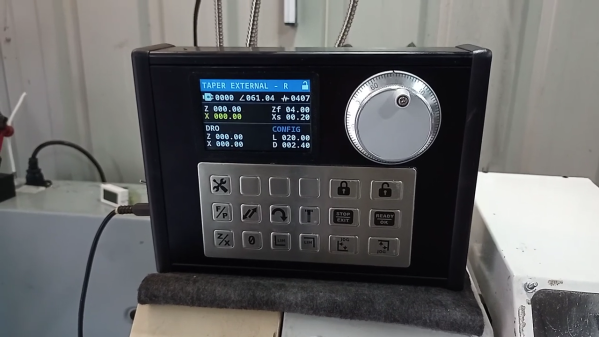
The first thing that struck us about this build was the polished, professional look of it. The enclosure for the Nucleo-64 dev board sports a nice TFT display and an IP65-rated keyboard, as well as a beefy-looking jog wheel. The spindle speed is monitored by a 600 pulses-per-revolution optical encoder, and the lathe’s leadscrew is powered by a closed-loop NEMA 24 stepper. This combination allows for the basic threading operations, but the addition of a powered cross slide opens up a ton more functionality. Internal and external tapers are a few keypresses away, as are boring and turning and radius operations, both on the right and on the left. The video below shows radius-cutting operations combined to turn a sphere.

From [Hobby Machinist]’s to-do list, it looks like filleting and grooving will be added someday, as will a G-code parser and controller to make this into a bolt-on CNC controller. Inspiration for the build is said to have come in part from [Clough42]’s electronic leadscrew project from a few years back. Continue reading “Electronic Lead Screws – Not Just For Threading Anymore”

Electromyography

Electromyography Hack Chat

Join us on Wednesday, January 19 at noon Pacific as we kick off the 2022 Hack Chat season with the Electromyography Hack Chat with hut!

It’s one of the simplest acts most people can perform, but just wiggling your finger is a vastly complex process under the hood. Once you consciously decide to move your digit, a cascade of electrochemical reactions courses from the brain down the spinal cord and along nerves to reach the muscles fibers of the forearm, where still more reactions occur to stimulate the muscle fibers and cause them to contract, setting that finger to wiggling.

join-hack-chatThe electrical activity going on inside you while you’re moving your muscles is actually strong enough to make it to the skin, and is detectable using electromyography, or EMG. But just because a signal exists doesn’t mean it’s trivial to make use of. Teasing a usable signal from one muscle group amidst the noise from everything else going on in a human body can be a chore, but not an insurmountable one, even for the home gamer.

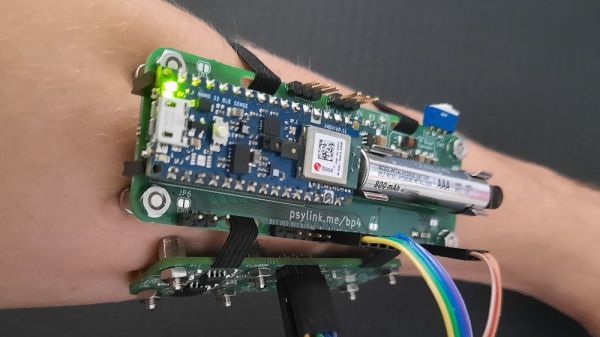
To make EMG a little easier, our host for this Hack Chat, hut, has been hard at work on PsyLink, a line of prototype EMG interfaces that can be used to detect muscle movements and use them to control whatever you want. In this Hack Chat, we’ll dive into EMG in general and PsyLink in particular, and find out how to put our muscles to work for something other than wiggling our fingers.

Our Hack Chats are live community events in the Hackaday.io Hack Chat group messaging. This week we’ll be sitting down on Wednesday, January 19 at 12:00 PM Pacific time. If time zones have you tied up, we have a handy time zone converter.

Continue reading “Electromyography Hack Chat”

Hackaday Links Column Banner

Hackaday Links: January 16, 2022

As winter well and truly grips the northern hemisphere, it’s time once again to dunk on Tesla for leaving some owners out in the cold — literally. It seems that some Model 3 and Model Y owners are finding their ride’s heat pump isn’t exactly up to the task of, you know, pumping heat. That this seems to be happening mostly in the northeastern US and southern Canada, where a polar vortex is once again dominating the weather and driving temperatures down into the -30 °C (-22 °F) range, perhaps speaks more to the laws of thermodynamics than it does to the engineering of the Tesla climate control system. After all, if there’s not much heat outside the car, it’s hard to pump it inside. But then again, these are expensive machines, some of which have had extensive repairs to address this exact same issue when it cropped up last year. It seems to us that owners have a legitimate gripe with Tesla about this, and they may be getting some help from the Feds, who are taking an interest in the situation from a safety standpoint. After all, no heat likely means fogged up windows, and that’s hardly conducive to a safe trip. But hey, that’s what self-driving is for, right?

Much has been made of the dearth of engineering cameras on the James Webb Space Telescope, and the fact that we’ve been relying on animations to illustrate the dozens of deployments needed to unfurl the observatory and make it ready for its mission. Putting aside the fact that adding extra cameras to the spacecraft makes little sense since the interesting stuff was all happening on the side where the sun doesn’t shine, we did get treated to what was billed as “humanity’s last look at Webb” thanks to an engineering camera on the Ariane 5 rocket. But not so fast — an astrophotographer named Ethan Gone managed to spot the JWST as it transited to L2 the day after launch. Granted, the blip of light isn’t as spectacular as the Ariane shots, and it took a heck of a lot of astrophotography gear to do it, but it’s still thrilling to watch Webb moving gracefully through Orion.

Continue reading “Hackaday Links: January 16, 2022”

Portable VO2 max measurment mask

Printable Portable Mask Gives You The Numbers On Your Workout

We’re currently in the midst of New Year’s Resolutions season, which means an abundance of spanking new treadmills and exercise bikes. And one thing becomes quickly obvious while using those machines: the instruments on them are, at best, only approximately useful for measuring things like your pulse rate, and in the case of estimating the calories burned by your workout, are sometimes wildly optimistic.

If precision quantification of your workout is your goal, you’ll need to monitor your “VO2 max”, a task for which this portable, printable mask is specifically designed. This is [Robert Werner]’s second stab at a design that senses both pressure differential and O2 concentration to calculate the maximum rate of oxygen usage during exercise. This one uses a commercially available respirator, of the kind used for painting or pesticide application, as the foundation for the build. The respirator’s filter elements are removed from the inlets to provide free flow of air into the mask, while a 3D printed venturi tube is fitted to its exhaust port. The tube houses the pressure and O2 sensors, as well as a LiPo battery pack and an ESP32. The microcontroller infers the volume of exhaled air from the pressure difference, measures its O2 content, and calculates the VO2 max, which is sent via Bluetooth to a smartphone running an exercise tracking app like Zwift or Strava.

[Robert] reports that his $100 instrument compares quite well to VO2 max measurements taken with a $10,000 physiology lab setup, which is pretty impressive. The nice thing about the design of this mask is how portable it is, and how you can take your exercise routine out into the world — especially handy if your fancy exercise bike gets bricked.