An HP15-C emulator PCB

Calculate Like It’s 1989 With This HP15C Emulator

Back in the day, your choice of calculator said a lot about your chops, and nothing made a stronger statement than the legendary Hewlett-Packard Voyager series of programmable calculators. From the landscape layout to the cryptic keycaps to the Reverse Polish Notation, everything about these calculators spoke to a seriousness of purpose.

Sadly, these calculators are hard to come by at any price these days. So if you covet their unique look and feel, your best bet might be to do like [alxgarza] and build your own Voyager-series emulator. This particular build emulates the HP15C and runs on an ATMega328. Purists may object to the 192×64 LCD matrix display rather than the ten-digit seven-segment display of the original, but we don’t mind the update at all. The PCB that the emulator is built on is just about the right size, and the keyboard is built up from discrete switches that are as satisfyingly clicky as the originals. We also appreciate the use of nothing but through-hole components — it seems suitably retro. The video below shows that the calculator is perfectly usable without a case; a 3D-printed case is available, though, as is an overlay that replicates the keypad of the original.

We’ve seen emulators for other classic calculators of yore, including Sinclair, Texas Instruments, and even other HP lines. But this one has a really nice design that gets us going.

Continue reading “Calculate Like It’s 1989 With This HP15C Emulator”

Hackaday Links Column Banner

Hackaday Links: August 29, 2021

If you thought that COVID-19 couldn’t possibly impact space travel, think again. The ongoing pandemic is having unexpected consequences for companies like SpaceX, who are worried about liquid oxygen shortages due to increased demand for medical oxygen. Massive amounts of liquid oxygen are used as the oxidizer for each rocket launch, of course, as well as in hospitals, which have giant tanks of liquid oxygen somewhere on site. Whether destined for space or for patient care, liquid oxygen comes from cryogenic separation plants, and SpaceX fears that they would have to delay or even cancel launches if manufacturers can’t keep up with demand and have to prioritize their healthcare customers. We’re actually not sure if this is a concern, though, since there are usually separate supply chains for medical and industrial gasses. Then again, we’d suspect a rocket engine might prefer to breathe ultra-pure LOX too.

Speaking of space, if you want to be an astronaut, perhaps the first skill you need to develop is patience. Not only might your ride not be ready to go when you are, but at least in the EU, you’ve got a long line of applicants in front of you. The European Space Agency announced this week that they’re working through a backlog of 23,000 applications for astronaut positions. About 20% of those will apparently be dropped in the pre-screening process, but the rest will (eventually) get an invitation to a full-day test at one of the ESA’s facilities. We imagine the attrition rate from there increases dramatically; either that or the ESA intends to hire a lot of astronauts.

Back here on Earth, Google this week did what it seems to do a lot of, and killed off one of its popular apps. This time the victim is the Android Auto phone app, although we have to admit the whole thing is confusing. The app allows you to connect your phone to the infotainment system in a compatible late-model car, letting you access all your apps without having to fiddle with your phone while driving. But Google also had an app that offered the same experience directly on the phone, for cars without a compatible display. As far as we can tell, the on-phone app is the only thing that’s going away in Android 12; the app for in-car displays will continue to be supported. Former users of the phone-only app are being encouraged to migrate to Google Assistant’s Driving Mode. Or, you know, you could just drive the car instead.

So your brand-new video card is running hot, and you can’t figure out why. At your wit’s end, you crack open the card’s cover and find the reason — a somewhat suspicious-looking foreign object. That’s what happened to Antony ter Horst and his Nvidia RTX 3090, which had a finger cot wedged inside it. It would appear to have slipped off the finger of some assembly worker, and it was clearly interfering with heat flow inside the card. Antony posted the pictures on reddit, which of course found much humor in the finger cot’s resemblance to another latex object. For our part, it put us in mind of some other stories of foreign objects found in common products — there’s a reason why we always check a loaf of bread before using it.

And finally, in a lot of ways YouTube has become the new “vast wasteland” of useless content. But like television before it, there are occasional gems to be found, especially to those of us who love to learn a little something as we watch. And so when we stumbled upon a video with the title “Hot Tap and Stopple Bypass at Smoky Lake” we had to check it out just to find out what each of those words meant. It turned out to be a great video on pipeline construction methods. The “hot tap” refers to cutting into the pipeline, containing high-pressure diluted bitumen from the shale oil fields near Smoky Lake, Alberta, without interrupting the flow of product. The “stopple” is a device that can be threaded into the pipe to permanently seal it, diverting the flow to a newly installed bypass. The whole process is fascinating, so we thought we’d share. Enjoy.

Continue reading “Hackaday Links: August 29, 2021”

Resin print before and after paint injection.

Resin 3D Prints Get A New Look With Paint Injection

As cool as resin-based 3D printers are, they’re not without their shortcomings. One sore point, especially for those looking to document their prints, is that the translucent resins often favored for stereolithography can make the finest details difficult to see. Injecting paint into the model is how [Andrew Sink] decided to attack this problem, and the results are pretty striking.

For sure, this isn’t a problem that everyone making resin prints is going to face. Some resins are nicely opaque, and the fine details of a print show up just fine. But transparent resins lend a nice look to some projects, and might benefit from [Andrew]’s technique. It’s pretty much as simple as it sounds: choose a hollow model — or modify an existing one — print it up in the usual way, and clean thoroughly inside and out with isopropanol before curing under UV. Using a curing station that can get UV light up into the voids is probably a smart idea.

To finish off, the cured model is injected with acrylic paint. Nothing special here, just craft store acrylic in a syringe. [Andrew] seemed to prefer a thicker paint; we don’t want to second guess, but intuitively a thinner paint would seem to have some advantages. In any case, be sure to provide adequate vent holes for the displaced air. The video below has a few before and after shots, and the technique really works well to show off surface detail. Plus it just plain looks cool.

This seems like a good technique to keep in mind, and might even work well for hollow FDM prints done with transparent filaments. Still on the fence about FDM vs. SLA? We can help with that.

Continue reading “Resin 3D Prints Get A New Look With Paint Injection”

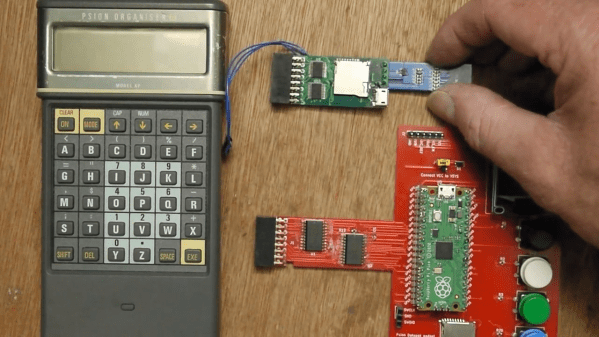
Psion Organiser with a Pico memory pack.

Proto-PDA Regains Its Memory With The Help Of A Raspberry Pi Pico

Remember the Psion Organiser? If you do, chances are you were an early adopter, as the 8-bit pocket computer had its heyday in the mid-1980s. Things have come a long way since then, of course, but just how far is illustrated nicely by the fact that a Raspberry Pi Pico can stand in for the Psion’s original memory packs.

Like many of the early attempts at putting a computer in your pocket, the Psion II had removable modules, which were dubbed “Datapaks”. The earliest versions of the Datapaks were little more than an EPROM chip on a small PCB, and the technical limitations of the day plus the quirky way of addressing the memory made it possible for [Amen] to mimic a Datapak using a modern microcontroller.

The first version was a breakout board that extended out of the Datapak slot significantly, with a Pico, OLED display, SD card slot, and a bunch of pushbuttons. That prototype proved that the Pico was indeed fast enough to fool the Psion into thinking a legit Datapak was plugged in. [Amen] later refined the design by making a board that stuffs everything into the Datapak slot, with the exception of the OLED which still dangles out where it can be seen. He puts the faux memory to the test in the video below.

It’s great to see groundbreaking tech of yesteryear like the Psion being taken care of and returned to use. We’ve seen others try before; here’s a hack that uses a Pi to connect a Psion Organiser to the internet through its RS-232 serial port.

Continue reading “Proto-PDA Regains Its Memory With The Help Of A Raspberry Pi Pico”

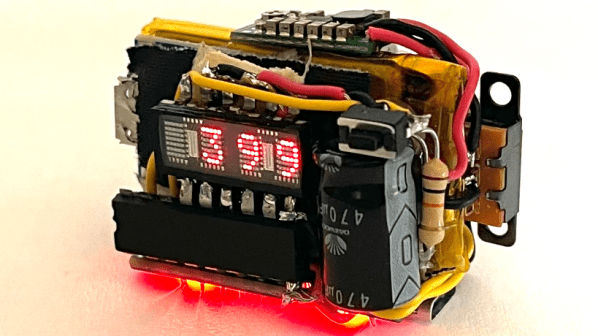
SYPHCOM, the compact CO2 sensor

Compact Sensor Keeps You Safe By Watching CO2 Levels

Remember when work meetings were just a bunch of people filling up a small, poorly ventilated room with their exhaled breath? Back in the good old days, all you had to worry about was being lulled to sleep by a combination of the endless slide deck and the accumulation of carbon dioxide. Now? Well, the stakes may just be a little bit higher.

In either situation, knowing the CO2 level in a room could be a handy data point, which is where a portable CO2 sensor like this one could be useful. Or at least that’s [KaRMaN]’s justification for SYPHCOM, the “simple yet powerful handheld carbon dioxide meter.” The guts of the sensor are pretty much what you’d expect — an Arduino Pro Micro, a SenseAir S8 CO2 sensor board, and the necessary battery and charging circuits. But the build does break the mold in a couple of interesting places. One is in the choice of display — a 1980s-era LED matrix display. The HDSP2000 looks like it belongs in a nice bench meter, and is surprisingly legible without a filter. It looks like it flickers a bit in the video below, but chances are that’s just a camera artifact.

The other nice part of this build is the obvious care [KaRMaN] put into making it as small as possible. The layout of boards and components is very clever, making this a solid, compact package, even without an enclosure. We’ve seen CO2 sensors with more features, but for a quick check on air quality, SYPHCOM looks like a great tool.

Continue reading “Compact Sensor Keeps You Safe By Watching CO2 Levels”

The interior of a failed boiler.

Fail Of The Week: Learning How Not To Silver Solder

Sure, there are subtleties, but by and large it’s pretty easy to pick up soldering skills with a little practice. But wait! Not all soldering is created equal, and as [Quinn Dunki] learned, silver soldering is far harder to get right.

Granted, the job [Quinn] is working on is much more demanding than tacking some components to a PCB. She has been building a model steam engine, a task fit to put anyone’s machining skills to the test. And a steam engine needs a boiler, which is where the silver soldering comes in. As she explains in the video below, silver soldering, or “hard” soldering, uses solder that melts at a much higher temperature than “soft” solders like we’re used to in electronics. That’s a big advantage in the heat and pressure of a boiler, but it does pose some problems, many of which [Quinn] managed to discover as she tried to assemble her copper beast.

It turns out that heating a big hunk of copper evenly without burning off the flux actually isn’t that easy, though you can’t say she didn’t give it the old college try. In the process, she managed to share a number of tidbits that were really interesting, like the fact that drawing acetylene from a tank too fast can be dangerous, or that model steam boilers have to be certified by qualified inspectors. In the end, her boiler couldn’t be salvaged, and was put to the saw to determine the problem, which seems to be her initial choice of heating with oxyacetylene; after that initial failure, there was little she could do to save the boiler.

As [Quinn] says, “Failure is only failure if you don’t learn from it.” And so it may be a bit unfair to hang “Fail of the Week” on this one, but still — she has to go back to the beginning on the boiler. And we already know that model steam engines aren’t easy.

Continue reading “Fail Of The Week: Learning How Not To Silver Solder”

Open-Source Insulin: Biohackers Aiming For Distributed Production

When you’ve got a diabetic in your life, there are few moments in any day that are free from thoughts about insulin. Insulin is literally the first coherent thought I have every morning, when I check my daughter’s blood glucose level while she’s still asleep, and the last thought as I turn out the lights, making sure she has enough in her insulin pump to get through the night. And in between, with the constant need to calculate dosing, adjust levels, add corrections for an unexpected snack, or just looking in the fridge and counting up the number of backup vials we have on hand, insulin is a frequent if often unwanted intruder on my thoughts.

And now, as my daughter gets older and seeks like any teenager to become more independent, new thoughts about insulin have started to crop up. Insulin is expensive, and while we have excellent insurance, that can always change in a heartbeat. But even if it does, the insulin must flow — she has no choice in the matter. And so I thought it would be instructional to take a look at how insulin is made on a commercial scale, in the context of a growing movement of biohackers who are looking to build a more distributed system of insulin production. Their goal is to make insulin affordable, and with a vested interest, I want to know if they’ve got any chance of making that goal a reality.

Continue reading “Open-Source Insulin: Biohackers Aiming For Distributed Production”