Microscopy Hack Chat With Zachary Tong

Join us on Wednesday, June 23 at noon Pacific for the Microscopy Hack Chat with Zachary Tong!

There was a time when electronics was very much a hobby that existed in the macroscopic world. Vacuum tubes, wire-wound resistors, and big capacitors were all mounted on terminal strips and mounted in a heavy chassis or enclosure, and interfacing with everything from components to tools was more an exercise in gross motor skills than fine. Even as we started to shrink components down to silicon chips, the packages we put them in were still large enough to handle and see easily. It’s only comparatively recently that everything has started to push the ludicrous end of the scale, with components and processes suitable only for microscopic manipulation, but that’s pretty much where we are now, and things are only likely to get smaller as time goes on.

The microscopic world is a fascinating one, and the tools and techniques to explore it are often complex. That doesn’t mean microscopy is out of the wheelhouse of the average hacker, though. Zachary Tong, proprietor of the delightfully eclectic Breaking Taps channel on YouTube, has been working in the microscopic realm a lot lately. We’ve featured his laser scanning confocal microscope recently, as well as his latest foray into atomic force microscopy. In the past he has also made DIY acrylic lenses, and he has even tried his hand at micromachining glass with lasers.

Zach is pretty comfortable working in and around the microscopic realm, and he’ll stop by the Hack Chat to share what he’s been up to down there. We’ll talk about all the cool stuff going on in Zach’s lab, and see what else he has in store for us.

join-hack-chatOur Hack Chats are live community events in the Hackaday.io Hack Chat group messaging. This week we’ll be sitting down on Wednesday, June 23 at 12:00 PM Pacific time. If time zones have you tied up, we have a handy time zone converter.
Click that speech bubble to the right, and you’ll be taken directly to the Hack Chat group on Hackaday.io. You don’t have to wait until Wednesday; join whenever you want and you can see what the community is talking about.

Rock-A-Bye Baby, On The Mechatronic Crib Shaker

While an engineering mindset is a valuable tool most of the time, there are some situations where it just seems to be a bad fit. Solving problems within the family unit would seem to be one such area, but then again, this self-rocking mechatronic crib seems to be just the cure for sleepytime woes.

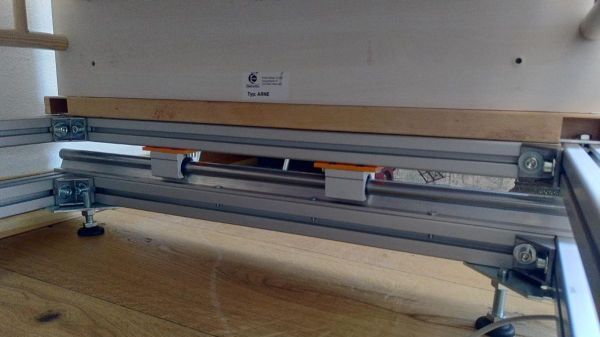
From the look of [Peter]’s creation, this has less of a rocking motion and more of a gentle back-and-forth swaying. Its purpose is plainly evident to anyone who has ever had to rock a child to sleep: putting a little gentle motion into the mix can help settle down a restless infant pretty quickly. Keeping the right rhythm can be a problem, though, as can endurance when a particularly truculent toddler is fighting the urge to sleep. [Peter]’s solution is a frame of aluminum extrusion with some nice linear bearings oriented across the short axis of the crib, which sits atop the whole thing.

A recirculating ball lead screw — nothing but the best for [Junior] — and a stepper drive the crib back and forth. [Peter] took care to mechanically isolate the drivetrain from the bed, and with the selection of the drive electronics and power supply, to make sure that noise would be minimal. Although thinking about it, we’ve been lulled to sleep by the whining steppers of our 3D printer more than once. Or perhaps it was the fumes.

Hats off to [Peter] for a setup that’s sure to win back a little of the new parent’s most precious and elusive commodity: sleep.

Hackaday Links Column Banner

Hackaday Links: June 20, 2021

The hits just keep coming for Elon Musk, as this week Starlink users reported their new satellite dishes apparently can’t take the heat. Granted, the places these reports are coming from are really, really hot, like Topock, Arizona, where one Starlink beta tester is located and where the air temperature is expected to hit 123°F (50°C) on Saturday. One user contacted Starlink customer service and was told that Dishy McFlatface is programmed to shut down if the surface temperature exceeds 50°C, which even in non-Arizona locations would be easily exceeded on a rooftop or in an urban heat island. Users experiencing thermal shutdown are taking extreme measures to get back online in the heat of the day, like by setting up sprinklers to water-cool their dishes. Others are building solar shades, and one die-hard is even considering putting the dish on an antenna tower, to get it up into the relatively cooler air above the ground. But these are just workarounds, and according to the engineer who did the Starlink teardown we featured a while back, the permanent fix may just be to redesign the thermal management. In other words, this isn’t likely to be another one of those problems that gets fixed with an OTA software push. Which is probably to be expected for something that’s still in the “Better than Nothing Beta” release.

We’ve all heard that AI and robots are going to replace pretty much every job at some point, but if one customer’s experience with an AI drive-through window is any gauge, it might take quite a while to get there. In a video posted on TikTok (we know, we know), a customer at a Chicago-area McDonald’s showed that the fast-food giant put exactly zero effort into making the experience anything but engaging. The synthesized voice is creepy, and evokes all the wrong kinds of feelings, like the ones you get when you’re forced to use a voice-response system to get through “voice mail jail”. At least in those cases, the voice at least sounds semi-apologetic when it can’t understand what you’ve said. After listening to it once, we’d much rather have a real human, even if it is a surly teen. This seems like a missed opportunity by McDonald’s, which probably has the resources to put a little humanity into their AI.

A while back, we dropped a link about satellites made largely of wood. At the time it seemed interesting if a bit self-serving, since the effort was largely backed by a large Finnish plywood company. And while that aspect of the project hasn’t changed, we’ve now got a better idea of how the WISA Woodsat is put together, and what it will do once it flies later this year. To be clear, the 1U CubeSat is not 100% wood, which of course would make including any electronics problematic. Instead, the side and top panels of the satellite are made from plywood, which are attached to aluminum rails that integrate with the launcher on the mothership. There’s also a metal pantograph-style selfie-stick, because pics or it didn’t happen. The interesting bit is the pre-treatment of the birch plywood, which is dried in a thermal vacuum chamber to prevent outgassing in space. Additionally, the exterior surface of the wood panels was covered with a thin layer of aluminum oxide, to give the surface a chance against highly reactive atomic oxygen. There will be sensors inside the satellite to see if any outgassing occurs, so we could actually get some valuable data about using wood in satellites out of what otherwise could have been just a publicity stunt.

As our long global nightmare appears to be playing out its endgame, and as the world begins to reopen itself to normal pursuits, it’s nice to see that some cons and meetups are actually returning to meatspace. One such event will be BornHack 2021, that week-long campout in a Danish forest with hundreds of like-minded hackers, tinkerers, and artists. The Call for Participation deadline has been extended to July 1, which gives you just a little more time to consider giving a presentation. We’ve heard Jenny List speak glowingly of BornHack, and it actually looks like a lot of fun.

And finally, it’s said that one can never include too many comments when writing code. Not everyone feels that way, of course; I once had a co-worker complain that I commented my code too much, which of course meant that I redoubled my efforts to make sure I had as many comments as possible. That meant I often ran out of ideas for pithy, pertinent, and gratuitous comments to sprinkle into my code. It’s a shame What The Commit didn’t exist back then. Just click the link and you’ll get a fresh, auto-generated comment ready to copy into your commits or embed in your code. Have fun!


Hackaday Podcast 123: Radioactive Rhinos, Wile E. Coyote Jetpack, Radio Hacks 3-Ways, And Battery Welders On The Spot

Hackaday’s Mike Szczys is taking a bit of vacation this week, so Elliot is joined by Staff Writer Dan Maloney to talk about all the cool hacks and great articles that turned up this week. Things were busy, so there was plenty to choose from, but how would we not pick one that centers around strapping a jet engine to your back to rollerskate without all that pesky exercise? And what about a light bulb that plays Doom – with a little help, of course. We’ll check out decals you can make yourself and why the custom keyboard crowd might want to learn that skill, learn about the other “first computer”, and learn how a little radiation might be just what it takes to save an endangered species.

Take a look at the links below if you want to follow along, and as always, tell us what you think about this episode in the comments!

Direct download (55 MB or so.)

Places to follow Hackaday podcasts:

Continue reading “Hackaday Podcast 123: Radioactive Rhinos, Wile E. Coyote Jetpack, Radio Hacks 3-Ways, And Battery Welders On The Spot”

Is That An EMP Generator In Your Pocket Or Is My Calculator Just Broken?

Ah, what fond memories we have of our misspent youth, walking around with a 9,000-volt electromagnetic pulse generator in our Levi’s 501s and zapping all the electronic devices nobody yet carried with them everywhere they went. Crazy days indeed.

We’re sure that’s not at all what [Rostislav Persion] had in mind when designing his portable EMP generator; given the different topologies and the careful measurement of results, we suspect his interest is strictly academic. There are three different designs presented, all centering around a battery-powered high-voltage power module, the Amazon listing of which optimistically lists as capable of a 400,000- to 700,000-volt output. Sadly, [Rostislav]’s unit was capable of a mere 9,000 volts, which luckily was enough to get some results.

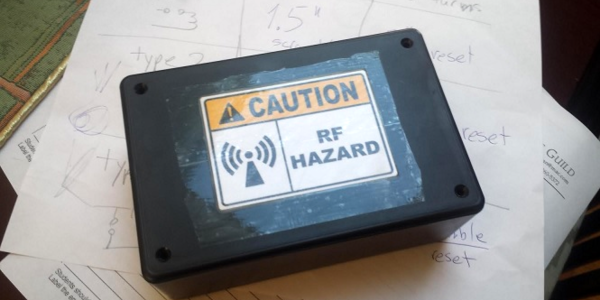
Coupled to a spark gap, one of seven different coils — from one to 40 turns — and plus or minus some high-voltage capacitors in series or parallel, he tested each configuration’s ability to interfere with a simple pocket calculator. The best range for a reset and scramble of the calculator was only about 3″ (7.6 cm), although an LED hooked to a second coil could detect the EMP up to 16″ (41 cm) away. [Rostislav]’s finished EMP generators were housed in a number of different enclosures, one of which totally doesn’t resemble a pipe bomb and whose “RF Hazard” labels are sure not to arouse suspicions when brandished in public.

We suppose these experiments lay to rest the Hollywood hype about EMP generators, but then again, their range is pretty limited. You might want to rethink your bank heist plans if they center around one of these designs.

Continue reading “Is That An EMP Generator In Your Pocket Or Is My Calculator Just Broken?”

Cloned Memory Module Fixes Broken Scopemeter

Finding broken test gear and fixing it up to work again is a time-honored tradition among hackers. If you’re lucky, that eBay buy will end up being DOA because of a popped fuse or a few bad capacitors, and a little work with snips and a soldering iron will earn you a nice piece of test gear and bragging rights to boot.

Some repairs, though, are in a class by themselves, like this memory module transplant for a digital scopemeter. The story began some time ago when [FeedbackLoop] picked up a small lot of broken Fluke 199C scopemeters from eBay. They were listed as “parts only”, which is never a good sign, and indeed the meters were in various states of disassembly and incompleteness.

The subject of the video below was missing several important bits, like a battery and a power connector, but most critically, its memory module. Luckily, the other meter had a good module, making reverse engineering possible. That effort started with liberating the two RAM chips and two flash chips, all of which were in BGA packages, from the PCB. From there each chip went into a memory programmer to read its image, which was then written to new chips. The chip-free board was duplicated — a non-trivial task for a six-layer PCB — and new ones ordered. After soldering on the programmed chips and a few passives, the module was plugged in, making the meter as good as new.

While we love them all, it’s clear that there are many camps of test gear collectors. You’ve got your Fluke fans, your H-P aficionados, the deep-pocketed Keithley crowd — but everyone loves Tektronix.

Continue reading “Cloned Memory Module Fixes Broken Scopemeter”

Retrotechtacular: Discovering Aerodynamics With The Chrysler Airflow

When you think about it, for most of human history we’ve been a pretty slow bunch. At any time before about 150 years ago, if you were moving faster than a horse can run, you were probably falling to your death. And so the need to take aerodynamics into consideration is a pretty new thing.

The relative novelty of aerodynamic design struck us pretty hard when we stumbled across this mid-1930s film about getting better performance from cars. It was produced for the Chrysler Sales Corporation and featured the innovative design of the 1934 Chrysler Airflow. The film’s narration makes it clear why the carmaker would go through the trouble of completely rethinking how cars are made; despite doubling average engine horsepower over the preceding decade, cars had added only about 15% to their top speed. And while to our 21st-century eyes, the Chrysler Airflow might look like a bulked-up Volkswagen Beetle, compared to the standard automotive designs of the day, it was a huge aerodynamic leap forward. This makes sense with what else was going on in the technology world at the time — air travel — the innovations of which, such as wind tunnel testing of models, were spilling over into other areas of design. There’s also the influence of [Orville Wright], who was called in to consult on the Airflow design.

While the Airflow wasn’t exactly a huge hit with the motoring public — not that many were built, and very few remain today; [Jay Leno] is one of the few owners, because of course he is — it set standards that would influence automotive designs for the next 80 years. It’s fascinating too that something seemingly as simple as moving the engine forward and streamlining the body a bit took so long to hit upon, and yet yielded so much bang for the buck.

Continue reading “Retrotechtacular: Discovering Aerodynamics With The Chrysler Airflow”