Tell Time Like It’s 1960 With This All-Transistor Digital Clock

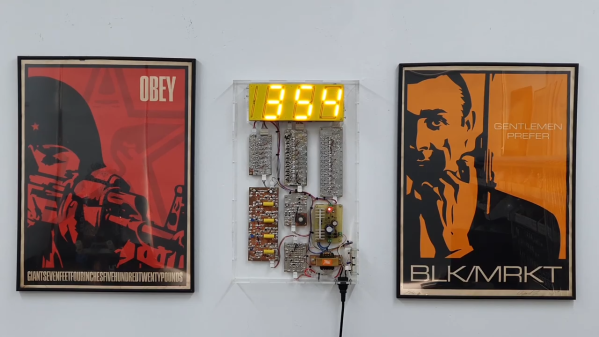
When you’ve got time on your hands, doing something the hard way can be therapeutic. Not that the present situation and the abundance of free time that many are experiencing has anything to do with [Leo Fernekes] all-transistor digital clock build, which he started a year ago with his students. But if you’ve got time to burn, this might be a good way to do it.

[Leo] says one of his design goals with this clock was to do it with the technology commercially available in 1960, which means relying completely on discrete components. And he and his students managed to do just that, with the exception of the seven-segment displays, which were built from the LED filaments from some modern light bulbs. Everything else, though, is as old school as it gets, and really underscores all the complexity that gets abstracted away from timekeeping with modern chips. The video below covers each module in detail, from the Schmitt trigger that cleans up the 50-Hz line frequency to the ring counters and diode matrices used to drive the display. We found the analog stair step dividers used to bring the line frequency down to a more usable pulse train particularly interesting. That clever bit of engineering saved 10 transistors over what would be required for traditional flip-flop dividers.

There’s a lot to learn from this design, and the execution is great too – we’re suckers for Manhattan-style builds, of course. Hats off to [Leo] and his lucky students on a great build.

Continue reading “Tell Time Like It’s 1960 With This All-Transistor Digital Clock”
Machine Vision Keeps Track Of Grubby Hands

Can you remember everything you’ve touched in a given day? If you’re being honest, the answer is, “Probably not.” We humans are a tactile species, with an outsized proportion of both our motor and sensory nerves sent directly to our hands. We interact with the world through our hands, and unfortunately that may mean inadvertently spreading disease.

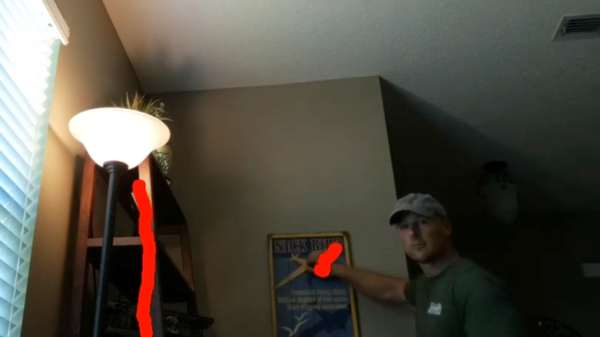
[Nick Bild] has a potential solution: a machine-vision system called Deep Clean, which monitors a scene and records anything in it that has been touched. [Nick]’s system uses Jetson Xavier and a stereo camera to detect depth in a scene; he built his camera from a pair of Raspberry Pi cams and a Pi 3B+, but other depth cameras like a Kinect could probably do the job. The idea is to watch the scene for human hands — OpenPose is the tool he chose for that job — and correlate their depth in the scene with the depth of objects. Touch a doorknob or a light switch, and a marker is left on the scene. The idea would be that a cleaning crew would be able to look at the scene to determine which areas need extra attention. We can think of plenty of applications that extend beyond the current crisis, as the ability to map areas that have been touched seems to be generally useful.

[Nick] has been getting some mileage out of that Xavier lately — he’s used it to build an AI umpire and shades that help you find lost stuff. Who knows what else he’ll find to do with them during this time of confinement?

Continue reading “Machine Vision Keeps Track Of Grubby Hands”

Brainstorming COVID-19 Hack Chat

Join us on Wednesday, April 8 at noon Pacific for the Brainstorming COVID-19 Hack Chat!

The COVID-19 pandemic has been sweeping across the globe now for three months. In that time it has encountered little resistance in its advances, being a novel virus with just the right mix of transmissibility and virulence that our human immune systems have never encountered. The virus is racking up win after win across the world, crippling public health and medical systems, shutting down entire economies, and forcing billions of people into isolation for the foreseeable future.

While social distancing is certainly an effective way to limit the spread of the disease, it feels more like hiding than fighting. Bored and stuck at home, millions of fertile minds are looking for an outlet for this frustration, a more affirmative way to fight the good fight and build solutions that the world sorely needs. And thus we’ve seen the outpouring of designs, ideas, and prototypes of everything from social distancing helpers to personal protective equipment (PPE) hacks.

In this Hack Chat, we’ll try to provide a framework around which hackers can start to turn their ideas into COVID-19 solutions. There are a ton of problems right now, but the most acute and most approachable seem to revolve around making sure healthcare providers have the PPE they need to do their job safely. Hacking at the edges of managing social distancing seems doable, too, both in terms of helping people keep a healthy distance from each other and in managing the isolation that causes. And let’s not forget about managing boredom; idle hands lead to idle minds, and staying healthy mentally is just as important as good handwashing and nutrition.

Join us on Wednesday for this group-led Hack Chat and bring your best ideas for attacking COVID-19 head-on.

join-hack-chatOur Hack Chats are live community events in the Hackaday.io Hack Chat group messaging. This week we’ll be sitting down on Wednesday, April 8 at 12:00 PM Pacific time. If time zones have got you down, we have a handy time zone converter.

Click that speech bubble to the right, and you’ll be taken directly to the Hack Chat group on Hackaday.io. You don’t have to wait until Wednesday; join whenever you want and you can see what the community is talking about.

Continue reading “Brainstorming COVID-19 Hack Chat”

Hackaday Links Column Banner

Hackaday Links: April 5, 2020

Git is powerful, but with great power comes the ability to really bork things up. When you find yourself looking at an inscrutable error message after an ill-advised late-night commit, it can be a maximum pucker-factor moment, and keeping a clear enough head to fix the problem can be challenging. A little proactive social engineering may be in order, which is why Jonathan Bisson wrote git-undo, a simple shell script that displays the most common un-borking commands he’s likely to need. There are other ways to prompt yourself through Git emergencies, like Oh Shit, Git (or for the scatologically sensitive, Dangit Git), but git-undo has the advantage of working without an Internet connection.

Suddenly find yourself with a bunch of time on your hands and nothing to challenge your skills? Why not try to write a program in a single Tweet? The brainchild of Dominic Pajak, the BBC Micro Bot Twitter account accepts tweets and attempts to run them as BASIC programs on a BBC Microcomputer emulator, replying with the results of the program. It would seem that 280 characters would make it difficult to do anything interesting, but check out some of the results. Most are graphic displays, some animated, and with an unsurprising number of nods to 1980s pop culture. Some are truly impressive, though, like Conway’s Game of Life written by none other than Eben Upton.

The COVID-19 pandemic is causing all sorts of cultural shifts, but we didn’t expect to see much change in the culture of a community that’s been notoriously resistant to change for over a century: amateur radio. One of the most basic facts of life in the amateur radio world is that you need a license to participate, with governments regulating the process. But as a response to the pandemic, Spain has temporarily lifted licensing requirements for amateur radio operators. Normally, an unlicensed person is only allowed to operate on amateur bands under the direct supervision of a licensed amateur. The rules change allows unlicensed operators to use a station without supervision and is intended to give schoolchildren trapped at home an educational experience. In another change, some countries are allowing special callsign suffixes, like “STAYHOME,” to raise awareness during the pandemic. And the boom in interest in amateur radio since the pandemic started is remarkable; unfortunately, finding a way to take your test in a socially distant world is quite a trick. Our friend Josh Nass (KI6NAZ) has some thoughts about testing under these conditions that you might find interesting.

And finally, life goes on during all this societal disruption, and every new life deserves to be celebrated. And when Lauren Devinck made her appearance last month, her proud parents decided to send out unique birth announcement cards with a printed circuit board feature. The board is decorative, not functional, but adds a distinctive look to the card. The process of getting the boards printed was non-trivial; it turns out that free-form script won’t pass most design rule tests, and that panelizing them required making some compromises. We think the finished product is classy, but can’t help but think that a functional board would have really made a statement. Regardless, we welcome Lauren and congratulate her proud parents.

Fail Of The Week: How Not To Die Of Boredom During Isolation

They say you can’t actually die from boredom, but put a billion or so people into self-isolation, and someone is bound to say, “Hold my beer and watch this.” [Daniel Reardon]’s brush with failure, in the form of getting magnets stuck up his nose while trying to invent a facial touch reminder, probably wasn’t directly life-threatening, but it does underscore the need to be especially careful these days.

The story begins with good intentions and a small stack of neodymium magnets. [Daniel]’s idea for a sensor to warn one of impending face touches was solid: a necklace with magnetic sensors and wristbands studded with magnets. Sounds reasonable enough; one can easily see a compact system that sounds an alarm when a hand subconsciously crosses into the Danger Zone while going in for a scratch. Lacking any experience in circuits, though, [Daniel] was unable to get the thing working, so he started playing with the magnets instead. One thing led to another, and magnets were soon adorning his earlobes, and then his nostrils. Unfortunately, two magnets became locked on either side of his septum, as did two others meant to neutralize the pull of the first pair. So off [Daniel] went to the emergency department for a magnetectomy.

Of course it’s easy to laugh at someone’s misfortune, especially when self-inflicted. And the now-degaussed [Daniel] seems to be a good sport about the whole thing. But the important thing here is that we all do dumb things, and hackers need to be especially careful these days. We often work with sharp, pointy, sparky, toxic, or flammable things, and if we don’t keep our wits about us, we could easily end up in an ER somewhere. Not only does that risk unnecessary exposure to COVID-19, but it also takes medical resources away from people who need it more than you do.

By all means, we should be hacking away these idle hours. Even if it’s not in support of COVID-19 solutions, continuing to do what we do is key to our mental health and well-being. But we also need to be careful, to not stretch dangerously beyond our abilities, and to remember that the safety net that’s normally there to catch us is full of holes now.

Thanks to [gir.st] for the tip — you actually were the only one to send this in.

Shoot The Moon With This Homebrew Hardline RF Divider

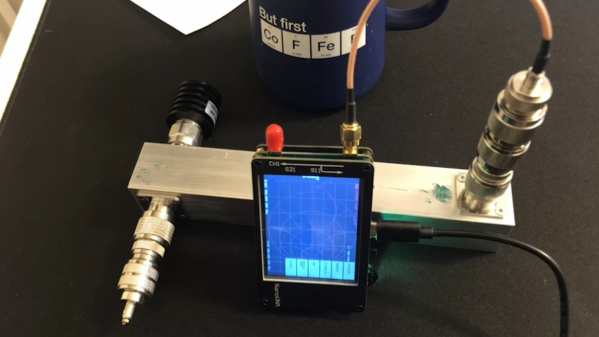
You can say one thing for [Derek]’s amateur radio ambitions — he certainly jumps in with both feet. While most hams never even attempt to “shoot the Moon”, he’s building out an Earth-Moon-Earth, or EME, setup which requires this little beauty: a homebrew quarter-wave hardline RF divider, and he’s sharing the build with us.

For background, EME is a propagation technique using our natural satellite as a passive communications satellite. Powerful, directional signals can bounce off the Moon and back down to Earth, potentially putting your signal in range of anyone who has a view of the Moon at that moment. The loss over the approximately 770,000-km path length is substantial, enough so that receiving stations generally use arrays of high-gain Yagi antennas.

That’s where [Derek]’s hardline build comes in. The divider acts as an impedance transformer and matches two 50-ohm antennas in parallel with the 50-ohm load expected by the transceiver. He built his from extruded aluminum tubing as the outer shield, with a center conductor of brass tubing and air dielectric. He walks through all the calculations; stock size tubing was good enough to get into the ballpark for the correct impedance over a quarter-wavelength section of hardline at the desired 432-MHz, which is in the middle of the 70-cm amateur band. Sadly, though, a scan of the finished product with a NanoVNA revealed that the divider is resonant much further up the band, for reasons unknown.

[Derek] is still diagnosing, and we’ll be keen to see what he comes up with, but for now, at least we’ve learned a bit about homebrew hardlines and EME. Want a bit more information on Moon bounce? We’ve got you covered.

Continue reading “Shoot The Moon With This Homebrew Hardline RF Divider”

Laser Artistry Hack Chat

Join us on Wednesday, April 1 at noon Pacific for the Laser Artistry Hack Chat with Seb Lee-Delisle!

It’s hard to forget the first time you see a laser light show. A staple at concerts starting in the 1980s, seeing a green laser lance out over the heads of tens of thousands of screaming fans to trace out an animated figure or pulsating geometric shapes was pure fascination, and wondering how it was all done was half the fun. As we all know now, it was all done with mirrors, tiny and connected to low-inertia galvanometers capable of the twitchiest of movements, yet precise enough to position the beam of light exactly where it needed to be to create the desired illusion. It was engineering, science, and art all wrapped up into one package.

Fast forward to the present day, and laser show technology has certainly advanced. Bulky laser tubes have been replaced by solid-state devices, more colors are available, and galvo designs have improved. The art and artistry of the laserist have grown with the tech, which is where our guest Seb Lee-Delisle comes into his own. We’ve featured some of Seb’s work before, like an Asteroids laser vector display and enormous public laser displays. And now he’ll stop by to talk about how the art and the tech combine in his hands to produce something much greater than the sum of its parts.

join-hack-chatOur Hack Chats are live community events in the Hackaday.io Hack Chat group messaging. This week we’ll be sitting down on Wednesday, April 1 at 12:00 PM Pacific time. If time zones have got you down, we have a handy time zone converter.

Click that speech bubble to the right, and you’ll be taken directly to the Hack Chat group on Hackaday.io. You don’t have to wait until Wednesday; join whenever you want and you can see what the community is talking about.

Continue reading “Laser Artistry Hack Chat”