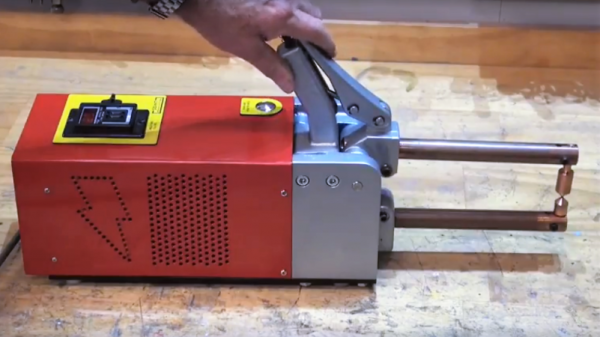
Not Just Your Average DIY Spot Welder

Microwave oven transformer spot welder builds are about as common as Nixie tube clocks around here. But this spot welder is anything but common, and it has some great lessons about manufacturing techniques and how to achieve a next level look.

Far warning that [Mark Presling] has devoted no fewer than five videos to this build. You can find a playlist on his YouTube channel, and every one of them is well worth the time. The videos covering the meat of what went into this thing of beauty are below. The guts are pretty much what you expect from a spot welder — rewound MOT and a pulse timer — but the real treat is the metalwork. All the very robust parts for the jaws of the welder were sand cast in aluminum using 3D-printed patterns, machined to final dimensions, and powder coated. [Mark] gives an excellent primer on creating patterns in CAD, including how to compensate for shrinkage and make allowance for draft. There are tons of tips to glean from these videos, and plenty of inspiration for anyone looking to achieve a professional fit and finish.

In the category of Best Appearing Spot Welder, we’ll give this one the nod. Runners-up from recent years include this plastic case model and this free-standing semi-lethal unit.
Continue reading “Not Just Your Average DIY Spot Welder”

Coolant Hoses Retasked To Lend A Helping Hand

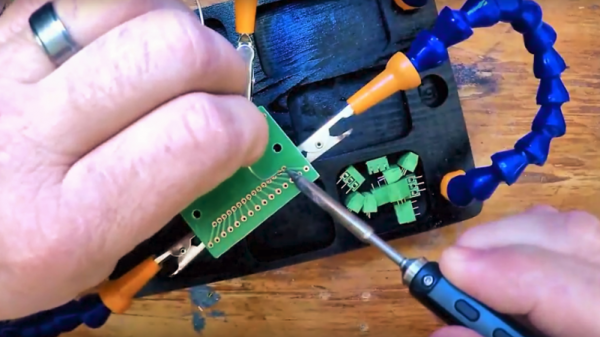
Everyone needs a helping hand in the shop once in a while, and most of us have gone the traditional route and bought one of those little doohickies with the cast iron base and adjustable arms terminated in alligator clips. They’re cheap, they’re readily available, and they’re “Meh,” at best.

In the quest for better hands, [Jeremy S. Cook] came up with this custom design for a benchtop aid, and we’re pretty impressed. There are commercial designs out there that use the same flexible coolant hoses, called Loc-Line, which are often seen spewing coolant on metalworking machines like mills and lathes. But the stuff is cheap, and with a little work, you can build something that fits your needs rather than working around a commercial design. [Jeremy] cut the base for his out of standard dimensional lumber with a CNC router, but the same thing could be done with simple hand tools. A 3D-printed base would be easy enough, too, although it might require some ballast to keep it from wiggling on the bench. The Loc-Line hoses were easily modded to hold alligator clips, and we can imagine other accessories too, like lights and a magnifier — or even a 3D-printed scoop to suction soldering fumes through the hose.

It’s a simple project, to be sure, but a useful one, and we like the design. But don’t think [Jeremy] isn’t thinking big, too — remember his magnificent lighted polycarbonate Strandbeest?

Continue reading “Coolant Hoses Retasked To Lend A Helping Hand”

Thermal Camera Diagnoses Thermal Issue On A Sonoff Switch

No matter what your experience level with troubleshooting, there’s always at least a little apprehension when you have to start poking through a mains powered device. A little fear is a good thing; it keeps you focused. For some, though, the aversion to playing with high voltage is too much, which can cause problems when something fails. So what do you do when you’re reluctant to even open the case? Easy — diagnose the problem with an infrared camera.

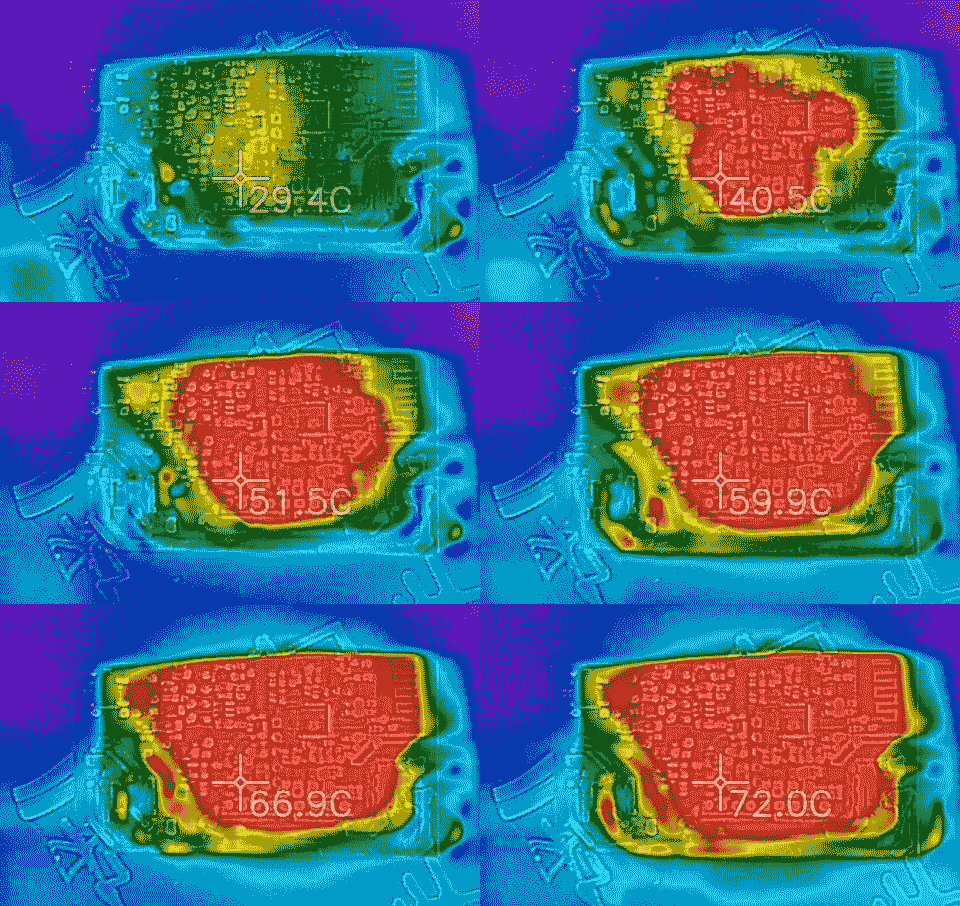
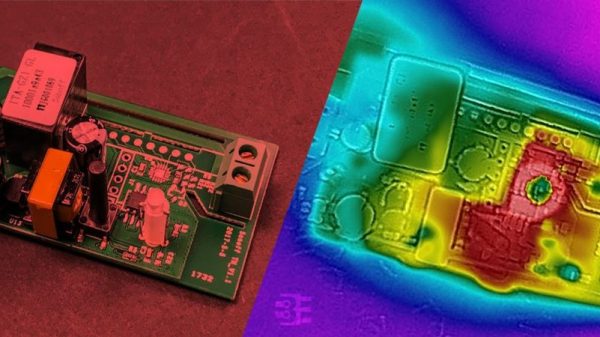
[Bald Engineer]’s electrophobia started early, with some ill-advised experiments in transcutaneous conduction. So when his new Sonoff WiFi switch failed soon after deploying it to control a lamp in his studio, popping the top while it was powered up was out of the question. The piquant aroma of hot plastic was his first clue to the problem, so he whipped out his Flir One Thermal Camera and watched the device as it powered up. The GIF nearby shows that there was clearly a problem, with a bloom of heat quickly spreading out from the center of the unit. A few IR images of the top and bottom gave him some clues as to the culprits, but probing the board in those areas once power was removed revealed no obviously damaged components.

[Bald Engineer] hasn’t yet gotten to the bottom of this, but his current thinking is that the NCP1117 regulator might be bad, since it rapidly spikes to 115°C. Still, we think this is a nifty diagnostic technique to add to our toolkit, and a great excuse to buy an IR camera. Or, we could go with an open-source thermal camera instead.

[via Dangerous Prototypes]

Fire Extinguisher Ball Mill Destined To Grind Kitty Litter

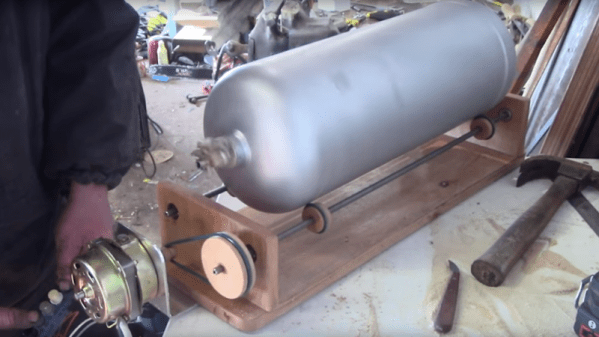
Nothing says hack like a tool quickly assembled from a few scrap-heap parts. For [Turbo Conquering Mega Eagle], his junkyard finds were a fire extinguisher, an old office fan, and a few scraps of plywood; the result was a quick and easy ball mill.

There’s very little mention of what said ball mill will be for — [TCME] said something about milling bentonite clay, AKA kitty litter — but that’s hardly the point. Having previously fabricated a much smaller version of this ball mill that could chuck up in his lathe, he scaled this one up considerably. The spent fire extinguisher was relieved of the valve and some external bits to create the mill’s drum. Plywood was used for a quick frame to support rollers and to turn a couple of pulleys for the running gear. The fan motor proved barely capable of performing, though, even with the mechanical advantage of the pulleys and an improvised drive belt. The motor just didn’t have the oomph to turn the drum when loaded with ceramic balls, but a quick adjustment to the drive train did the trick. The video below shows the whole build process, which couldn’t have taken much more than a couple of hours.

It looks like a sand casting project may be on deck for [TCME]’s milled bentonite, so we’ll look forward to that. Perhaps his other recent fire extinguisher build will make an appearance in that video too.

Continue reading “Fire Extinguisher Ball Mill Destined To Grind Kitty Litter”

Cook Up Your Own High-Temperature Superconductors

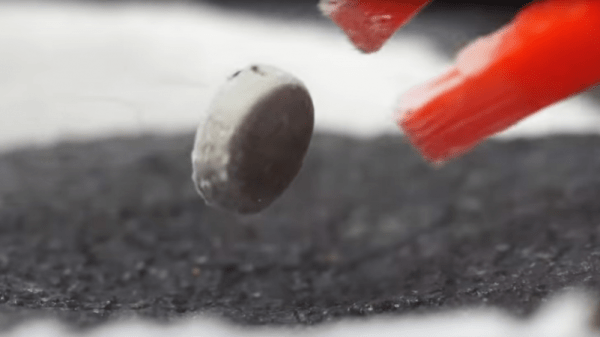
It looks more like a charcoal briquette than anything, but the black brittle thing at the bottom of [Ben Krasnow]’s crucible is actually a superconducting ceramic that can levitate magnets when it’s sitting in liquid nitrogen. And with [Ben]’s help, you can make some too.

Superconductors that can work at the relatively high temperature of liquid nitrogen instead of ultracold liquid helium are pretty easy to come by commercially, so if you’re looking to just float a few magnets, it would be a lot easier to just hit eBay. But getting there is half the fun, and from the look of the energetic reaction in the video below, [Ben] had some fun with this. The superconductor in question here is a mix of yttrium, barium, and copper oxide that goes by the merciful acronym YBCO.

The easy way to make YBCO involves multiple rounds of pulverizing yttrium oxide, barium chloride carbonate, and copper oxide together and heating them in a furnace. That works, sort of, but [Ben] wanted more, so he performed a pyrophoric reaction instead. By boiling down an aqueous solution of the three components, a thick sludge results that eventually self-ignites in a spectacular way. The YBCO residue is cooked in a kiln with oxygen blowing over it, and the resulting puck has all the magical properties of superconductors. There’s a lot of detail in the video, and the experiments [Ben] does with his YBCO are pretty fascinating too.

Things are always interesting in [Ben Krasnow]’s life, and there seem to be few areas he’s not interested in. Of course we’ve seen his DIY CAT scanner, his ruby laser, and recently, his homemade photochromic glass.

Continue reading “Cook Up Your Own High-Temperature Superconductors”

Fail Of The Week: The Little Ultrasonic Knife That Couldn’t

We all know the feeling of an idea that sounded great when it was rattling around in our head, only to disappoint when we actually build the thing. It’s a natural consequence of trying new stuff, and when it happens, we salvage what we can and move on, hopefully in wisdom.

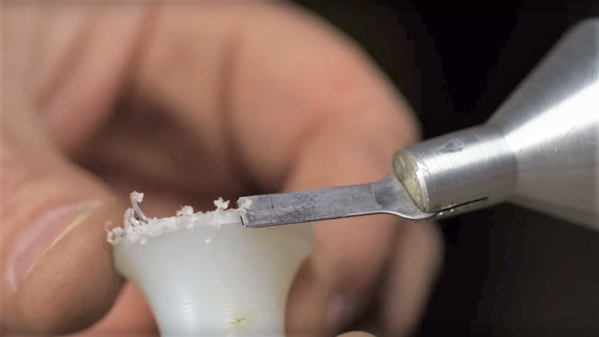
The thing that at least semi-defeated [This Old Tony] was an attempt to build an ultrasonic cutter, and it didn’t go well. Not that any blood was shed in the video below, although there seemed like there would be the way [Old Tony] was handling those X-Acto blades. His basic approach was to harvest the transducer and driver from a cheap ultrasonic cleaner and retask the lot into a tool to vibrate a knife rapidly enough to power it through tough materials with ease.

Spoiler alert: it didn’t work very well. We think the primary issue was using a transducer that was vastly underpowered compared to commercial (and expensive) ultrasonic cutters, but we suspect the horn he machined was probably not optimized either. To be fair, modeling the acoustic performance of something like that isn’t easy, so we can’t expect much. But still, it seems like the cutter could have worked better. Share your thoughts on how to make version 2.0 better in the comments.

The video is longish, but it’s as entertaining as any of [Old Tony]’s videos, and packed full of incidental gems, like the details of cavitation. We enjoyed it, even if the results were suboptimal. If you want to see a [This Old Tony] project that really delivers, check out his beautiful boring head build.

Continue reading “Fail Of The Week: The Little Ultrasonic Knife That Couldn’t”

“The Commodore Story” Documentary Premieres Today

What is it about a computer that was introduced 36 years ago by a company that would be defunct 12 years later that engenders such passion that people still collect it to this day? We’re talking about the Commodore 64, of course, the iconic 8-bit wonder that along with the other offerings from Commodore International served as the first real computer to millions of us.

There’s more to the passion that Commodore aficionados exhibit than just plain nostalgia, though, and a new documentary film, The Commodore Story, seeks to explore both the meteoric rise and fall of Commodore International. Judging from the official trailer below, this is a film anyone with the slightest interest in Commodore is not going to want to miss.

It will of course dive into the story of how the C64 came to be the best selling computer in history. But Commodore was far from a one-trick pony. The film traces the history of all the Commodore machines, from the PET computers right through to the Amiga. There are interviews with the key players, too, including our own Bil Herd. Bil was a hardware engineer at Commodore, designing several machines while there. He has shared some of these stories here on Hackaday, including the development of the C128  (successor to the C64) and making the C64 speak.

We can’t wait to watch this new documentary and luckily we won’t have to. It’s set to start streaming on Netflix, Amazon, and iTunes today, so pop up some popcorn and settle in for a two-hour ride through computer history but right now we’re unable to get firm dates on when. However, those of you in the Mountain View area have an even better opportunity this evening.

The Commodore Story will be premiered live at 6:30pm PST at the Computer History Museum. Grab your tickets to the premiere and a Q&A session with Bil Herd, Leonard Tramiel, and Hedley Davis.

Continue reading ““The Commodore Story” Documentary Premieres Today”