Rubik’s Robot So Fast It Looks Like A Glitch In The Matrix

From Ferraris to F-16s, some things just look fast. This Rubik’s Cube solving robot not only looks fast, it is fast: it solved a standard cube in 380 milliseconds. Blink during the video below and you’ll miss it — even on the high-speed we had trouble keeping track of the number of moves this solution took. It looked like about 20.

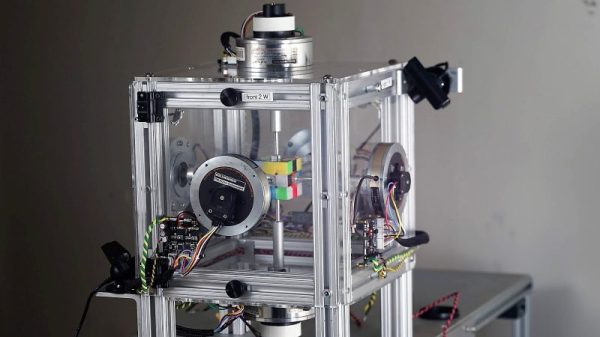
Beating the previous robot record of 637 milliseconds is just the icing on the cake of a very cool build undertaken by [Ben Katz]. He and his collaborator [Jared] put together a robot with a decidedly industrial look — aluminum extrusion chassis, six pancake servo motors with high-precision optical encoders, and polycarbonate panels for explosion containment which proved handy during development. The motors had to be modified to allow the encoders to be attached to the rear, and custom motor controllers were fabricated. [Jared] came up with a unique board to synchronize the six motors and prevent collisions between faces. Machine vision is provided by just two PlayStation Eye cameras; mounted at opposite corners of the enclosure, each camera can see three faces at a time. They had a little trouble distinguishing the red from the orange, which was solved with a Sharpie.

[Ben] and [Jared] think they can shave a few milliseconds here and there with tweaks, but even as it is, this is a great lesson in optimization and integration. We’ve covered Rubik’s robots before, like this two-motor slow and steady design and this six-motor build that solves a cube in less than a second.

Continue reading “Rubik’s Robot So Fast It Looks Like A Glitch In The Matrix”

Touchless Shop Doors Over-Engineered To A Blissful Level

When [John Saunders] wanted an automatic door for his shop, rather than settle for a commercial unit, he designed and built a proximity-sensing opener to ease his passing. Sounds simple, right?

Fortunately for us, there are no half-measures at Saunders Machine Works, thanks to the multiple Tormach workcells and the people who know how to use them. The video below treats us to quite a build as a result; the first part is heavy on machining the many parts for the opener, so skip ahead to 8:33 if you’re more interested in the control electronics and programming.

The opener uses time-of-flight distance sensors and an Arduino to detect someone approaching, with a pneumatic cylinder to part a plastic strip curtain. [John] admits to more than a little scope creep with this one, which is understandable when you’ve got easy access to the tools needed to create specialized parts at will.

In the end, though, it works well for everyone but [Judd], the shop dog, and it certainly looks like it was a fun build to boot. [John]’s enthusiasm for mixing machining and electronics is infectious; check out his automated bowl feeder for assembly line use.

Continue reading “Touchless Shop Doors Over-Engineered To A Blissful Level”

IoT Chore Reminder For The Serially Forgetful

The secret to domestic bliss often lies in attention to detail, an area in which we can all do a little better. But if paper notes and smartphone reminders are not enough to help you remember to knock jobs off your list, perhaps this IoT task reminder will give you the edge you need to keep the peace at home.

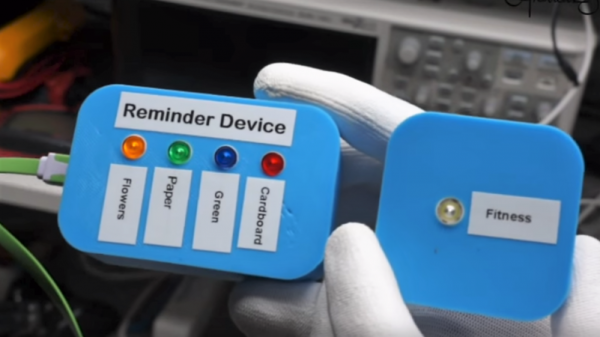
As [Andreas Spiess] points out, his best intentions of scheduling recurring tasks in Google Calendar were not enough to keep him on on top of his share of chores around the house. He found that the notifications popping up on his phone were far too easy to swipe away in favor of other distractions, so he set about building a real-world reminder. His solution uses a WeMOS D1 Mini in a bright blue 3D-printed box with from one to four LED switches on the front. Each box is linked to his Google Calendar, and when a task comes due, its light turns on. Sprinkled about the house near the task, like the laundry room or near the recycling, [Andreas] can’t help but see the reminder, which only goes out when he cancels it by pressing the task button. Simple but effective, and full of potential for other uses too.

Of course, the same thing could be accomplished with a Magic Mirror build, which we’ve seen a lot of over the years. But there’s something about the simplicity of these devices and their proximity to the task that makes sense — sort of like the Amazon Dash concept. We might build a few of these too.

Continue reading “IoT Chore Reminder For The Serially Forgetful”

Wireless Protocol Reverse Engineered To Create Wrist Wearable Mouse

We’ve seen a few near-future sci-fi films recently where computers respond not just to touchscreen gestures but also to broad commands, like swiping a phone to throw its display onto a large flat panel display. It’s a nice metaphor, and if we’re going to see something like it soon, perhaps this wrist-mounted pointing device will be one way to get there.

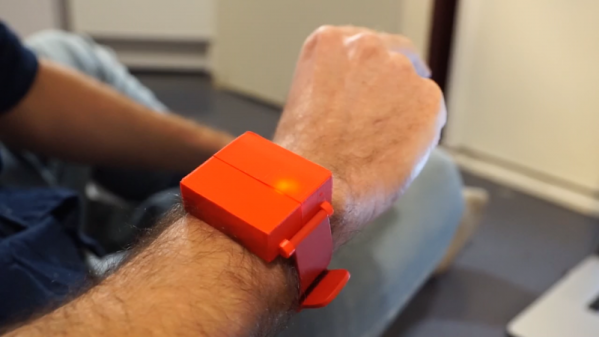
The video below shows the finished product in action, with the cursor controlled by arm movements. Finger gestures that are very much like handling a real mouse’s buttons are interpreted as clicks. The wearable has a Nano, an MPU6050 IMU, and a nRF24L01 transceiver, all powered by some coin cells and tucked nicely into a 3D-printed case. To be honest, as cool as [Ronan Gaillard]’s wrist mouse is, the real story here is the reverse engineering he and his classmate did to pull this one off.

The road to the finished product was very interesting and more detail is shared in their final presentation (in French and heavy with memes). Our French is sufficient only to decipher “Le dongle Logitech,” but there are enough packet diagrams supporting into get the gist. They sniffed the packets going between a wireless keyboard and its dongle and figured out how to imitate mouse movements using an NRF24 module. Translating wrist and finger movements to cursor position via the 6-axis IMU involved some fairly fancy math, but it all seems to have worked in the end, and it makes for a very impressive project.

Is sniffing wireless packets in your future? Perhaps this guide to Wireshark and the nRF24L01 will prove useful.

Continue reading “Wireless Protocol Reverse Engineered To Create Wrist Wearable Mouse”

High-Effort Streaming Remote For Low-Effort Bingeing

There’s no limit to the amount of work some people will put into avoiding work. For instance, why bother to get up from your YouTube-induced vegetative state to adjust the volume when you can design and build a remote to do it for you?

Loath to interrupt his PC streaming binge sessions, [miroslavus] decided to take matters into his own hands. When a commercially available wireless keyboard proved simultaneously overkill for the job and comically non-ergonomic, he decided to build a custom streaming remote. His recent microswitch encoder is prominently featured and provides scrolling control for volume and menu functions, and dedicated buttons are provided for play controls. The device reconfigures at the click of a switch to support Netflix, which like YouTube is controlled by sending keystrokes to the PC through a matching receiver. It’s a really thoughtful design, and we’re sure the effort [miroslavus] put into this will be well worth the dozens of calories it’ll save in the coming years.

A 3D-printed DIY remote is neat, but don’t forget that printing can also save a dog-chewed remote and win the Repairs You Can Print contest.

Continue reading “High-Effort Streaming Remote For Low-Effort Bingeing”

How To Test A B-52 Against EMP: Project ATLAS-I

Audacious times generate audacious efforts, especially when national pride and security are perceived to be at stake. Such was the case in the 1950s and 1960s, with the Space Race that started with a Russian sphere whizzing around the planet and ended with Neil Armstrong’s footprint on the Moon. But at the same time, other efforts were underway to answer big questions of national import, such as determining how durable the United States’ strategic assets were, and whether they could withstand the known effects of electromagnetic pulse (EMP), a high-intensity burst of electromagnetic energy that could potentially disable a plane in flight. Finding out just what an EMP could do to a plane would take big engineering and a large forest’s worth of trees.

Continue reading “How To Test A B-52 Against EMP: Project ATLAS-I”

A Relay Calculator With DIY Neon Displays, Just Because

This looks like one of those projects that started out as a glimmer of an idea and led down a rabbit hole. But it’s a pretty cool rabbit hole that leads to homebrew neon seven-segment displays on a calculator with relay logic.

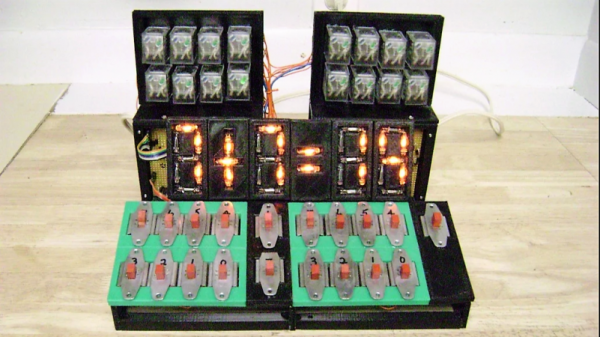
It’s a little thin on documentation so far, but that’s because [Mark Miller]’s build is one of those just-for-the-fun-of-it things. He started with a bag full of NE-2 tubes and the realization that a 3D-printed frame would let him create his own seven-segment displays. The frames have a slot for each segment, with a lamp and current limiting resistor tucked behind it; with leads brought out to pins and some epoxy potting, these displays would be hard to tell from a large LED seven-segment. Rolling your own displays has the benefit of being able to extend the character set, which [Mark] did with plus-minus and equal sign modules. All of these went together into a two-banger calculator — addition and subtraction only so far — executed in relays and vacuum tubes. Version 2.0 of the calculator regressed to all-relay logic, which must sound great.

We heartily regret the lack of a satisfyingly clicky video, but we’ll give it a pass since this is so cool. We’ll be watching for more on this project, but in the meantime, if you still need to get your click on, this electromechanical BCD counter should help.