Powder Coating With A Fluidized Bed

There’s no beating the beauty and durability of a high-quality powder-coated part. There’s just something about the look and feel of the finish that goes far beyond mere painting and makes it worth the effort and expense. The typical electrostatic spray powder-coating setup can be expensive, though, and not necessarily suitable for every workpiece.

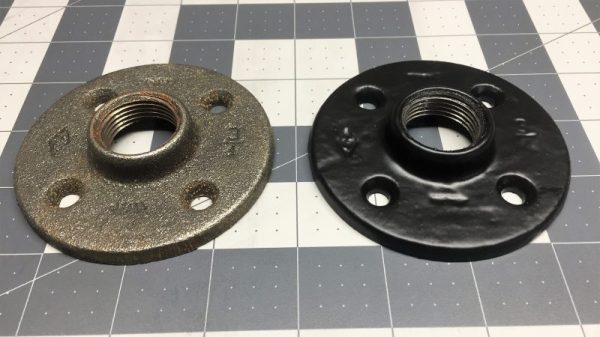
Enter the fluidized-bed powder coating chamber, perfect for limited runs of small parts, and the brainchild of [Andrew Mayhall]. With a business providing furniture kits based on iron pipe, [Andrew] needed a way to finish flanges and fittings, and powder coating provided the best look. The fluidizer he built is a great alternative to spray coating; it blows air through a bed of fine thermoplastic granules, which causes them to act like a fluid. It’s similar to the fluidized-bed hot tub we recently featured, but on a much smaller scale and with different requirements based on the ultrafine particle size and aggregation properties of the powder. [Andrew] had to add mechanical agitation to achieve a homogeneous fluid bed, and after much experimentation he’s now able to dip preheated parts into the bed and achieve one-step powder coating. The video after the break shows some of the operational details.

Does electrostatic powder-coating sound like more of your thing? No problem – DIY solutions abound, and a homebrew oven to bake your parts may be as close as the nearest file cabinet.

Continue reading “Powder Coating With A Fluidized Bed”

Touch Panels Make This Christmas Tree Interactive

The city of Liverpool, famously known as both the home port of the Titanic and the birthplace of The Beatles, also seems to have a thing for interactive public art installations. Witness this huge interactive Christmas tree that can be played by passersby.

The display in the city’s busy Williamson Square was commissioned by a municipal business group and built by [Adrian McEwen]. The idea was to adorn the 10-meter natural tree with large geometric ornaments covered with Neopixel strips. [Adrian] documents the build process in some detail, including that fact that over 170 meters of WS2812b strips went into the ornaments for the tree. While the strips themselves at IP68 rated, the connections needed when attaching them to the custom-made frames were not, and that had to be overcome with ample application of heat-shrink tubing. OctoWS2811 adapter boards were dangled about the tree to control the lights and connected together with garlands of Ethernet cables. Pressure sensors were used to control the lights when the EMI from the beefy power supplies needed to run everything proved too much for the original touch sensors. After a lot of bench testing and a few long nights working with the city crew to hang the display, passing Liverpudlians can now play the tree and enjoy the Christmas season.

Would you rather a smaller display for your own Christmas tree? This somewhat hyperactive indoor light show might be what you’re looking for.

Continue reading “Touch Panels Make This Christmas Tree Interactive”

Watch Video On A Oscilloscope With An ESP32

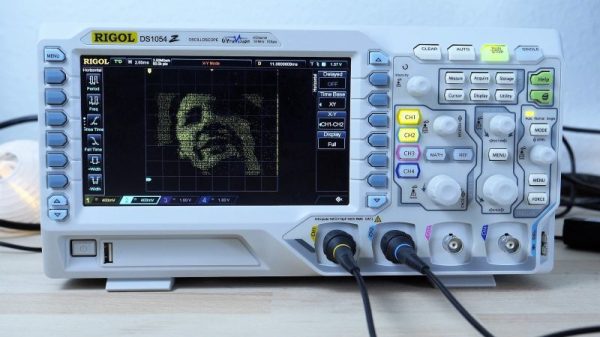
[bitluni] got a brand new scope, and he couldn’t be happier. No, really — check the video below; he’s really happy. And to celebrate, he turned his scope into a vector display using an ESP32.

Using a scope in X-Y mode is nothing new, of course. The technique is used to display everything from Lissajous patterns from an SDR to bouncing balls from an analog computer. Taken on as more of an exercise to learn how to use his new tool than a practical project, [bitluni]’s project starts by using two DACs on an ESP32 to create simple Lissajous patterns to learn about the scope’s controls. Next he built some code to display 3D point clouds, but learned that the native DAC code wasn’t up to the job. A little hacking improved the speed 27-fold, which was enough for great 3D images and live video from an I²S camera module. The latter was accomplished by grabbing frames from the camera and rendering them pixel by pixel, CRT style. The results are pretty clean, and there’s a lot to be learned about both using scopes as X-Y displays and tweaking the ESP32 for maximum performance.

Need more background on the ESP32? Start by checking out these ESP32 tutorials.


Continue reading “Watch Video On A Oscilloscope With An ESP32”

Coffee Table Model Railroad With All The Bells And Whistles (and Lights And Sirens)

For some, the allure of a real, physical world that you create and control is overwhelming. Combine that with a love of trains, and you get the model railroad. Some are incredibly detailed, and it seems like the larger the layout the better. Not everyone has the real-estate to devote to such a hobby, though, and moving down to N-gauge railroads is often the key to scratching the model railroad itch in a confined space.

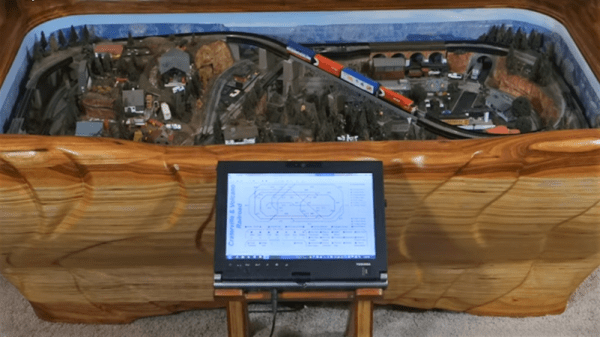
But [Chris Plumley]’s complete N-gauge model railroad in a coffee table takes the concept to a new and tiny level. The superlatives to describe this layout are many and begin with the coffee table itself, a free-form sculptural design intended to evoke the natural contours of a landscape. Removing the lid reveals an intricately detailed world that rises up on a lift. The mainline train and a two-station trolley line ply the imaginary world under full computer control, complete with sound effects and animated lighting. An LCD screen stands in for a drive-in movie theater — remember drive-ins? — and a house fire rages on, never to be quenched by the arriving fire engines. And as a bonus, the locomotive has a dash cam to provide an engineer’s eye view of the layout. The attention to detail is wonderful, but the kicker is that this layout has existed in one form or another for sixty years. Talk about persistence!

If you’re intrigued by combining the world of microcontrollers and model railroads, you should really check out this tutorial to get started.

Continue reading “Coffee Table Model Railroad With All The Bells And Whistles (and Lights And Sirens)”

VFD Puts The Suck Back Into Desoldering Station

A dedicated desoldering station is a fantastic tool if you’re in the business of harvesting components from old gear. Having heat and suction in a single tool is far more convenient than futzing with spring-loaded solder suckers or braid, but only as long as the suction in the desoldering tool has a little oomph behind it. So if the suction on your solder sucker is starting to suck, this simple VFD can help restore performance.

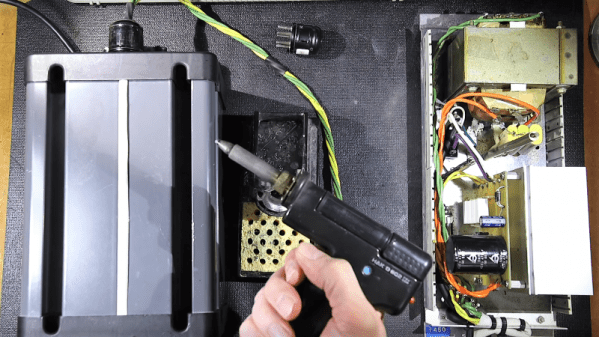
Luckily for [Mr. Carlson], his Hakko 470 desoldering station is equipped with an AC induction motor, so it’s a perfect candidate for a variable frequency drive to boost performance. He decided to build a simple VFD that boosts the frequency from 60-Hz mains to about 90-Hz, thereby jacking the motor speed up by 50%. The VFD is just a TL494 PWM chip gating the primary coil of a power transformer through a MOSFET. Duty cycle and frequency are set by trimmers, and the whole thing is housed in an old chassis attached to the Hakko via an anachronistic socket and plug from the vacuum tube days. That’s a nice touch, though, because the Hakko can be returned to stock operation by a simple bridging plug, and the video below shows the marked difference in motor speed both with and without the VFD plugged in.

We’ve marveled at [Mr. Carlson]’s instrument packed lab before and watched his insider’s tour of a vintage radio transmitter. Here’s hoping we get to see more of his hopped-up solder sucker in action soon.

Continue reading “VFD Puts The Suck Back Into Desoldering Station”

Logic Analyzer Pushes The Limits Of Miniaturization

Careful not to sneeze while using this diminutive logic analyzer — you could send it flying across the bench.

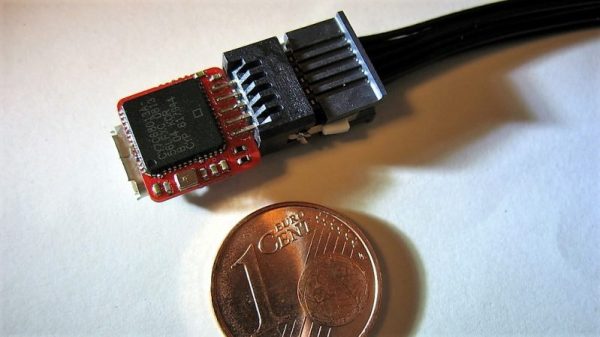
Undertaken more for the challenge than as a practical bench tool, [Uwe Hermann]’s tiny logic analyzer is an object lesson on getting a usable circuit as small as possible. Sure, some sacrifices had to be made; it’s only an eight-channel instrument without any kind of input protection at all, and lacks niceties like an EEPROM. But that allows it to fit on a mere 11 x 11-mm fleck of PCB. That’s a pretty impressive feat of miniaturization, given that the Cypress microcontroller running the show is in QFN package that takes up 64-mm² all by itself. A micro-USB connector takes up much of the back side of the board and allows the analyzer to talk to sigrok, an open-source signal analysis suite.

Everything about the project is totally open, including the PCB files, so you can build your own if you feel up to the challenge. We’d strongly suggest you check out this primer on logic analyzers first, though, especially since it focuses on the capabilities of the sigrok suite.

Old Scanner Finds New Life In DIY PCB Fab

Cheap, high-quality PCBs are truly a wonder of our age. That a professionally fabricated board with silkscreen and solder mask can be ordered online and delivered to your door has lowered the bar between a hobbyist project and a polished product. But the wait can be agonizing, and it can throw a wrench into the iterative design process. What to do?

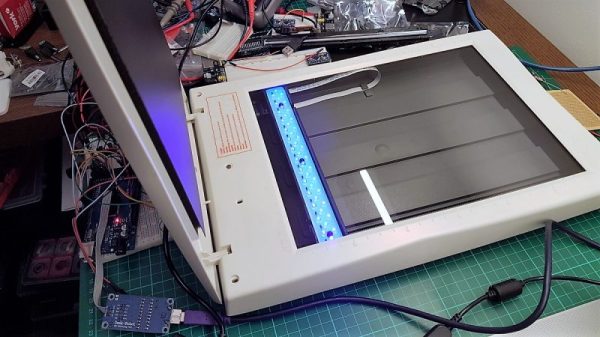
[Andras Kabai] knows the answer to that, and this former flatbed scanner turned into a UV exposer is the centerpiece of his DIY board fab. The old Mustek scanner was a couple of bucks secondhand, and provided not only the perfect form-factor for a board scanner but a trove of valuable parts to reuse. [Andras] replaced the original fluorescent light bar with a long, narrow PCB stuffed with UV LEDs, and added an Arduino Mega to control the original stepper drive. The project looks like it went through a little feature creep, with an elaborate menu system and profiles that include controls for exposure time, the brightness of the LED array via PWM, and the length of board that gets exposed. It’s clearly a work in progress, but early results are encouraging and we’ll be watching to see how [Andras]’ in-house fab shapes up.

This approach to PCB fab is only one of many, of course. You can turn a budget 3D-printer into a PCB machine, or even use an LCD to mask the boards during exposure. The latter intrigues us — an LCD mask and a scanning UV light source could make for a powerful PCB creation tool.