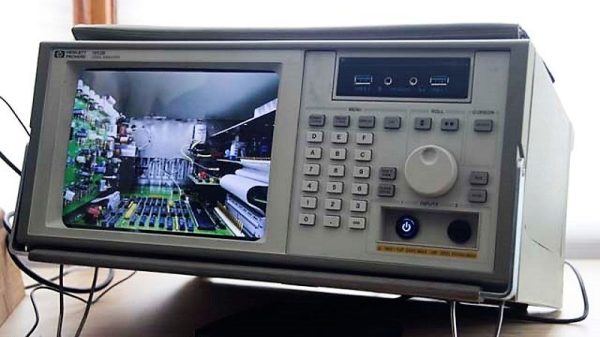
Old Logic Analyzer Becomes New PC Case

There are a lot of cool ways to wrap a case around your custom PC build. But the off-the-shelf stuff doesn’t really set your machine apart from the herd, no matter how many RGB LEDs you put inside. If you really want to stand out, think out of the box, and build your PC into the case of an old logic analyzer.

Looking for a little retro cool factor, [Bob Alexander] turned to the world’s boneyard, eBay, and rounded up a dead H-P 1653 logic analyzer. State of the art in 1989 but not worth repairing by [Bob]’s lights, he removed the original 10″ CRT to make room for an alternate display. After a bit of experimentation, he settled on an LCD panel mounted behind a sheet of acrylic that he thermoformed to the shape of the CRT face. All the original guts were removed to make way for the motherboard and power supply, and a custom PCB to interface the original keypad and rotary encoder into the PC. The old buttons now launch various programs and the encoder acts as the PC volume control. The floppy drive made way for a USB hub, the BNC connectors became power and reset buttons, and a photo taken through the CRT bezel before the electronics were removed provides a window into the soul of the original instrument. It’s a really nice build, and totally unique.

Need some inspiration for your custom case mod? This wall-mounted render farm is pretty snazzy. Or perhaps you’d prefer something more apocalyptic, like this ammo can PC.
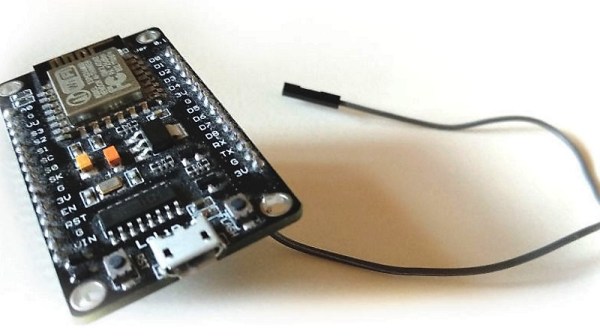
Espple: A Wireless Apple 1 On An ESP8266

The Apple 1 was one of the three big hobbyist computers that burst onto the scene in 1977. Unlike the PET 2001 and the TRS-80, only a couple hundred Apple 1s were ever produced, and with only a handful in existence today, you’ll have to fork out some serious money to get a Wozniak original for yourself.

The Apple 1 experience is easily emulated, of course, but this ESP8266 emulates the Apple 1 on hard mode. Dubbed the Espple by its creator [Hrvoje Cavrak], it emulates the 6502-based original in all its 1-MHz glory, while providing 20-kB of RAM, a considerable upgrade over the 4-kB standard. The complete original character set is provided for that old-timey feel, and there’s a BASIC interpreter ready to go. The kicker here, though, is that the emulator is completely wireless. You telnet into the 8266 rather than connecting a keyboard directly, and video is transmitted over-the-air using a GPIO pin as a 60-MHz PAL transmitter. A short length of wire is all you need to transmit to an analog PAL TV on channel 4; the video below shows a little BASIC code running and a low-res version of Woz himself.

You’ll find Apple emulators aplenty around these parts, everything from an Apple ][ on an Arduino Uno to a tiny Mac on an ESP32. There hasn’t been much in the way of Apple 1 emulations, though, at least until now.

Continue reading “Espple: A Wireless Apple 1 On An ESP8266”

Sonoff Factory Tour Is A Lesson On Life In Shenzhen

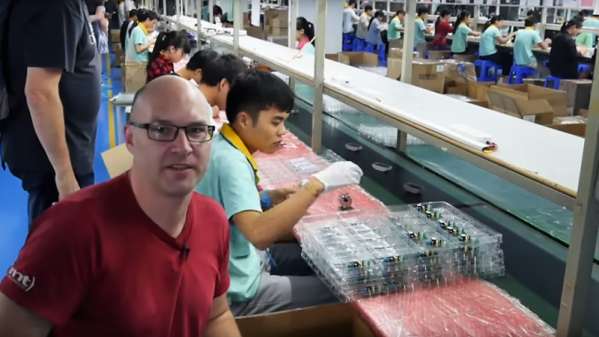
Judging by the popularity of “How It’s Made” and other shows of the genre, watching stuff being made is a real crowd pleaser. [Jonathan Oxer] from SuperHouse is not immune to the charms of a factory tour, so he went all the way to China to visit the factory where Sonoff IoT devices are made, and his video reveals a lot about the state of electronics manufacturing.

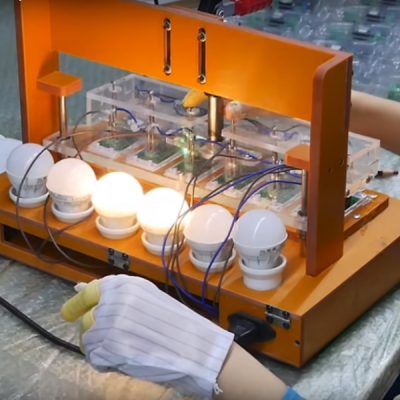
Test jig for six units at once

For those interested only in how Sonoff devices are manufactured, skip ahead to about the 7:30 mark. But fair warning — you’ll miss a fascinating discussion of how Shenzhen rose from a sleepy fishing village of 25,000 people to the booming electronics mecca of 25 million that it is today. With growth supercharged by its designation as a Special Economic Zone in the 1980s, Shenzhen is now home to thousands of electronics concerns, including ITEAD, the manufacturers of the Sonoff brand. [Jonathan]’s tour of Shenzhen includes a trip through the famed electronics markets where literally everything needed to build anything can be found.

At the ITEAD factory, [Jonathan] walks the Sonoff assembly line showing off an amazingly low-tech process. Aside from the army of pick and places robots and the reflow and wave soldering lines, Sonoff devices are basically handmade by a small army of workers. We lost count of the people working on final assembly, testing, and packaging, but suffice it to say that it’ll be a while before robots displace human workers in electronic assembly, at least in China.

We found [Jonathan]’s video fascinating and well worth watching. If you’re interested in Sonoff’s ESP8266 offerings, check out our coverage of reverse engineering them. Or, if Shenzhen is more your thing, [Akiba]’s whirlwind tour from the 2016 Superconference will get you started.

Continue reading “Sonoff Factory Tour Is A Lesson On Life In Shenzhen”

Balance Like A Mountain Goat On This Simple Stewart Platform

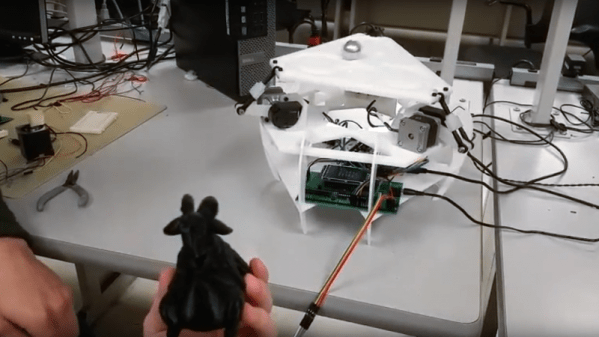
No goats were harmed in the making of this 3-DOF Stewart platform for [Bruce Land]’s microcontrollers course at Cornell.

If the name “Stewart platform” doesn’t ring a bell, the video below will help you out. [Team Microgoats] built a small version of the mechanical system commonly seen in flight simulators, opting for 3 DOF  to simplify the design. Their PIC32-controlled steppers can wobble and weave the table in response to inputs from an MPU-6050 six-axis accelerometer embedded in the base of a 3D-printed goat. Said goat appears to serve no other role in the build, but goats are cool, so why not? And if you’ve ever seen a mountain goat frolicking across a sheer vertical rock face like it was walking across a parking lot, you’ll understand the connection to the balance and control offered by a Stewart platform.

[Bruce Land]’s course is always a bonanza of neat projects that pop up in our tipline this time of year, like a POV box fan, a coin cell Rickrolling throwie, and a dynamometer for small electric motors.

Continue reading “Balance Like A Mountain Goat On This Simple Stewart Platform”

Exploring Options For DIY Waterproofing

TL;DR — Don’t use silicone to pot electronics.

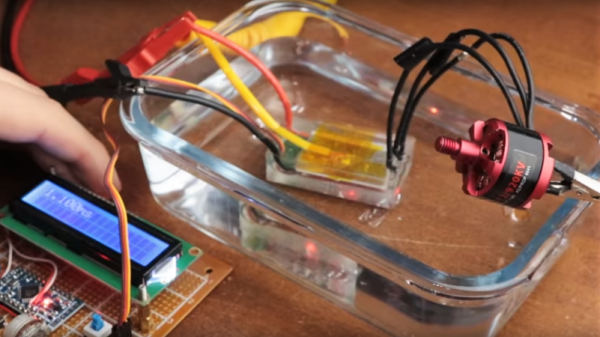
That’s the conclusion [GreatScott!] comes to after trying out several methods for waterproofing electronics. His efforts stem from a recent video in which he discovered that water and electricity sometimes actually do mix, as long as the water is distilled and the electronics in the drink are relatively simple. He found that the main problem was, unsurprisingly, electrolytic corrosion, so he set out to experiment with various waterproofing coatings. In a series of careful experiments he goes through the pros and cons of both conformal coatings and potting compounds. The conformal tests used simple clear nail polish on an ESC board; that worked pretty well, but it was a little hard to reach all the nooks and crannies. He also tried potting with a thick black silicone compound, but that ended up never really curing in the middle. A final attempt with legitimate two-part epoxy potting compound sealed up the ESC tight, although we doubt the resulting brick would perform well on a quadcopter.

If you want to explore potting a bit further, check out this introduction to the basics.

Continue reading “Exploring Options For DIY Waterproofing”

A Visit From Saint Rich

With apologies to Clement Clarke Moore, Richard Stallman, and the English-speaking world in general — ed.

‘Twas the night before Christmas
While up in my bed,
I stared at the ceiling
With feelings of dread.

I’d really no reason for portents of doom
Lying there, sleepless, in gathering gloom.
We’d wrapped all the presents, and decked out the tree,
But still, there was something niggling at me.

Continue reading “A Visit From Saint Rich”

Low-Power Motor Can Run For Years On A Coin Cell

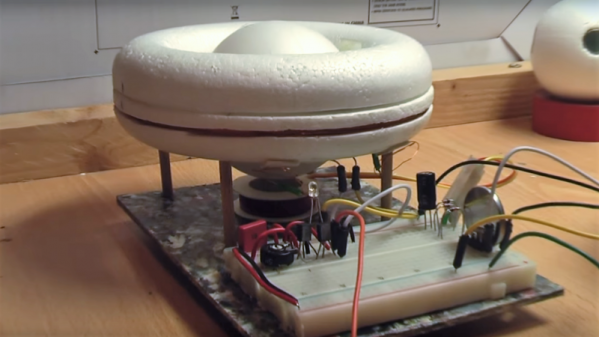
Can you run an electric motor for two years on a single lithium coin cell? [IamWe] figured out how to do it, and even though his donut motor doesn’t look like any motor we’ve ever seen before, it’s a pretty solid lesson in low-current design.

The donut motor is really just a brushless DC motor with a sign-pole stator and a multi-pole rotor. The frame of the motor is built from a styrofoam donut, hence the motor’s name. The rotor is a styrofoam sphere with neodymium magnets embedded around its equator. A sharpened bicycle spoke serves as an axle, and clever magnetic bearings provide near-zero friction rotation. The stator coil comes from an old solenoid and is driven by a very simple two-transistor oscillator. [IamWe]’s calculations show that the single CR2032 coin cell should power this motor for over two years. This one looks easy enough to whip up that it might make a nice project for a long winter’s night. Watch it spin in the video below.

This one seems like a perfect entry for the Coin Cell Challenge contest. Sure, it may not be a coin cell jump starter for your car, but our guess is this motor will still be spinning in 2020, and that’s no mean feat.

Continue reading “Low-Power Motor Can Run For Years On A Coin Cell”