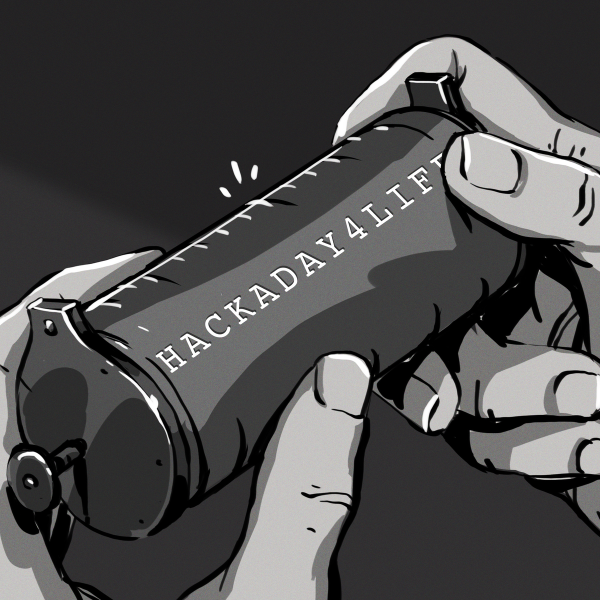
As it turns out, it’s not feasible to print an entire crossbow yet. But [Dan]’s crossbow build does a good job of leveraging what a 3D printer is good at. Most of the printed parts reside in the crossbow’s trigger group, and the diagrams in the write-up clearly show how the trigger, sear and safety all interact. Particularly nice is the automatic nature of the safety, which is engaged by drawing back the string. We also like the printed spring that keeps the quarrel in place on the bridle, and the Picatinny rail for mounting a scope. Non-printed parts include the aluminum tubes used in the stocks, and the bow itself, a composite design with fiberglass rods inside PVC pipe. The video below shows the crossbow in action, and it looks pretty powerful.
Actually, we’ll partially retract our earlier dismissal of entirely 3D-printed crossbows, but [Dan]’s version is a lot more practical and useful than this model. And for a more traditional crossbow design, check out this entirely hand-made crossbow.
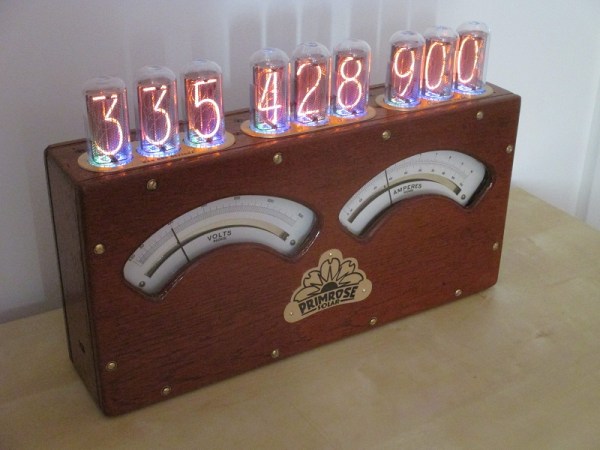
The appeal of adding Nixie tube displays to a project seems to know no end. First it was Nixie clocks, now it’s Nixie power meters, with the latest addition being this Nixie-Steampunk hybrid solar power monitor.
We’re suckers for a project with a vintage look, and this one pushes all the buttons. Built on commission for a solar power company CEO’s office, [Paul Parry]’s build is based on a Depression-era Metropolitan-Vickers combined voltmeter and ammeter. The huge meters with mirrored scales and the rich wood of the case – our guess is that it’s mahogany – made a great starting point, and after some careful hole drilling, nine IN-18 Nixies were sprouting from the case. A strip of RGB LEDs below decks added the requisite backlighting of the envelopes, and a Raspberry Pi was enlisted to interpret data from the company’s solar farm and drive the tubes and the meters. The project was capped off with a new finish on the case and a couple of fancy brass plaques.
[Paul] sent us the tip for his build after seeing the last power meter we covered, and we have to say they’re both great looking and functional projects. Keep the Nixie projects coming!
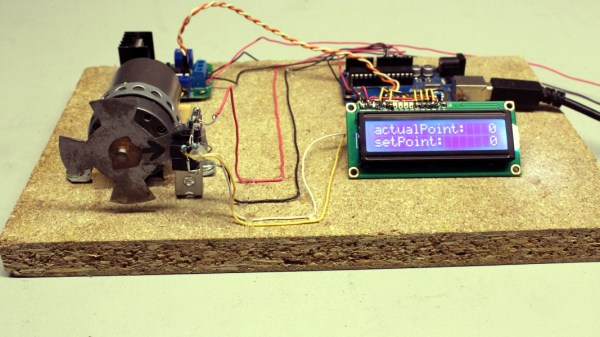
Is it really possible to build a rotary encoder out of a flattened tin can and a couple of photodetectors? Sure it’s possible, but what kind of resolution are you going to get from such a contraption? Is there any way that you’d be able to put them to work in a DIY project like a CNC router? If you pay attention to the basics then the answer is yes, and [HomoFaciens] wants to prove that to you with this detailed video on homebrew encoder design.
Faithful Hackaday readers will no doubt recognize [HomoFaciens] from a number of prior appearances on these pages, including this recent hardware store CNC router build. When we first ran across his builds, we admit a snicker or two was had at the homemade encoders, but if you watch the results he manages to get out of his builds, you quickly realize how much you can accomplish with very little. The video is a primer on encoder design, walking you through the basics of sensing rotation with phototransistors, and how a pair of detectors is needed to determine the direction of rotation. He also discusses the relative merits of the number of teeth in the chopper; turns out more isn’t necessarily better. And in the end he manages to turn a car wiper motor into a high-torque servo, which could be a handy trick to have filed away.
It’s a parent’s worst nightmare. Doctors tell you that your baby is sick and there’s nothing they can do. Luckily though, a combination of hacks led to a happy ending for [Teegan Lexcen] and her family.
When [Cassidy and Chad Lexcen]’s twin daughters were born in August, smaller twin [Teegan] was clearly in trouble. Diagnostics at the Minnesota hospital confirmed that she had been born with only one lung and half a heart. [Teegan]’s parents went home and prepared for the inevitable, but after two months, she was still alive. [Cassidy and Chad] started looking for second opinions, and after a few false starts, [Teegan]’s scans ended up at Miami’s Nicklaus Children’s Hospital, where the cardiac team looked them over. They ordered a 3D print of the scans to help visualize possible surgical fixes, but the 3D printer broke.
Not giving up, they threw [Teegan]’s scans into Sketchfab, slapped an iPhone into a Google Cardboard that one of the docs had been playing with in his office, and were able to see a surgical solution to [Teegan]’s problem. Not only was Cardboard able to make up for the wonky 3D printer, it was able to surpass it – the 3D print would only have been the of the heart, while the VR images showed the heart in the context of the rest of the thoracic cavity.[Dr. Redmond Burke] and his team were able to fix [Teegan]’s heart in early December, and she should be able to go home in a few weeks to join her sister [Riley] and make a complete recovery.
We love the effect that creative use of technology can have on our lives. We’ve already seen a husband using the same Sketchfab tool to find a neurologist that remove his wife’s brain tumor. Now this is a great example of doctors doing what it takes to better leverage the data at their disposal to make important decisions.
In the summer of 1929, it would probably have been hard for the average Joe to imagine the degree to which his life was about to change. In October of that year, the US stock market tumbled, which in concert with myriad economic factors kicked off the Great Depression, a worldwide economic disaster that would send ripples through history to this very day. At its heart, the Depression was about a loss of confidence, manifested in bank failures, foreclosures, unemployment, and extreme austerity. People were thrust into situations for which they were ill-prepared, and if they were going to survive, they needed to adapt and do what they could with what they had on hand. In short, they needed to hack their way out of the Depression.
Social Hacking: Welcome to the Jungle
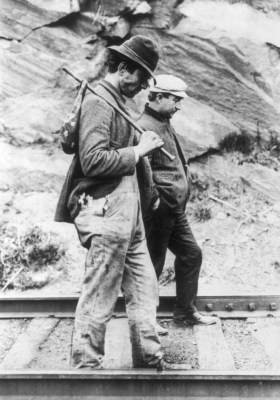
Bindlestiffs ambulating down the high iron. Source: Wikipedia
One reaction to the change in the social contract in the 1930s was increased vagrancy. While homelessness was certainly thrust upon some people by circumstances – in the depth of the Depression in 1933, something like 25% of men were unemployed, after all – life on the road was clearly a choice for millions. A typical story was that of the bored teenage boy, facing no prospects for a job and wishing to relieve his large family of the burden of one more mouth to feed. Hitting the road with a few possessions in his “bindle,” he learned the craft of life on the road from more experienced vagrants. And thus another hobo was created.
The popular image of the hobos as unique to the Depression is a little awry. Economic upheaval certainly swelled their ranks, but in America, hobos had first appeared after the Civil War, with war-weary veterans riding the rails looking for work. By the time the Depression hit, there was an extensive hobo culture in the United States, complete with its own slang and a rough code of ethics.
Hobos were top of the heap in the vagrant hierarchy, the “knights of the road.” They were migrant workers, generally unskilled, willing to stay in one place for a paying job but unwilling to commit to settling down. When the job was done or he had made enough money, he moved on. Tramps were the next step down – wanderers who were willing to work but only when absolutely necessary. Lowest in the pecking order were the bums who stayed put and relied on the kindness of strangers for their survival. Regardless of rank, all the vagrants had one thing in common – the road. More or less constantly on the move, they had to quickly learn how to provide for themselves without the creature comforts, which before the Depression hit had begun to include many modern conveniences.
Cooking arrangements were one thing hobos excelled at, whether on the road or in one of the many hobo camps, or jungles, that sprung up at railroad crossings outside of towns. A campfire in a ring of rocks is the traditional view of outdoor cookery, but the hobos quickly learned that it’s not terribly fuel-efficient. One solution to this problem was the hobo stove, an ancestor of the rocket stove. Relying on convection to draw a huge volume of air into a combustion chamber, hobo stoves were easily fabricated from tin cans and other metal scraps that were easy to come by in a world before recycling and large municipal landfills. Most were assembled on the spot and served for a meal or two before being abandoned, but some actually had insulation between double walls and clever arrangements of the fuel shelf to feed automatically as the fuel burned away. Scraps of wood, pinecones, newspapers and cardboard – a hobo stove will eat almost anything, and burn hot enough that even damp fuel isn’t a problem.
Often finding himself with time on his hands, many a hobo kept himself busy with arts and crafts projects in camp. Making hobo nickels was a popular way to pass the time, and often resulted in a trade item far more valuable than the base value of the starting material. The Indian head figure on the US Buffalo nickels of the day were modified with tools fabricated from old nails and files; metal was pushed around the coin to create features on the figure, usually a bowler hat and facial hair. A ‘bo could trade the miniature bas-relief sculpture for a good meal; today genuine hobo nickels from the Depression era command high prices from collectors.
Radio: Razor Blades and Copper Pipe
Unless the hobo was flopping in town or at a really well-equipped jungle, chances are pretty good he wasn’t listening to the radio too much. From our 21st century outlook, it’s sometimes hard to appreciate how new and exciting radio was and the impact it had on everyday life in America during the Depression. Radio connected the nation in a way no other medium ever had. That the Depression did not kill this infant technology in its cradle is a testament to both its power as a medium – families would stop making payments on almost everything else so they could keep their radio sets – and to the tenacity of early electronics hobbyists, who learned to keep radios alive and even to fabricate them from almost nothing.
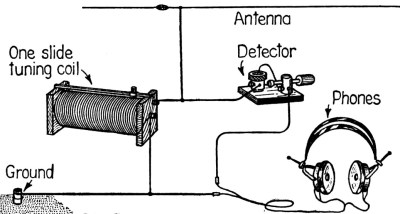
Although tube-type superheterodyne receivers were widely available all through the Depression, crystal sets were still a popular and sometimes necessary hacker project during the Depression. Relying on nothing more than a tuned circuit and a detector connected to an antenna and high-impedance headphones, a crystal set was able to pick up strong AM broadcasts and sometimes even shortwave stations. The earliest detectors were crystals of galena probed by a tiny “cat’s whisker” wire, but metal oxides could also form the necessary rectifying junction, leading to detectors built out of razor blades and safety pins. Crystal radio skills would serve many a Depression-era farm boy well during the next decade as they went off to war in Europe and the Pacific; there they created foxhole radios to listen in on broadcasts without the risk of a more sophisticated radio set, whose local oscillator could be detected by the enemy.
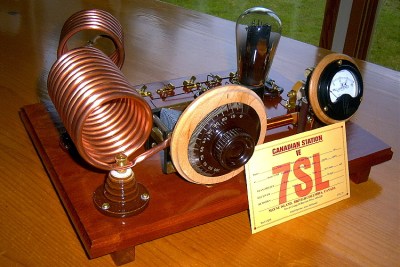
VE7SL’s replica 1929 TNT transmitter, a close relative of the Hartley. Source: The VE7SL Radio Notebook
Receivers weren’t the only area in which Depression-era hackers made an impact. As commercial broadcasting took off, so did amateur radio, and few commercial transmitters were available to satisfy the burgeoning ham market. Depression-era hams had to home-brew almost everything and came up with some beautiful designs that modern glowbug hams recreate with loving attention to detail. A popular transmitter back in the day was based on the Hartley oscillator (PDF link). Using only a single triode tube and a tuned circuit with coils wound from 1/4″ copper tubing, Hartley transmitters could be built on a literal breadboard from scraps and widely available parts. Tuned to the 40- or 80-meter band, or even down to the 160-meter band, a Hartley or the closely related Tuned-Not-Tuned (TNT) or Tune-Plate-Tuned-Grid (TPTG) continuous-wave (CW) transmitters could put out enough power to work coast-to-coast contacts, or QSOs. Modern hams pay homage to the Depression-era pioneers of amateur radio with regular “QSO Parties” using replica Hartleys – most with bypass capacitors to keep the lethal voltages their forebears had to deal with off the coils.
The Great Depression lasted through the 1930s in America, finally dissipating just before the country mobilized for World War II. With factories suddenly working beyond capacity to supply the war effort, unemployment figures quickly plummeted, and the austere practices of the Depression were generally rolled back. Hobo culture declined and amateur radio was shut down by the federal government for the duration of the war, but neither the war effort nor full employment could kill the hobo spirit — modern hobos still ply the rails to this day. And the skills and mindsets developed by Depression-era social and electronics hackers paved the way for a lot of what was to come in the post-war years.
Who doesn’t like to ring in the New Year with explosives? But speaking from personal experience – I can neither confirm not deny nearly blowing my hand off once with a small dry-ice grenade – a hands-off way to launch your fireworks can be a plus, in which case you might want to check out this automatic firecracker launcher.
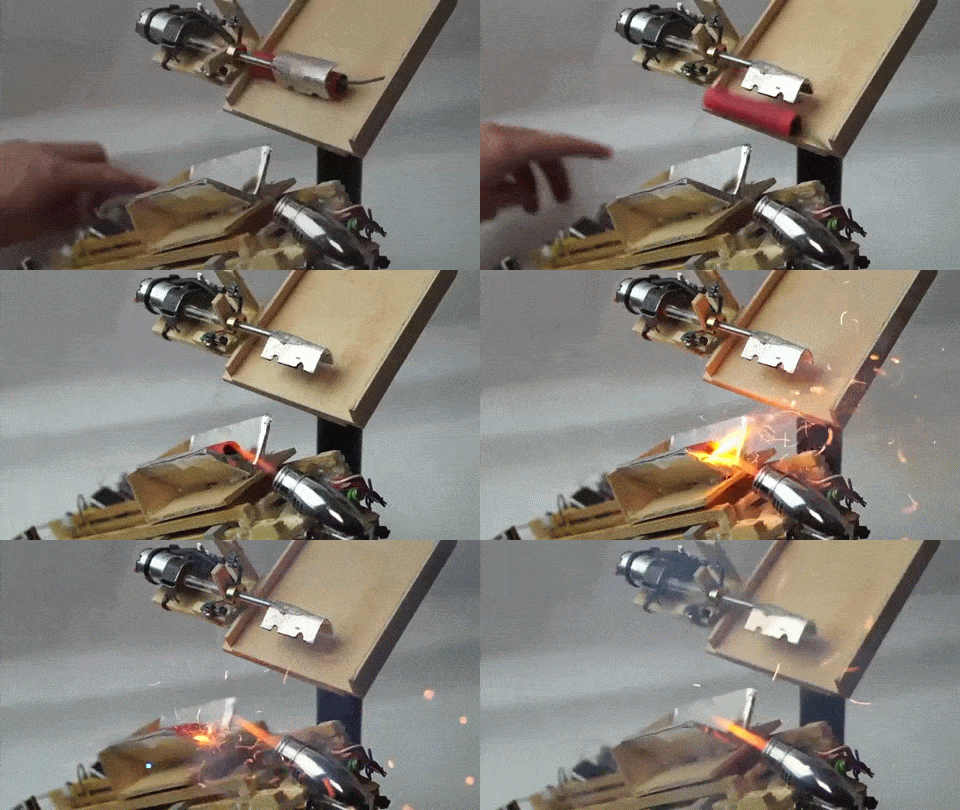
[Valentin]’s build has all the earmarks of an inspired afternoon of hasty hacking. Mostly built of wood and hot glue, there’s a feed ramp for fresh ammo and an elastic-powered sled on a ramp. Fireworks are metered onto the sled with one turn of a small gear motor, the fuse is light by a butane torch, and another gear motor pulls the sled back and launches the firecracker. The launch is somewhat anemic – perhaps some stouter rubber bands or latex tubing would provide a little more oomph. But it’s still a fun build with plenty of potential for improvement – perhaps something along the lines of this automated beer catapult? Continue reading “Your Fingers Will Never Leave Your Hands With This Firecracker Launcher”→
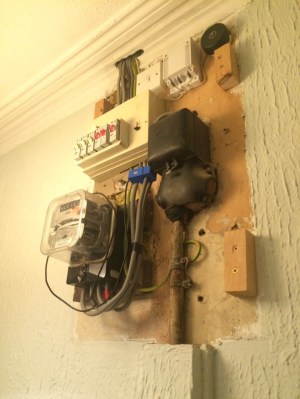
When you move into a new house, there’s always something that needs fixing up. A bit of paint and some new drapes may help freshen up the place and put your mark on it, but things like exposed wiring and a very utilitarian looking electrical panel in your front hall are altogether different. Unwilling to live with the mess, [John Whittington] decided to enclose his utility panel and add a Nixie tube IoT watt meter to dress things up while monitoring energy usage.
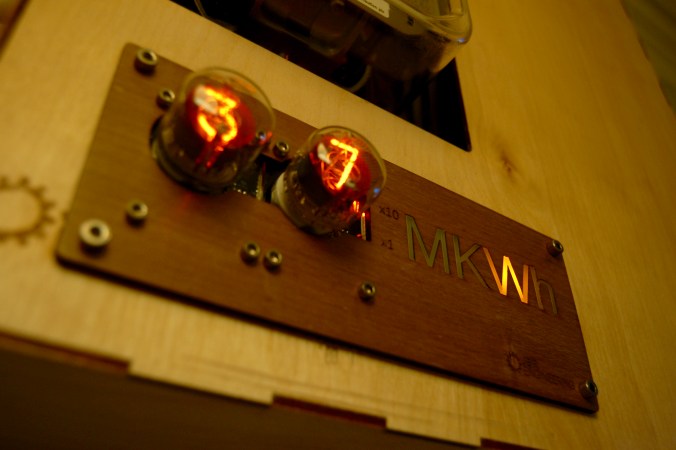
Looking at the “before” pictures on [John]’s blog, we can see why he’d want to invest the effort – not exactly an attractive way to greet guests at the front door. A simple wooden box to replace the previous cover would have sufficed, but why pass up the opportunity to add value? [John] opted for a Nixie tube display to complement the glass of the electric meter. The Nixie modules were a bit on the pricey side, though, so with only a pair of tubes to work with, [John] came up with a clever system to indicate the scale of the display. We doubt he’ll ever see megawatt-level instantaneous power draw, but the meter is also capable of totalling energy use, and as a bonus an ESP-8266 gives lets him stream data to the web.
We’ve featured tons of Nixie projects before – everything from clocks to cufflinks. We have to agree that [John]’s Nixie project turned out great, and it’s sure to be a conversation starter with arriving guests.





 Looking at the “before” pictures on [John]’s blog, we can see why he’d want to invest the effort – not exactly an attractive way to greet guests at the front door. A simple wooden box to replace the previous cover would have sufficed, but why pass up the opportunity to add value? [John] opted for a Nixie tube display to complement the glass of the electric meter. The Nixie modules were a bit on the pricey side, though, so with only a pair of tubes to work with, [John] came up with a clever system to indicate the scale of the display. We doubt he’ll ever see megawatt-level instantaneous power draw, but the meter is also capable of totalling energy use, and as a bonus an ESP-8266 gives lets him stream data to the web.