Shark With Frickin’ LED Tells People Not To Bother You

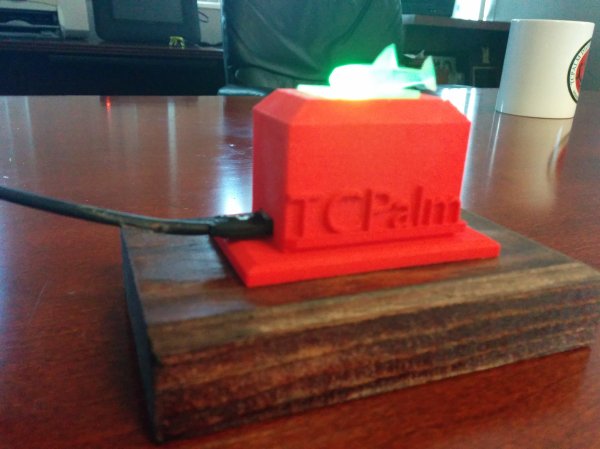
Everybody is busy these days, but sometimes it’s hard to tell. What with teleconferences being conducted over tiny Bluetooth headphones and Skype meetings where we seem to be dozing in front of the monitor, we’ve lost some of the visual cues that used to advertise our availability. So why not help your colleagues to know when to give you space with this shark themed WiFi-enabled meeting light?

Why a shark and not a mutated intemperate sea bass? Only [falldeaf] can answer that. But the particulars of the build are well-documented and pretty straightforward. A Photon runs the show, looking for an Outlook VFB file to parse. An RGB LED is used to change the color of the translucent 3D printed shark based on whether you’re in a meeting, about to step into one, or free. The case is 3D printed as well, although [falldeaf] farmed the prints out to a commercial printing outfit because of the size and intricacy of the parts. He did fabricate a nice looking wood base for the light, though.

There are plenty of ways to tell people to buzz off, but this is a pretty slick solution. For those in open floor plan workspaces, something like this IoT traffic light for you and your cube-mates might be in order.

Stepping Out In Style With Top Hat Navigation

Wearable tech is getting to be a big thing. But how we interface with this gear is still a bit of a work in progress. To explore this space, [Bruce Land]’s microcontroller course students came up with an acoustic interface to assist with navigation while walking. With style, of course.

[Bruce], from the Cornell University School of Electrical and Computer Engineering, has been burning up the Hackaday tips line with his students’ final projects. Here’s the overview page for the Sound Navigation Hat. It uses a PIC32 with GPS and compass. A lot of time was spent figuring out how to properly retrieve and parse the GPS data, but for us the interesting bits on that page are how the directional sound was put together.

Audio tones are fed to earbuds with phase shift and amplitude to make it seem like the sound is coming from the direction you’re supposed to walk. Navigation is all based on pre-programmed routes which are selected using a small LCD screen and buttons. One thing’s for sure, the choice of headwear for the project is beyond reproach from a fashion standpoint – engineering has a long history with the top hat, and we think it’s high time it made a comeback.

Is this a practical solution to land navigation? Of course not. But it could be implemented in smartphone audio players for ambient turn-by-turn navigation. And as a student project, it’s a fun way to demonstrate a novel interface. We recently covered a haptic navigation interface for the visually impaired that uses a similar principle. It’ll be interesting to see if either of these interfaces goes anywhere.

Continue reading “Stepping Out In Style With Top Hat Navigation”

Garbage Can RC Car Engine Powers Ridiculous Pencil Sharpener

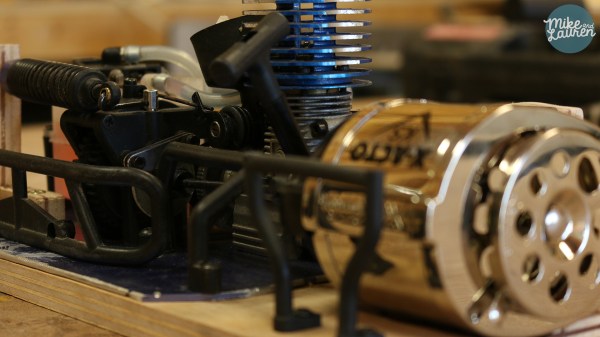
Christmas has come and gone, and no doubt garbage cans are filling with toys that got but a single use before giving up the ghost. If you scrounge around, you might get lucky and score a busted RC car so you can be like [Mike] and build a completely unnecessary nitro-powered pencil sharpener.

This is one from the [Tim The Tool Man Taylor] “more power” files. To be fair, [Mike] acknowledges as much right up front, and as a learning tool for these super-powerful internal combustion engines, we think it’s a pretty cool project. After dealing with a seized cylinder on what looks to be a VX .18 engine rated at about 1.1 horsepower, [Mike] learns the basics of starting and controlling the engine. Once coupled to a pencil sharpener that clearly isn’t engineered to work at a bazillion RPM and jury-rigging a damper for the clutch, [Mike] fires up the engine and races through a pack of 10 pencils in record time.

As silly as this hack seems, it could come in handy if you decide to go into the colored pencil jewelry market at production levels.

Continue reading “Garbage Can RC Car Engine Powers Ridiculous Pencil Sharpener”

Mobile Mini Green Recreates Coeur D’Alene’s Floating 14th Hole

Golf is an expensive obsession for some, with course fees on the most memorable and challenging courses running into the hundreds of dollars a game and beyond. If playing one of the most unusual holes in golf is simply beyond your means, there’s no need to fret – just do what [TVMiller] did and build a miniature mobile replica of the famous Coeur d’Alene Resort Floating 14th hole.

The Floating 14th is pretty spectacular as far as golf holes go. With a green located on an island about a hundred yards offshore of beautiful Lake Coeur d’Alene in northern Idaho, there’s little room for error – after all, it’s surrounded by a 49 square mile water trap. [TVMiller]’s replica green recreates the target quite accurately, although we doubt the Jolly Wrencher flag is regulation for championship play. But the best part is the motorized platform and smartphone app that can be used to send the mini green out as far as you feel like practicing. Sure, it could be a tad more realistic if the replica green actually floated, but asphalt fairways are a little easier to come by than Olympic-sized swimming pools.

A fun, tongue-in-cheek project, and we really enjoyed the faux TV coverage of the 2015 Hackaday Golf Championship in the video below. If real golf isn’t your thing, you might want to build a table-top golf course, or play a round of mini golf with a ball-incinerating Portal themed hole.

Continue reading “Mobile Mini Green Recreates Coeur D’Alene’s Floating 14th Hole”

Parts Bin Emergency Lights Deal With Tornado’s Aftermath

Sometimes having a deep inventory of parts in your shop is a pain – the clutter, the dust, the things you can’t rationally justify keeping but still can’t bear to part with. But sometimes the parts bin delivers and lets you cobble together some emergency lighting when a tornado knocks out your power.

It has been hard to avoid discussions of the weird weather in the US this winter. The eastern half of the country has had record warm temperatures, the west has been lashed by storms, and now December tornadoes have ripped through Texas and other parts of the south, with terrible loss of life and wide-ranging property damage. [TheTimmy] was close enough to one massive EF4 tornado to lose power on Saturday night, and after the charm of a candlelight Christmas evening wore off, he headed to the shop. He had a bunch of sealed lead acid batteries from old UPSs and a tangle of 12V LED modules, and with the help of some elastic bands and jumper clips he wired up a bunch of lights for around the house. Safer than candles by a long shot, and more omnidirectional than flashlights to boot.

The power came back before the batteries ran out of juice, so we don’t get to see any hacks for recharging batteries in a grid-down scenario. Still, it’s good to see how a deep parts bin and good mindset can make a positive impact on an uncomfortable situation. We’ve seen similar hacks before, like this hacked cordless tool battery pack or powering a TV with 18650 batteries. Be sure to share your story of epic power-outage hacks in the comments below.

Is Robot Butter Better Butter?

Humans have been making butter for thousands of years. If you have a cooperative cow or sheep and a means to agitate her milk, butter is not far behind. So why would you employ a $15,000 industrial robot to make butter? Because – robot butter!

Actually, Robutter is a design experiment by [Stephan], [Philipp], and [Jonas] to explore where craft ends and industrial processes begin, and to see how automation adds or removes values from traditional products. It’s a fair question, given that butter can be churned with everything from animal skins to massive continuous churns. So the team programmed [DIRK], a Fanuc LR Mate 200ic which is normally more at home on an assembly line, to carefully agitate a container of cream. After a bit of fiddling they found the optimal position and movements to produce a delicate butter that looks pretty tasty. The video after the break shows the process and the results, but sadly there’s no taste test of the Robutter against grocery store butter.

It may come as a surprise that Hackaday appears never to have featured a butter making project before. Sure, we’ve got a lot of food hacks, most of which seem to involve beer or coffee. But we did run across a recent article on a buttermilk pancake-making robot that you might like to check out.

Continue reading “Is Robot Butter Better Butter?”

Mostly Wood Motorized Camera Slider

Camera slides can make for interesting dolly shots in your videos, or can spice up an otherwise drab time-lapse sequence. When it came time for one of his own, [Bob] did what any hacker would do and rolled his own motorized camera slide in the wood shop.

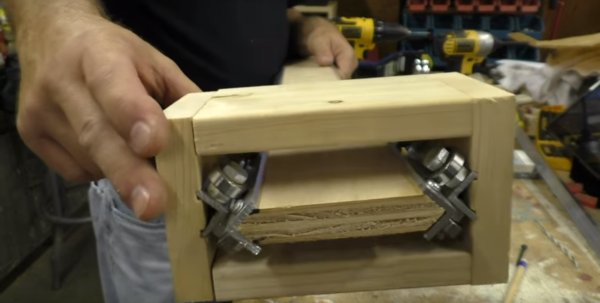
We always like to see work based on a hacker’s own prior art, and [Bob] managed to leverage parts and techniques from his impromptu claw machine build for this slider. The rollers in this project use the same 3/4″ angle aluminum and skateboard bearings as the previous build. The bearings roll on a plywood strip capped with the same angle stock for durability and low friction. The stepper motor bracket and pillow blocks are 3D printed, as are the timing pulleys. [Bob] admits that the whole rig is a little noisy and blames it on the rough quality of the pulley prints. He has plans to replace them with commercially available pulleys, which should help; one further suggestion we have is to code a soft-start algorithm into the ATtiny85 to eliminate that jerkiness you see when he demos the slider in the video below.

There are plenty of ways to move a camera along a single axis, and a surprising number of them use parts from the roller sports. We’ve covered quite a few of them before, like this slide that uses skateboard trucks, or this non-motorized rig built from fence posts and inline skate wheels.

Continue reading “Mostly Wood Motorized Camera Slider”