Feral cats are a huge problem in some areas. Roaming freely in cities and in rural settings and reproducing with reckless abandon, colonies of feral cats can exhibit nuisance behavior that often results in unpleasant measures being taken to control their population. More humane programs, such as trap-neuter-return (TNR), seek to safely trap cats, give them basic vaccinations and neuter them, and either return them to their colony or, for a lucky few, ready them for adoption. Such programs are proving successful, but are not without issues. Enter Das Katzetelegraf.
You don’t need to understand a lick of German to figure out exactly what Das Katzetelegraf does from its name. Consisting of an Arduino, a GSM module, and a simple magnetic reed switch attached to the door of a humane cat trap, Das Katzetelegraf sends a text message to a TNR program volunteer when a cat has been trapped. Instead of waiting in the trap for the TNR workers to make daily rounds, the cats are quickly retrieved and the trap is reset for the next cycle. This reduces the time the cat spends in the trap, stressed and without access to food or water, and improves the animal’s outcome. As a bonus, each trap’s throughput is increased, so more animals can be cycled through the TNR program.
TNR can really help reduce feral cat populations, and Das Katzetelegraf can make them even more effective. But if you just have a stray cat pooping up your garden, a Raspberry Pi cat-deterring sprinkler might be a better choice.
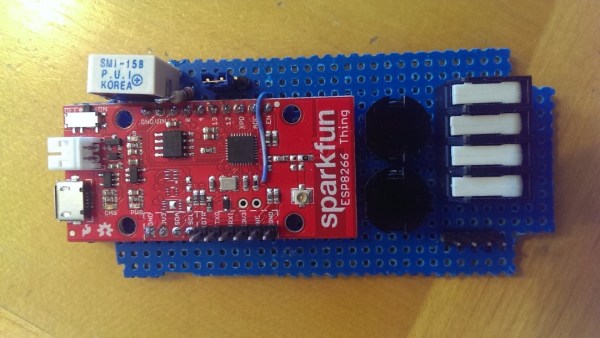
It has been incredibly humid around these parts over the last week, and there seems to be something about these dog days that makes you leave the fridge or freezer door open by mistake. [pnjensen] found this happening all too often to the family chill chest, with the predictable accretion of frost on the coils as the water vapor condensed out of the entrained humid air and froze. The WiFi-enabled fridge alarm he built to fight this is a pretty neat hack with lots of potential for expansion.
Based on a Sparkfun ESP8266 Thing and home-brew door sensors built from copper tape, the alarm is rigged to sound after 120 seconds of the door being open. From the description it seems like the on-board buzzer provides a periodic reminder pip while the door is open before going into constant alarm and sending an SMS message or email; that’s a nice touch, and having the local alarm in addition to the text or email is good practice. As a bonus, [pjensen] also gets a log of each opening and closing of the fridge and freezer. As for expansion, the I2C header is just waiting for more sensors to be added, and the built-in LiPo charger would provide redundancy in a power failure.
If frost buildup is less a problem for you than midnight snack runs causing another kind of buildup, you might want to check out this willpower-enhancing IoT fridge alarm.
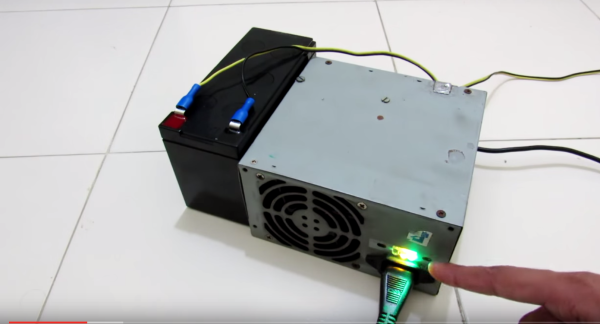
The uninterruptible power supply was once a standard fixture in the small office/home office as a hedge against losing work when the electrons stop flowing from your AC outlet. Somewhat in decline as computing hardware shifts away from dedicated PCs toward tablets, phones and laptops, the UPS still has a lot of SOHO utility, and off-the-shelf AC units are easy to find. But if your needs run more to keeping the electrons flowing in one direction, then you might want to look at [Kedar Nimbalkar]’s programmable DC backup power system.
Built inside a recycled ATX power supply case, [Kedar]’s project is heavy on off-the-shelf components, like a laptop power supply for juice, a buck converter to charge the 12 volt sealed lead acid battery, and a boost converter to raise the output to 19.6 volts. An Arduino and an optoisolator are in charge of controlling the charging cycle and switching the UPS from charging the battery to using it when mains voltage drops.
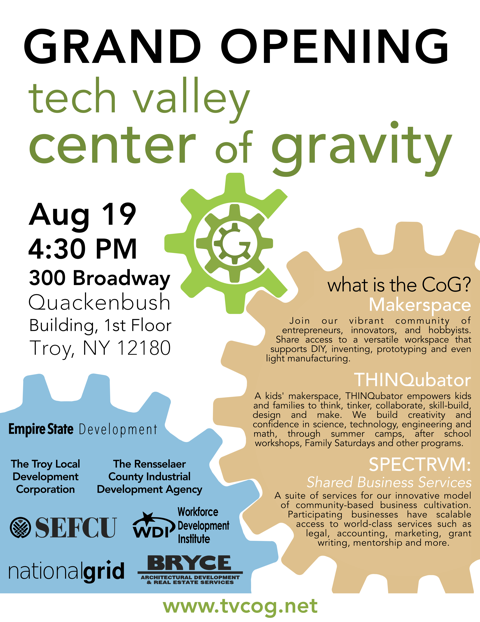
Last week we got an invitation in the Hackaday tip line to attend the grand opening of a hackerspace in Troy, New York. Styling itself the Tech Valley Center of Gravity, the group seemed intriguing – a combination of makerspace and business incubator. But what was this about a grand opening? Hackerspaces don’t open – they just occupy a found space and grow by accretion until they reach a critical mass of equipment and awesomeness. I decided I needed to see this for myself, and being only a two-hour drive from my home, I headed off with my kids in tow and a small pile of Hackaday swag to see what a ribbon cutting for a hackerspace would be like. Plus I absolutely had to find out what in the world a “Quackenbush Building” was.
I was not disappointed. The Center of Gravity is a really special group of folks with an incredible vision of what it means to be hackers. Hackerspaces make a lot of things – great projects and gadgetry, plus sawdust, metal chips, and the occasional puff of Magic Blue Smoke. The Center of Gravity makes all of that, but it also makes entrepreneurs, businesses, and actual products. And it can reasonably claim to have a hand in community renewal.
The Quackenbush
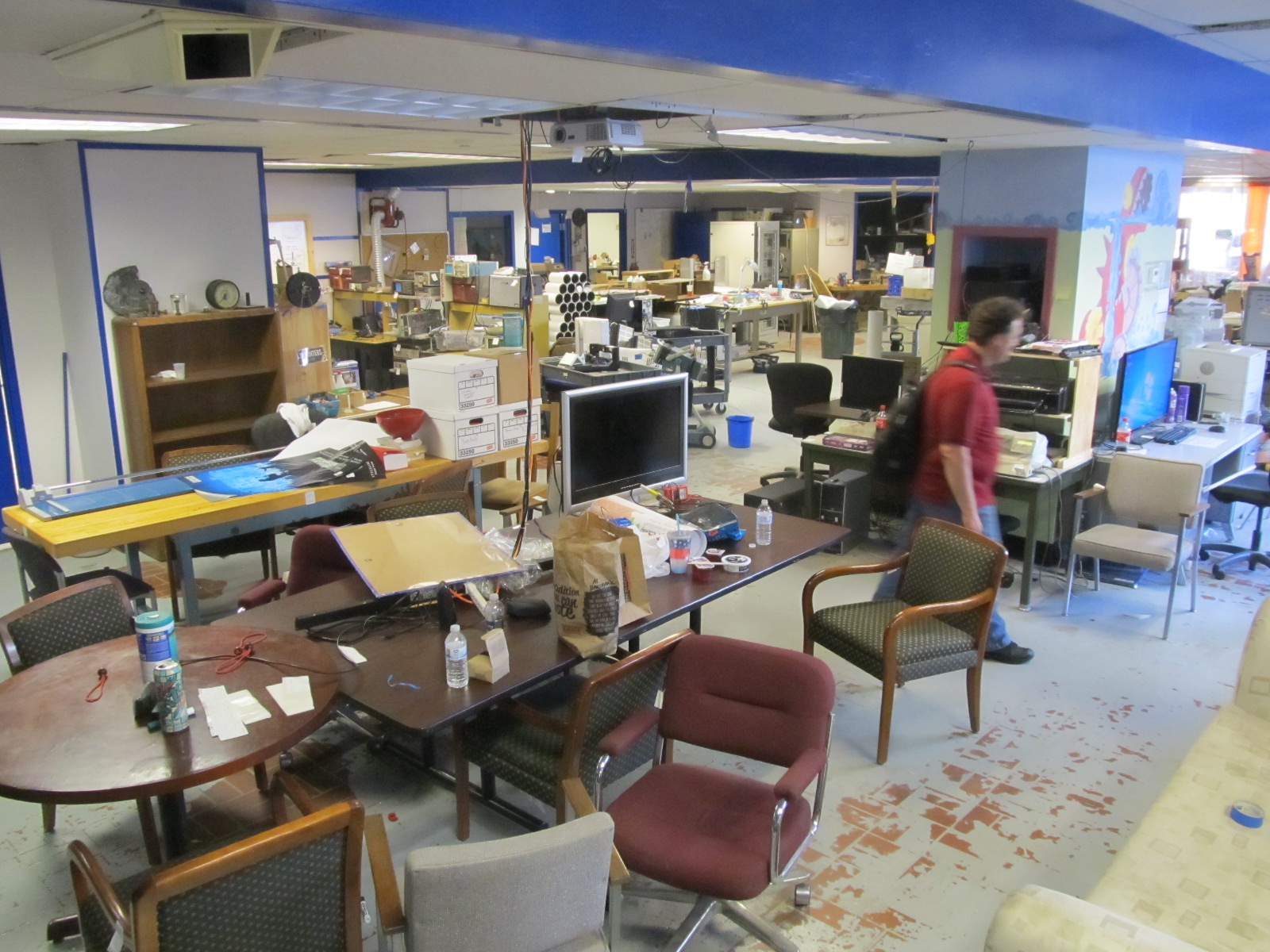
The Quackenbush Building [source 1=”<a” 2=”href="http://alloveralbany.com/archive/2015/08/19/tech-valley-center-of-gravity-quackenbush-building">All” 3=”Over” 4=”Albany</a>” language=”:”][/source]I have to admit my first impression of the event was a little confused. There was a huge crowd stuffed into the high-ceilinged first floor of an old building taking up most of a city block. There were a few 3D printers set up on tables, and groups of people demonstrating cool stuff – my son was especially keen to try the Airsoft rifle interface to Counterstrike. But the whole thing had a decidedly science fair atmosphere to it, with obvious civilians mixing and mingling with the black t-shirted hackers. There were also quite a few folks in business attire, plus white-shirted wait staff circulating with appetizers and drinks. But where was the machine shop? The laser cutters? The electronics benches and oscilloscopes and function generators? Where were the projects in various states of assembly? Had I driven all this way just to see a community outreach event?
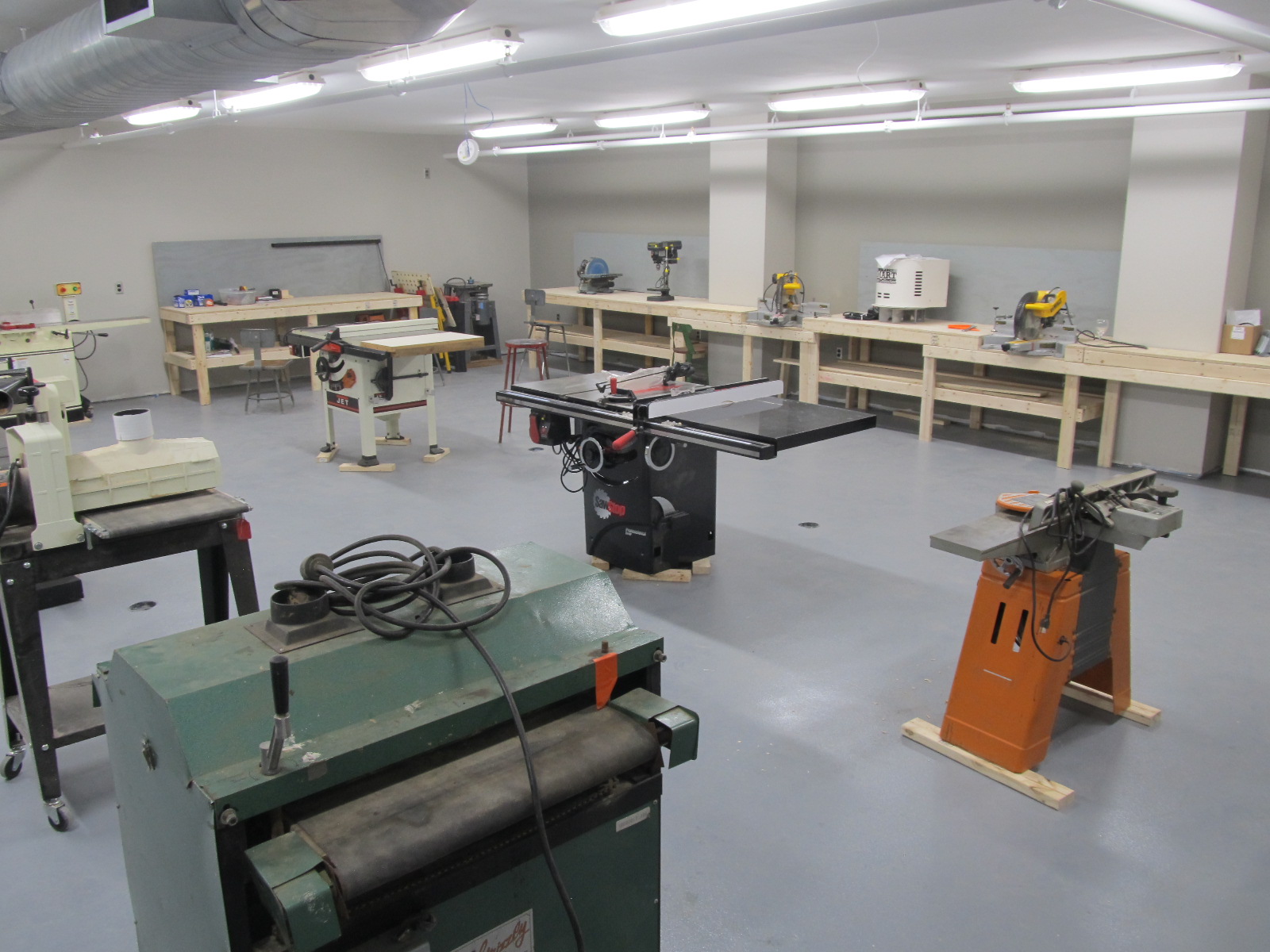
Disappointed, I headed down the stairs to the basement, which was mercifully cooler than the first floor. Ah, ha! Here were the shops – huge and brand new, with separate areas for woodwork and metalwork. And here I met [Bob Bownes], vice president of CoG, serial entrepreneur, and the fellow who invited me. And this is where I finally learned the full story of what was going on.
The CoG woodshop – still has that new hackerspace smell.
The ribbon cutting that was going on upstairs – the ribbon being a copper braid and the scissors being a MIG welder – was the official start of the CoG’s residency in its new space in the renovated Quackenbush Building. Built in the 1850s, it was home to the Quackenbush Department Store until the 1930s, when it switched hands to another chain. It finally became a Rite Aid pharmacy which, in a sign of the hard times Troy would fall upon, closed in the early 2000s. The beautiful old building was purchased by a local developer, renovated with the help of various state grants, and its 48,000 square feet were turned over to the CoG group, who could now move out of their cramped and confining home in the bottom of a parking garage that was once a McDonald’s and an off-track betting parlor.
Making Businesses
It wasn’t just good fortune that lead to the CoG being able to expand so dramatically. As [Bob] explained, the CoG had been designed from the ground up to be a business incubator as well as a hackerspace. If you have an idea, you can turn it into a product in the CoG hackerspace, then turn the product into a business in the incubator. The upper two floors of the Quackenbush are devoted to the incubator, which provides fledgling companies with access to administrative functions, provides conference and office space, and helps get businesses off the ground.
The old CoG, in a former McDonald’s.
One such business is Vital Vio, a maker of visible light disinfection fixtures. Vital Vio got its start in the aforementioned former McDonald’s, and will take advantage of the 3,000 square foot light manufacturing swing space in the basement of the Quackenbush to ramp up its production. The goal is to have Vital Vio and the companies that will no doubt follow it move on to space of their own, at which point the next company will take over the swing space for their first manufacturing operation – hack, rinse, repeat. With quite a few businesses already in the incubator stage, it should be exciting to watch what comes out of the CoG over the next few years.
Making Community
I had been to Troy a few times back in the ’80s and ’90s, and I wasn’t impressed. It always seemed seedy and run down to me, like so many towns and cities in the northeast US that had their manufacturing hearts ripped out of them in the 1970s. But the Troy we saw on Wednesday was a totally different place – vital and happening, with bistros and bakeries and funky public spaces. [Bob] explained that CoG had plenty to do with that – at least six new companies had relocated to the area around the Quackenbush specifically because of CoG. And it’s hoped that the businesses that spin off the incubator will choose to stay close to the nest, which will attract more businesses and more people to the area. That’s quite a change from the point where even a McDonald’s and an off-track betting parlor are no longer viable.
My trip to the Tech Valley Center of Gravity was not your typical hackerspace tour, but the CoG is not your typical hackerspace. There’s a lot to be said for the vision that created this place, and the model they’ve adopted for churning out businesses really seems to be working. Almost the entire incubator space is spoken for already, so there are plenty of companies waiting to be born there. That’s not to say that the average hacker who just wants a place to play won’t feel at home in the CoG – there’s plenty of room for them too, and the CoG even welcomes families with special memberships and STEM outreach programs. But if you have the germ of an idea, it can go from product to business with the help of a place like this, and that’s a pretty cool idea.
My thanks to [Bob], [Matt] and [Tait] for taking so much time out of their celebration to show us around. I hope we can visit again once everything is moved and you’re settled into your awesome new home.
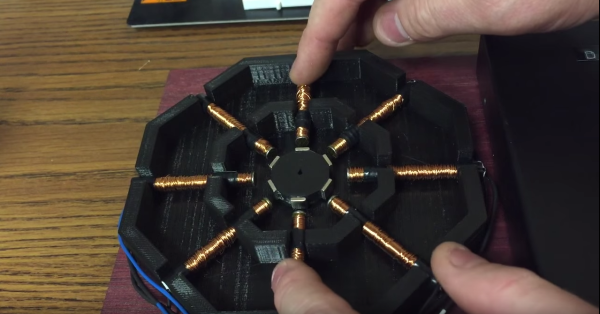
Few hackers have trouble understanding basic electric motors. We’ve all taken apart something that has a permanent magnet DC motor in it and hooked up its two leads to a battery to make it spin. Reverse the polarity, reverse the spin; remove the power, stop the spin. Stepper motors (and their close cousins, brushless DC motors) are a little tougher to grok, though, especially for the beginner. But with a giant 3D printed stepper motor, [Proto G] has made getting your head around electronically commutated motors a little easier.
While we’ve seen 3D printed stepper motors before, the size and simple layout of this one really lends to understanding the theory. With a 3D-printed frame, coils wound on nails, and rare-earth magnets glued to a rotor, this is an approachable build that lays the internals of a stepper motor out for all to see and understand. You can easily watch how the rotor lines up as the various coils are energized in a circular pattern, although it might be more revealing to include bi-color LEDs to indicate which coils are energized and what the polarity is. Those would be especially helpful demonstrating the concept of half-stepping. We’d also like to see more detail on the controller electronics, although admittedly all the video-worthy action is in the motor itself.
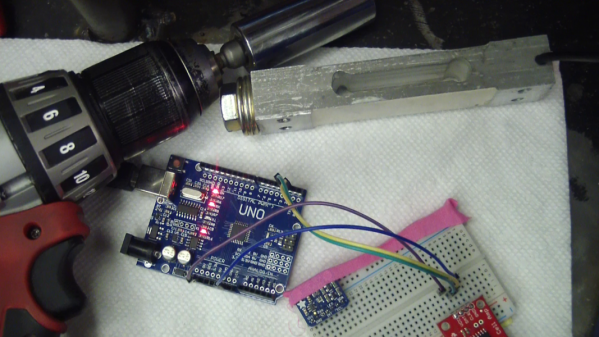
Ever obsessed with stripping the hype from the reality of power tool marketing, and doing so on the cheap, [arduinoversusevil] has come up with a home-brew digital torque meter that does the job of commercial units costing hundreds of times as much.
For those of us used to [AvE]’s YouTube persona, his Instructables post can be a little confusing. No blue smoke is released, nothing is skookum or chowdered, and the weaknesses of specific brands of tools are not hilariously enumerated. For that treatment of this project, you’ll want to see the video after the break. Either way you choose, he shows us how a $6 load cell and a $10 amplifier can be used to accurately measure the torque of your favorite power driver with an Arduino. We’ve seen a few projects based on load cells, like this posture-correcting system, but most of them use the load cell to measure linear forces. [AvE]’s insight that a load cell doesn’t care whether it’s stretched or twisted is the key to making a torque meter that mere mortals can afford.
Looks like low-end load cells might not be up to measuring the output on your high-power pneumatic tools, at least not repeatedly, but they ought to hold up to most electric drivers just fine. And spoiler alert: the Milwaukee driver that [AvE] tested actually lived up to the marketing. Continue reading “High Tech, Low Cost Digital Torque Meter”→
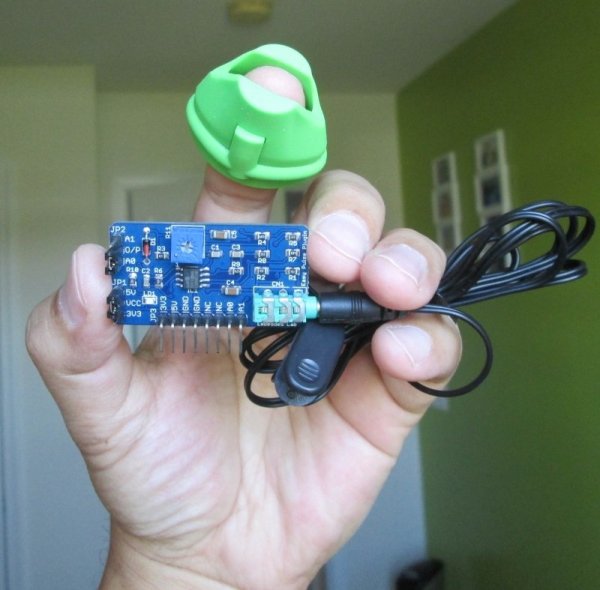
Chances are pretty good you’ve had a glowing probe clipped to your fingertip or earlobe in some clinic or doctor’s office. If you have, then you’re familiar with pulse oximetry, a cheap and non-invasive test that’s intended to measure how much oxygen your blood is carrying, with the bonus of an accurate count of your pulse rate. You can run down to the local drug store or big box and get a fingertip pulse oximeter for about $25USD, but if you want to learn more about photoplethysmography (PPG), [Rajendra Bhatt]’s open-source pulse oximeter might be a better choice.
PPG is based on the fact that oxygenated and deoxygenated hemoglobin have different optical characteristics. A simple probe with an LED floods your fingertip with IR light, and a photodiode reads the amount of light reflected by the hemoglobin. [Rajendra]’s Easy Pulse Plugin receives and amplifies the signal from the probe and sends it to a header, suitable for Arduino consumption. What you do with the signal from there is up to you – light an LED in time with your heartbeat, plot oxygen saturation as a function of time, or drive a display to show the current pulse and saturation.