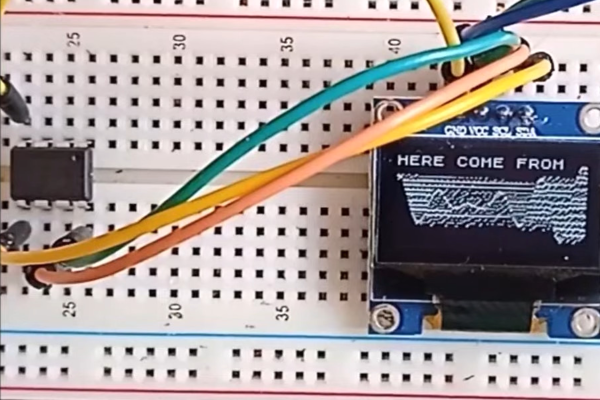
[Görg Pflug] wrote in with his really nice graphics library. It’s got multiple layers, two text consoles, greyscale, internal halftoning, and sprites. It can pull off a number of classic graphics tricks and demos. Oh yeah, and did we mention it runs on a freaking ATtiny85 and an I2C OLED screen?!
This is an amazing piece of work — if you’d asked us if this was possible, we would have probably said “no”. And now it’s yours to use in your own projects. The GitHub repo is full of demos showing off everything from switching between multiple layers, extremely rapid text scrolls, animations, boing balls, and even a Wolfenstein-style raycaster. On an ATtiny85.
There’s a demo video, embedded below, that shows it all off, but honestly you have to think about what’s going to to be suitably wowed. The first demo just seems to have a graphic wave over static text, for instance. No big deal? It’s blending the greyscale layers together and dithering them out to black and white for the OLED in real time! On an ATtiny85.
While the library is written in straight C++, there are even a couple examples of how you’d integrate this with Arduino’s Wire library if you so wished. We don’t know about you, but this makes us want to whip together an ATtiny85 and SSD1306 OLED demo board just to start playing around. This isn’t just an amazing hack, but it would also be a useful way to add graphics and a nice console to any project you’re working on.
Did we mention it’s all done on an ATtiny85? Over I2C? Kudos!
We ran an article this week about RS-485, a noise resistant differential serial multidrop bus architecture. (Tell me where else you’re going to read articles like that!) I’ve had my fun with RS-485 in the past, and reading this piece reminded me of those days.
You see, RS-485 lets you connect a whole slew of devices up to a single bundle of Cat5 cable, and if you combine it with the Modbus protocol, you can have them work together in a network. Dedicate a couple of those Cat5 lines to power, and it’s the perfect recipe for a home, or hackerspace, small-device network — the kind of things that you, and I, would do with WiFi and an ESP8266 today.
Wired is more reliable, has fewer moving parts, and can solve the “how do I get power to these things” problem. It’s intrinsically simpler: no radios, just serial data running as voltage over wires. But nobody likes running cable, and there’s just so much more demo code out there for an ESP solution. There’s an undeniable ease of development and cross-device compatibility with WiFi. Your devices can speak directly to a computer, or to the whole Internet. And that’s been the death of wired.
Still, some part of me admires the purpose-built simplicity and the bombproof nature of the wired bus. It feels somehow retro, but maybe I’ll break out some old Cat5 and run it around the office just for old times’ sake.
This article is part of the Hackaday.com newsletter, delivered every seven days for each of the last 200+ weeks. It also includes our favorite articles from the last seven days that you can see on the web version of the newsletter.
Want this type of article to hit your inbox every Friday morning? You should sign up!
This year’s Hackaday Prize is off to a roaring start. And that’s fantastic, because this year’s challenge is a particularly important one: reducing mankind’s footprint on the earth through better energy collection, better resource use, and keeping what we’ve already got running a little bit longer. Not only is this going to be the central challenge for the next century, but it’s also a playground for hackers like us.
The first phase, Planet-Friendly Power, is in full swing, and we saw some entries on the first day! Were they cheating? Did they have inside information? Nope! Tons of hackers are working on energy efficient ways to drive their projects all along. If your Raspberry Pi data-logger can run on the fuel of the sun, it’s not only better for the world, but it’s a project that you don’t have to remember to change the batteries on.
We’ve got a challenge on recycling, one on reverse engineering stuff to keep it out of the landfill, and one on environmental monitoring and communications infrastructure. These are all great hacker topics, and showcase how folks like us can do our small parts to keep the world running without running it into the ground.
So all of you out there making mesh networks, optimizing solar projects, hacking open closed IoT networks to keep them from obsolescence, or building plastic-sorting robots, this is your chance to get some money and some recognition for your good work.
Thanks again to our Supplyframe overlords for consistently backing and believing in the purpose of the Hackaday Prize, and also to DigiKey who’s been a sponsor of the Prize many years running! Without them, we wouldn’t be able pull this off.
Hack the planet! (Non-ironically, and literally. And get money for doing it.) Hooray for the Hackaday Prize!
This article is part of the Hackaday.com newsletter, delivered every seven days for each of the last 200+ weeks. It also includes our favorite articles from the last seven days that you can see on the web version of the newsletter.
Want this type of article to hit your inbox every Friday morning? You should sign up!
The biggest challenge facing humanity over the next century is how to do as much or more, with less environmental impact. Reducing our collective footprint on the planet is of course not any one person’s responsibility alone, and if it’s going to require a million clever solutions to create a sustainable future, then we know just the group of hackers to get to work.
This year’s 2022 Hackaday Prize challenges you to think of big or small ways to create greener energy sources, make recycling easier, hack old devices to save them from the landfill, or build out the networks that keep our local communities together and conscious of our group effort. If you’ve got a super solar harvester, a recycling robot, or even reverse engineering tools to help combat forced technological obsolescence, we want to see your hacks. Or if you’d like, you can simply save the world in the wildcard round.
As always, courtesy of our overlords at Supplyframe and the generous sponsorship of Digikey, we’ve got tons of prize money to give out to the best projects. The top ten projects in each of five challenge rounds will receive a $500 cash prize, and five winning projects will bag from $5,000 to $50,000 in the finals in November. But you shouldn’t wait — the first round, Planet-Friendly Power, starts right now!
Get your team together, start brainstorming an idea, post it up on Hackaday.io to enter in the Prize, and you’re on your way. Independent of the judging, we’ll be looking through the field and writing up awesome projects as we find them. This is your chance to be seen, to help create a better world, and maybe even to win big.
Challenge
Date
The Details
Planet-Friendly Power
Mar 29 – May 1
Your solution should lower the cost of clean energy, through energy harvesting and/or storage efficiency improvements.
Reuse, Recycle, Revamp
May 1 – June 12
Your project facilitates recycling of material that would otherwise end up in the waste stream.
Hack it Back
June 12th – July 24
Your project adds new capabilities to older electrical gear to keep it useful.
Climate Resilient Communities
July 24 – Sept 4
Design devices that help communities be more resilient to weather and climate disasters and/or collect data from their environments so that they may advocate for changes in local infrastructure.
Save the World Wildcard
Sept 4 – Oct 16th
This is where anything goes, your designs should stand apart from the other challenges but still create a more promising future for all.
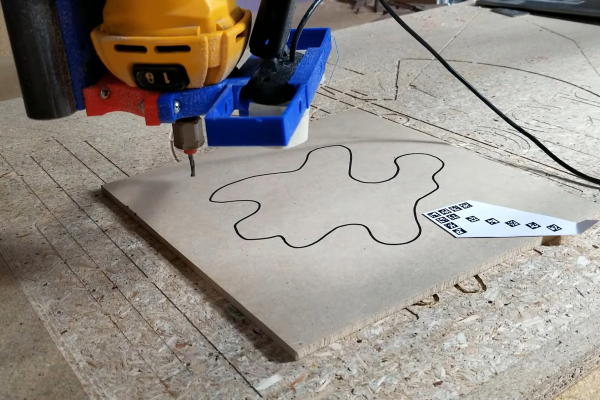
We got a tip this week, and the tipster’s comments were along the lines of “this doesn’t look like it’s a finished work yet, but I think it’s pretty cool anyway”. And that was exactly right. The work in question is basically attaching a simple webcam to a CNC router and then having at it with OpenCV, and [vector76]’s application was cutting out freeform hand-drawn curves from wood. To amuse his daughter.
But there’s no apology necessary for presenting a work in progress. Unfinished hacks are awesome! They leave room for further improvement and interpretation. They are like an unfinished story, inviting the hacker to dream up their own end. At least that’s how this one worked on me.
My mind went racing — adding smart and extensible computer vision to a CNC router enables not only line tracing, but maybe smarter edge finding, broken tool detection, and who knows what else. With the software end so flexible these days, and the additional hardware demands so minimal, it’s an invitation. It’s like Pavlov ringing that bell, and I’m the dog-hacker. Or something.
So remember this when you get half done with a project, get to a workable first-stage demo, but you haven’t chased down each and every possibility. Leaving something up to other hackers’ imagination can be just as powerful. Your proof of concept doesn’t have to be the mother of all demos — sometimes just a working mouse will suffice.
This article is part of the Hackaday.com newsletter, delivered every seven days for each of the last 200+ weeks. It also includes our favorite articles from the last seven days that you can see on the web version of the newsletter.
Want this type of article to hit your inbox every Friday morning? You should sign up!
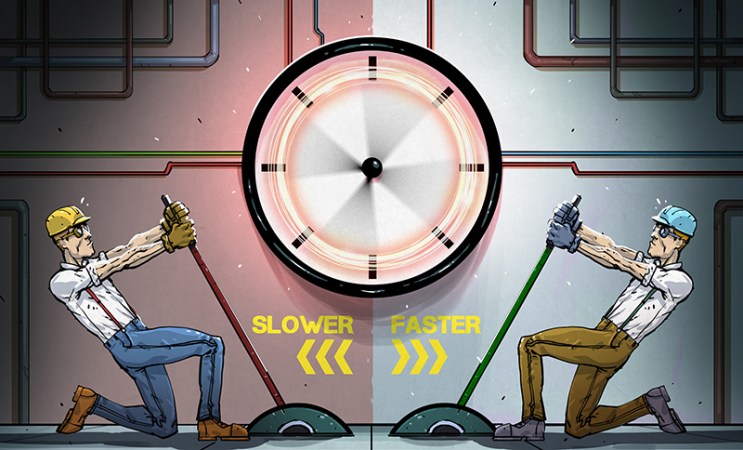
The US Senate has approved the “Sunshine Protection Act”, a bill to make Daylight Saving time the default time and do away with the annual time changes. While I can get behind the latter half of this motion, redefining Daylight Saving time as Standard time is, in my opinion, nonsense.
It’s particularly funny timing, coming right around the Vernal Equinox, when the sun stands at its highest right at Noon Standard Time, to be debating calling this time “one PM” forevermore.
Right Idea, Wrong Time
Let’s do a quick overview of the good idea here — doing away with time changes. These are known to cause sleep disturbances and this leads not just to sleepy heads on Monday morning, but to an increased risk of heart attack and accidents in general. When researchers look into the data, it’s the “springing forward” that causes trouble. People who’ve slept one extra hour don’t seem to suffer as much as people who’ve lost one. Go figure.
So maybe it makes sense to stop changing times. If we’re going to settle on one standard time, do we pick Standard time or Daylight Saving time? Admittedly, this is a totally unfair way to pose the question, but there are a number of good reasons to prefer all-year Standard time. The biggest one is winter. Basically, it’s already tough enough to get up on a cold January morning when the sun is not due to rise for another hour or two. Add another hour of darkness on top, and you know why the two previous attempts to run all-year Daylight Saving were short-lived. And why the Swedes drink so much coffee.
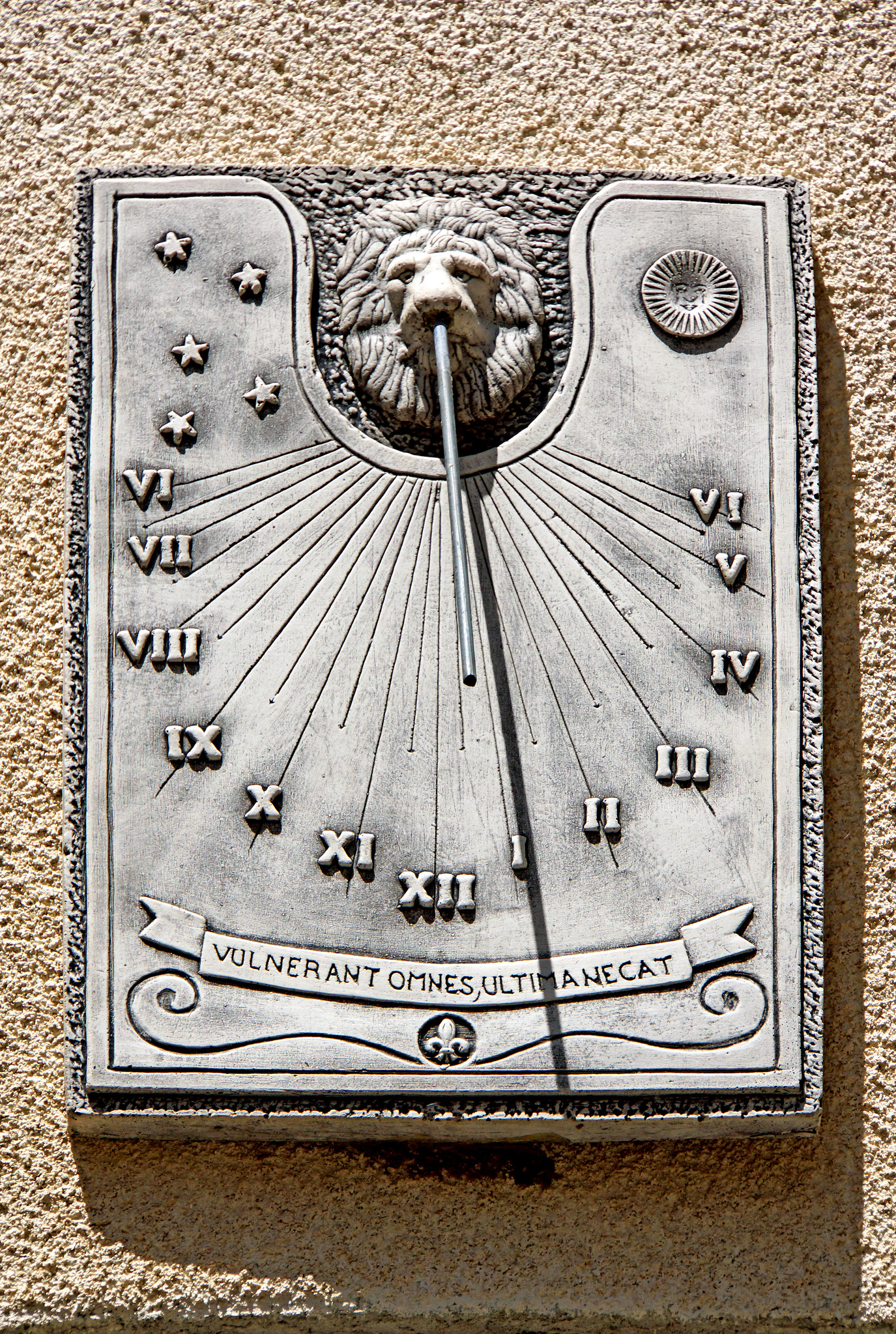
There’s also the fundamental logic behind our measurement of time that’s stood for centuries, and is embedded in most of our cultural references to time. Ante Meridian and Post Meridian. High Noon, when the hour hand on the clock points straight up, represents the sun itself. But even before clocks, the sun’s halfway point along its daily journey marked the halfway point of the day. That’s not only why we eat lunch when we do, it’s the origin of man’s time-telling itself.
If we change the definition of noon permanently, we’ve decoupled time from the sun. How will we explain time to future children? I’ll accept Daylight Saving time when we start reprinting analog watches with 1 o’clock at the top and start referring to 12 AM as the one that’s just before the sun reaches its peak. As soon as “one noon” replaces “twelve noon”, I’ll get on board. Midnight, when the clock strikes one, just doesn’t send the same shiver down my spine. Sorry, Dracula.
If culture and physics point to Standard Time, why would you want Daylight Saving to be the new normal? When people think of Daylight Saving, they naturally think of those nice long summer days that stretch out into the night. My personal bet is that many folks are confounding summertime with Summer Time. Heck, even the name of the bill proposes to protect sunshine itself, rather than just move the hands of the clock around. These are not good reasons.
[Jamie] aka [vector76] hit us with a line-tracing plugin for OctoPrint that cuts out whatever 2D shape you draw on a piece of wood. The plugin lets you skip the modeling step entirely, going straight from a CNC-mounted webcam that reads your scribbles and gives you a Gcode toolpath in return. The code is on GitHub and there’s a demo video embedded below.
Under the hood, OpenCV is doing a lot of the image processing, including line detection, and the iterative “find the line” and “move the toolhead” steps really show off what computer vision can do. It starts off with a fiducial arrow for scale and orientation, then it mores the webcam around the scene. The user can enter the usual milling parameters: speeds, feeds, depth of cut, tool offset, milling direction, etc. And then it gets to work.
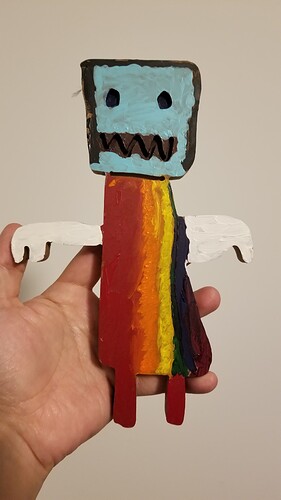
Right now, it’s limited to paths with non-crossing lines, and probably with good contrast and a nice dark line — all the usual CV restrictions. But mounting a webcam to a CNC toolhead and using it for various pathing problems really opens up tons of possibilities: visual homing, workpiece edge finding, copying parts, custom fitting odd shapes, and more. This project is clearly an invitation to keep on hacking, an appetizer. Once you see the girl pirate robot that [Jamie]’s daughter made, you’ll get the idea.
We’ve seen a similar OpenCV approach used for center-finding bore holes, but while we’ve seen a few webcams used with laser cutters, the CNC mill applications seem largely untapped. Let us know in the comments if you’ve got some other good examples.