RC3 2021: Now Here, Nowhere

The annual meeting of the Chaos Computer Club, Germany’s giant hacker group, is online again this year. While those of us here are sad that we don’t get to see our hacker friends in person, our loss is your gain — the whole thing is online for the entire world to enjoy.

This year’s Congress has gone entirely decentralized, with many local clubs hosting their own video streams and “stages”. Instead of four tracks, there are now six or seven tracks of talks going on simultaneously, so prepare to be overwhelmed by choice. You can find the overall schedule here, so if you see anything you’d like to watch, you’ll know when to tune in.

Like last year, there is also a parallel 2D simulation world, like Zelda with videoconferencing, but for which you’ll need a ticket, and they’re sold out. (Check out the demo video if you want to see what that’s about.) And what would a conference be without t-shirts, armbands, and even a sticker exchange? Or course, it all has to be done by mail, but you do what you can.

We’ll be keeping our eyes on the talks, and let you know if we see anything good. If you do the same, let us know in the comments!
Blender? No, Grinder

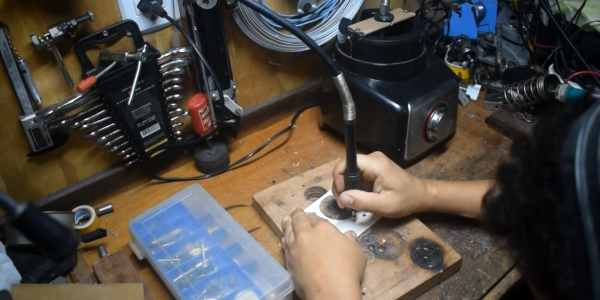
[Leandro Felipe] is no stranger to the dirty hack, and this video of his conversion of a blender into a handheld rotary grinding tool is no exception. (Embedded below.) But the end result is something pretty useful — a lighter and more maneuverable rotary grinder that’s got a lot more grunt to boot.

(The video is in Portuguese, but the captions work pretty well, once you get over the fact that the robots translate “grinding tool” as “rectifier” a lot of the time. And anyway, you’re here for the hacks.)

The highlights are a handmade coupling that mates the blender motor with the flexible shaft and chuck, purchased separately. And the flattened-out PVC pipe used as a mounting bracket. And him using the motor itself against a file to “lathe” down the drive shaft. And…

The tip of the day comes when he holds the blender motor in a metal vise to test it out. Metal and spinning magnets — what’s the worst that could happen?  Sparks, smoke, and a trip to the thrift store for another used blender.

If you just want to see the finished piece, you can jump ahead to the end. But it’s basically, get yourself a speed-adjustable blender, couple it to the shaft of an off-the shelf grinder, and you’re set.

It’s an idea so conceptually easy, you might wonder if Hackaday has ever showcased a blender dr3mel before. We have. What else can you power with a blender motor?

Thanks [Danjovic] for the tip!

Continue reading “Blender? No, Grinder” →

Do You Need A Cycloidal Drive?

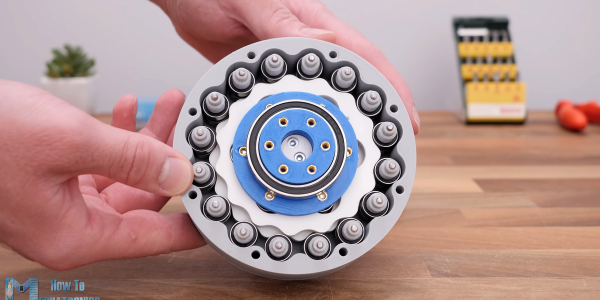
A cycloidal gear drive is one of the most mesmerizing reduction gears to watch when it is running, but it’s not all just eye-candy. Cycloidals give decent gearing, are relatively compact and back-drivable, and have low backlash and high efficiency. You probably want one in the shoulder of your robot arm, for instance.

But designing and building one isn’t exactly straightforward. Thanks, then, to [How To Mechatronics] for the lovely explanation of how it works in detail, and a nice walkthrough of designing and building a cycloidal gear reducer out of 3D printed parts and a ton of bearings. If you just want to watch it go, check out the video embedded below.

The video is partly an ad for SolidWorks, and spends a lot of time on the mechanics of designing the parts for 3D printing using that software. Still, if you’re using any other graphical CAD tool, you should be able to translate what you learned.

It’s amazing that 3D printing has made sophisticated gearbox designs like this possible to fabricate at home. This stuff used to be confined to the high-end machine shops of fancy robotics firms, and now you can make one yourself this weekend. Not exotic or unreliable enough for you? Well, then, buy yourself some flexible filament and step on up to the strain wave, aka “harmonic drive”, gearbox.

Thanks to serial tipster [Keith] for the tip!

Continue reading “Do You Need A Cycloidal Drive?” →

When Hacking And Biosensing Collide

[Prof. Edwin Hwu] of the Technical University of Denmark wrote in with a call for contributions to special edition of the open-access scientific journal Biosensors. Along the way, he linked in videos from three talks that he’s given on hacking consumer electronics gear for biosensing and nano-scale printing. Many of them focus on clever uses of the read-write head from a Blu-ray disc unit (but that’s not all!) and there are many good hacks here.

For instance, this video on using the optical pickup for the optics in an atomic force microscope (AFM) is bonkers. An AFM resolves features on the sub-micrometer level by putting a very sharp, very tiny probe on the end of a vibrating arm and scanning it over the surface in question. Deflections in the arm are measured by reflecting light off of it and measuring their variation, and that’s exactly what these optical pickups are designed to do. In addition to phenomenal resolution, [Dr. Hwu’s] AFM can be made on a shoestring budget!

Speaking of AFMs, check out his version that’s based on simple piezo discs in this video, but don’t neglect the rest of the hacks either. This one is a talk aimed at introducing scientists to consumer electronics hacking, so you’ll absolutely find yourself nodding your heads during the first few minutes. But then he documents turning a DVD player into a micro-strobe for high speed microfluidics microscopy using a wireless “spy camera” pen. And finally, [Dr. Hwu’s] lab has also done some really interesting work into nano-scale 3D printing, documented in this video, again using the humble Blu-ray drive, both for exposing the photopolymer and for spin-coating the disc with medium. Very clever!

If you’re doing any biosensing science hacking, be sure to let [Dr. Hwu] know. Or just tear into that Blu-ray drive that’s collecting dust in your closet.

Continue reading “When Hacking And Biosensing Collide” →

Santa’s Beard-Combing Robot

Working all year long, herding elves and fabricating toys for all the good boys and girls; it takes dedication. It’s only natural that one could fall behind in beard care, right? This year, [Norbert Zare] saves Christmas with his beard-combing robot.

OK, this is much more of a shitty robot in the [Simone Giertz] school of wicked funny machines than it is a serious robotics project. But props to [Norbert] for completeness — the code that wiggles the two servos that get the job (almost) done is even posted up on GitHub.

Check out the video below the break. Ho ho ho!

Continue reading “Santa’s Beard-Combing Robot” →

Hackaday Podcast Super-Short Holiday Edition

It’s a holiday weekend, and the Podcast is taking a break until 2022. But that can’t stop Hackaday’s Elliot Williams from giving out a t-shirt to the winner of last week’s What’s That Sound.

It’s the shortest Podcast ever!


Direct download (5 MB)

Continue reading “Hackaday Podcast Super-Short Holiday Edition” →

WS2812s On A 6502

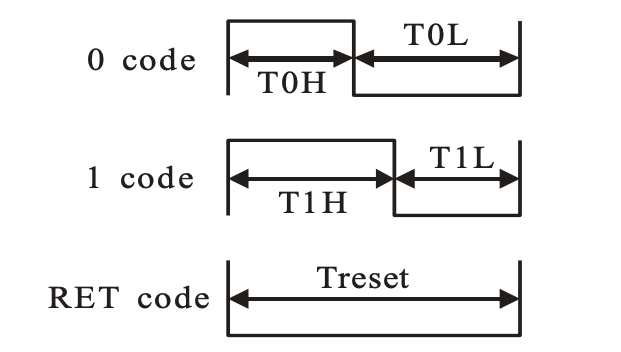
We can still remember when the WS2812 LED first came into our consciousness, way back in the mists of time. The timing diagrams in the datasheet-of-questionable-veracity made it sound quite tricky, with tight timing tolerances and essentially a high-speed two-bit PWM data protocol at 500 kHz. It was a challenge to bit-bang with an ATtiny85 back then, but there’s no way something as old and crusty as an Apple II would be up to snuff, right?

[Anders Nielsen] took up the challenge of getting the venerable 6502 processor to drive Neopixels and won! After all, if the chip is good enough for Bender and the Terminator T-800, it should be able to blink some colored LEDs, right? The secret sauce is shift registers!

Specifically, [Anders] abuses the 74LS165 parallel-in, serial-out shift register for his dirty work. Instead of bit-banging the WS2812’s “long high is a 1, short high is a 0” signal directly, the first few bits of the shift register are hard-wired to VCC and the last few to GND.

The bits in the middle determine if the pulse shifted out is long or short, and they’re set by the 6502, through a 6522 VIA chip, just like the Apple II would have. Clocking the data out of the shift register handles the timing-critical stuff. Very clever!

Video below the break.

Continue reading “WS2812s On A 6502” →