The Problem Of Making A Good Metal-To-Glass Seal

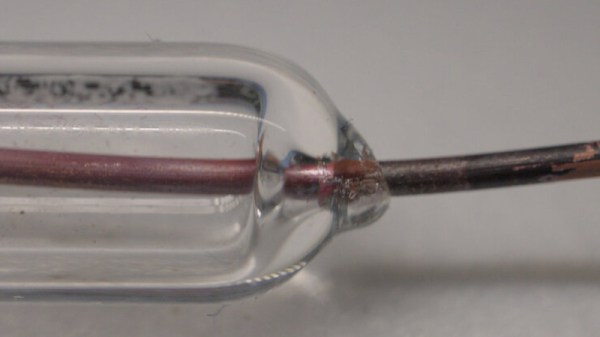
If you’ve ever taken a close look at a vacuum tube, you’ll have seen the seals around the pins that keep everything air-tight while providing the the device’s electrical contacts. As [maurycyz] finds out, it’s not an easy process to get right.

The problem is one of both chemistry and thermal expansion, as while a good seal can be made between glass and red copper oxide, it remains very difficult indeed to stop the glass cracking on cooldown due to differing thermal expansion properties. We’re led through a variety of experiments including surface treatments and flattening the metal to a sheet, with varying pros and cons. The most successful seal on the page comes from very thin tungsten wire, though hardly the most practical conductor for a vacuum tube.

It’s a fascinating investigation for the casual reader, taking them into the properties of metal-glass bonds and the difficulties involved in making them. We have even more respect for the people who make their own tubes after reading it.
This Alarm Clock Has The Capacity To Wake You

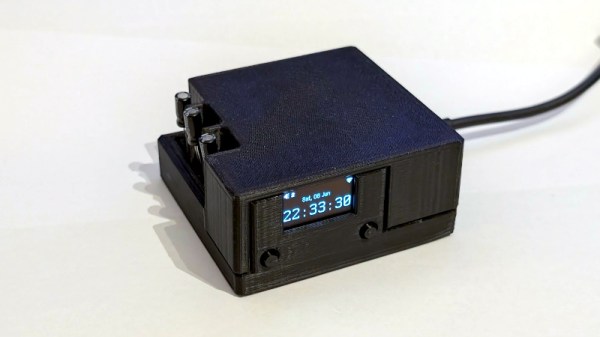
Every now and then a project comes into the Hackaday feed that has so many levels of wrong about it that you really shouldn’t do it at home, but is amusing enough to feature anyway with a warning. So it is with [ArcaEge]’s Capacitor Alarm Clock, which wakes up its unfortunate owner by blowing up electrolytic capacitors with reverse voltage. If you survive, you’ll certainly be awake!

It’s inspired unsurprisingly by an [ElectroBoom] video, and the premise is simple enough. An ESP32 serves as the clock, and triggers a relay for the alarm, which in turn overloads a suitably low-voltage electrolytic capacitor in a socket. The resulting explosion which appears in a video we’ve placed below the break, wakes the slumberer.

We don’t have to tell you that this is not the safest of hacks, and is presented here only for your entertainment. But it does provide a few points of interest, for example in identifying the difference between capacitors with a vent, and those without.

This isn’t the first time we’ve seen a project based around exploding capacitors, and that one maybe was a don’t-do-this-at-home too.

Continue reading “This Alarm Clock Has The Capacity To Wake You”

GentleOS, A Simple OS For Your Old PC

Every month or so we bring you a Jenny’s Daily Drivers article, in which we share with you an esoteric OS and try to use it for the everyday work of a Hackaday scribe. As part of that ongoing effort, the world of esoteric operating systems is always on the radar, even though many of them are unlikely to fulfill the Daily Driver requirement.

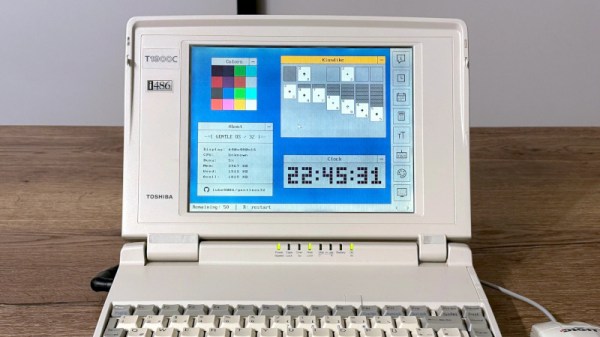
Even so, sometimes we see an OS that we like, and so it is with [Luke8086]’s GentleOS. It’s an operating system — or to be pedantic — a kernel shell into which applications are compiled, for older 16 and 32-bit x86 computers with a very low hardware requirement. It brings a simplicity to older PCs that we like.

Downloading the tiny image and booting it in a virtual machine, it’s almost ridiculously quick to boot on a 2020s computing behemoth with gigabytes of RAM and multiple 64-bit cores. It has a basic but nice and clean GUI, and a selection of basic applications and games. You won’t be using this for productivity work, but that’s hardly the point. It’s particularly pleasing to look at the code and find something simple enough to understand, too.

We like it, if you have an older PC it might be worth spinning this one up for a bit of fun.

The Hackaday Communicator Badge, Re-Imagined With New Firmware

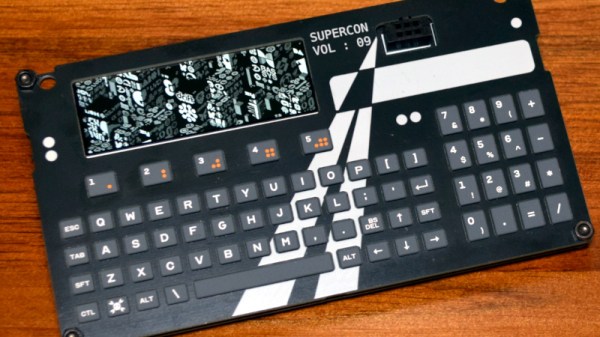
Our recently concluded event in Europe saw the return of the Hackaday Communicator badge — a stylish handheld gadget with a QWERTY keyboard, a LoRa radio, and an ESP32. It came complete with a simple messaging app built into its MicroPython firmware, and by all accounts it was a great success.

But there was certainly room for improvement, which is where [Giovi321]’s new firmware for the badge comes in. It brings support for Meshtastic proper, as well as longer battery life support for GPS module. To install this firmware you will need to have the ESP-IDF but fortunately there are very comprehensive instructions provided to help you. Under the hood it’s running FreeRTOS.

It’s something which is so often missing with an event badge, any sense of how it might have a life after the event rather than becoming a piece of e-waste. The Communicator badge is such a nice physical design that it obviously has potential, so this firmware unlocks it and gives the badge a use out in the real world. We really like it for this, and we’ll be flashing a few of our badges over to give it a shot shorlty.

If you’re looking to upgrade the hardware on your Communicator, check out the custom RGB keyboard we covered last week.

Mechanical Stability For Your Coils

If you work with radio, the chances are that before too long you’ll be winding an inductor. At radio frequencies these won’t be big chunky transformer style chokes, but often air-cored affairs supported by their own rigidity. As grizzled old radio amateurs will tell you though, relying on such a coil for stability is a fool’s errand. It will shift inductance from the slightest movement, thermal expansion, or even sound. Luckily [SolderSmoke] is here to remind us of the trusty fix, in the form of Q-dope, or a polystyrene solution that dries to form a rigid low-dielectric coating.

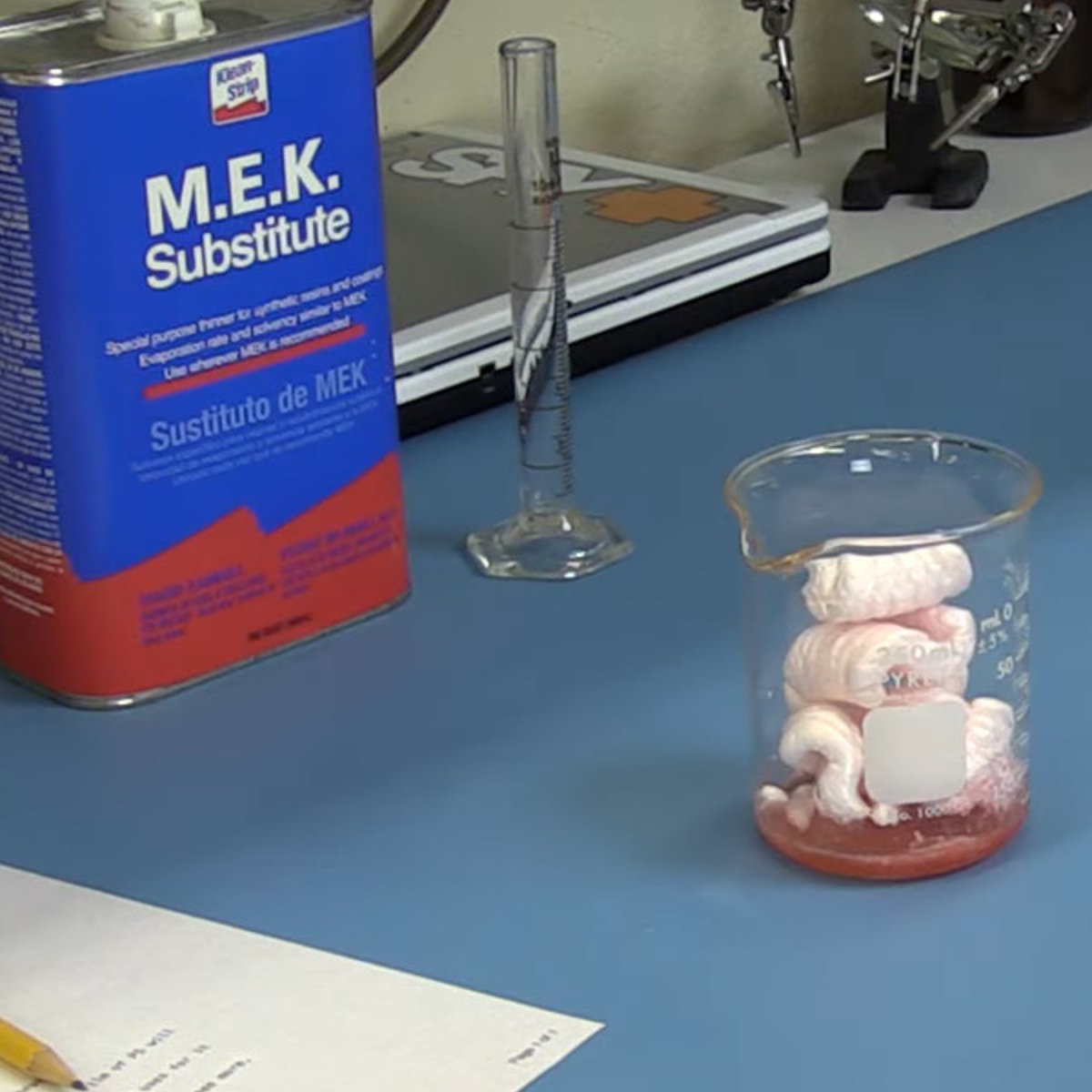
Where this is being written it wasn’t on the market so it was more usual to use nail lacquer, but reading the piece it seems American hams swore by the stuff. That’s in the past tense because it seems it’s no longer on the market. Even there though help is at hand, because dissolving packaging polystyrene in solvent yields an acceptable substitute. There’s even an 11-year-old how-to video linked from the SolderSmoke post, should you fancy making some of your own. We suggest you proceed with caution though, polymers dissolved in solvents sounds a lot like home-made napalm, and probably puts out fumes you don’t want to breathe.

Meanwhile should you fancy experiments of your own with inductors, we’ve got you covered.

AI The Truly Environmentally Friendly Way

A common complaint about the rise of commercial AI services is that they are power-hungry and thus damage the environment. If this concerns you then [Squeezlabs] has the solution, in the form of an AI powered by a handcrank.

The guts of the system is a Raspberry Pi 5 running llama.cpp and appropriate speech conversions, but it and the Large Language Model (LLM) side are not the most interesting part of this system. The power comes from a hand crank charger of the type you’ll see for sale on the likes of AliExpress, designed for USB charging. That in itself is not enough to power the Pi though, as upticks in the processing can cause brownouts that crash the machine. Thus there’s a custom-made capacitor board to take up the strain, and even with that the handle resistance varies significantly depending on the computing load.

We can see that this is not the ideal way to experience an LLM, but maybe that’s not the point. It does however point towards a future in which the power demands of processing decrease and less effort is required. Meanwhile, this is by no means the first hand cranked project we’ve seen.

Giving A Power Mac G4 A USB Upgrade, For Free!

At various times in the history of desktop computing, the market has stubbornly refused to follow the path dictated for it by a dominant manufacturer. IBM’s move to MCA in their PS/2 line is one of many examples. Another is Apple’s take on USB a couple of decades ago, when their view of the future lay with Firewire 800. [Pierre Dandumont] has revisited a Power Mac G4 from that era and unleashed what Apple never did back in the day: a USB 2.0 port. (French language, Google Translate).

The hack lies in Apple shipping the machine with an NEC USB 2.0 controller, but only using it for USB 1.1. A PowerPC Linux distro will happily use it for USB 2.0, but Mac OS refused. Replacing the BIOS ROM with an image designed for the same Mac without Firewire 800 cured the problem, but at the expense of being so we’re told irreversible.

An obscure set of Macs from the early 2000s with an odd combination of hardware and OS may not count for much in 2026, but back in the day having USB 2.0 was a big deal and this would really have mattered. We like it that he put this together, even if the chances of having a G4 on the Hackaday desktop probably isn’t too high.

This isn’t the first USB hack we’ve seen for a PowerMac G4.