A Headset Fit For A Hackaday Writer

I started writing this from a commuter train passing at speed through the outskirts of London, and my headset had just broken. The flexible joint that attaches one earpiece to the headband has snapped, leaving the earpiece dangling on its cable. This is annoying on its own, but what is annoying me enough to write about it is that this isn’t the first time. This is only the latest in a succession of headsets I’ve taken on the road with me has broken, not because of rough treatment, but simply due to flimsy or bad design. What on earth can I do about this?

Failure Built-In
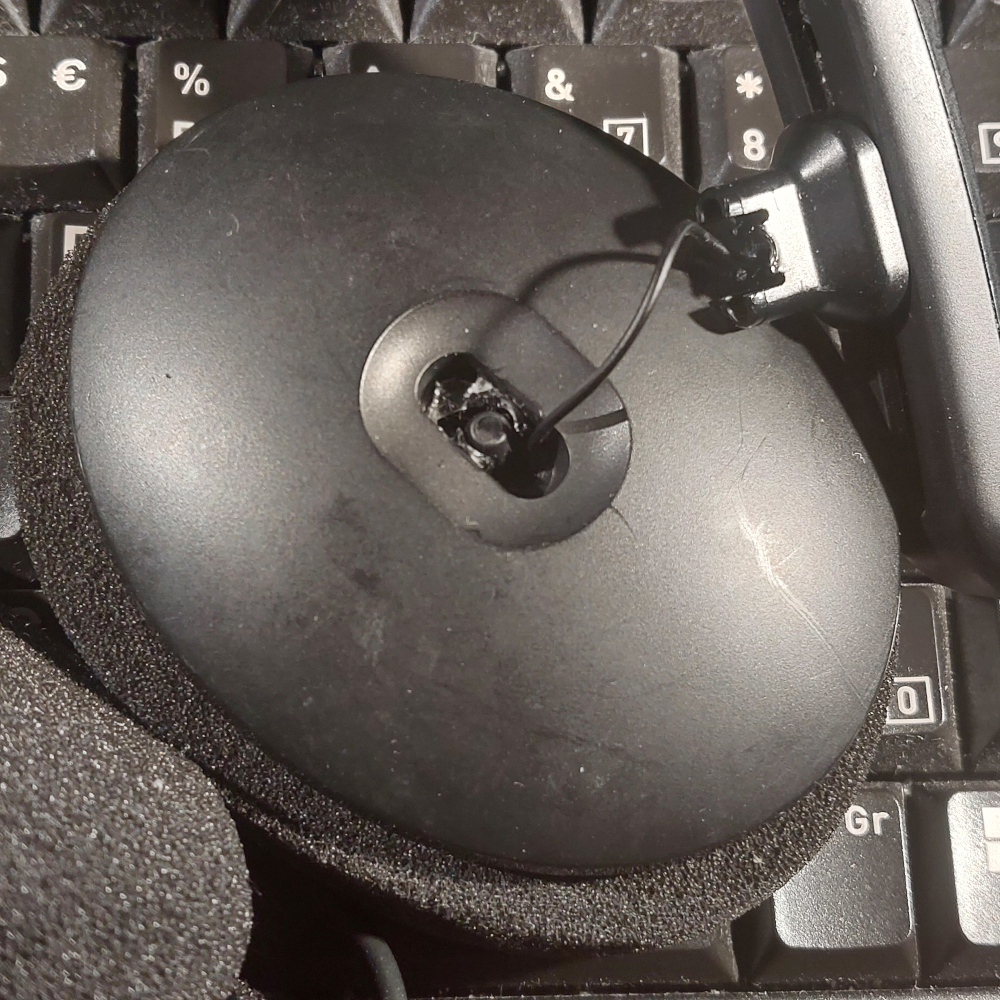
The earpiece of an EPOS headset, detached from its band.
Failure inevitable: the whole headset relied on a tiny piece of plastic in the centre.

The most recent three have been a JVC whose rotating joint allowing the earpiece to lie at a slight angle with my ear has failed, a quite expensive Logitech whose ear sponges failed closely followed by its USB cable, and now an EPOS whose ball joint has failed.

I repaired the JVC and got a bit more life out of it and I’ll have a go at repairing this EPOS, but that’s hardly the point. I’m paying not inconsequential money and I’m getting good sound quality and electronics, but I’m not getting anywhere near the mechanical quality I need. I could buy a set of tough DJ headphones such as the Sennheiser HD25, but they don’t come with a microphone, they’re not a headset.

So if I can’t buy a decent headset without spending military grade money on one from an F16 fighter, what can I do to make my own? I’m an engineer, damnit!

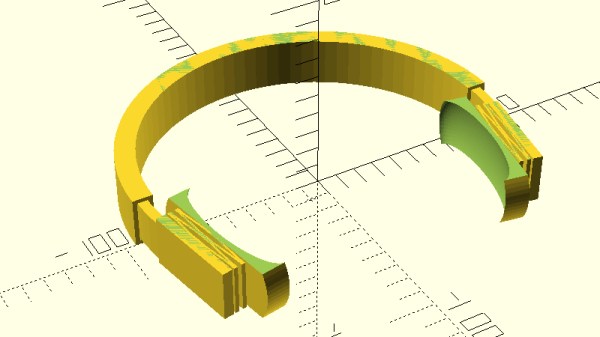
At its most basic, a headset is a springy band that goes over the head, with an earpiece at its end. But a human head is not a cube with vertical parallel sides, it’s a complex shape and every one is different. So those earpieces have to have some “give” in them in order to fit comfortably against the ear. In the simplest case this is achieved by giving the earpiece a soft surround that moulds itself to the ear, but most headsets incorporate some articulation. The earpiece must rotate a little around a vertical line parallel with the ear, and also with a horizontal line at right angles to the axis of the ear. The EPOS managed both axes by means of a ball joint, while the JVC had a stirrup with pins to achieve the horizontal motion, and a circular joint — the part which broke — for the vertical. In both case the weak point was a thin part of the plastic moulding which broke, on the EPOS a short stalk for the ball in the ball joint, and in the JVC a similar stalk for the circular joint. Any design I come up with must avoid this type of weak point, and spread the load of an earpiece over considerably more material than my broken headset. Continue reading “A Headset Fit For A Hackaday Writer” →
USB-C PD Tamed With This Analyzer

USB-C Power Delivery (PD) has been a boon to anyone working with low-voltage DC power, because at a stroke it replaces a vast array of wall warts, power supplies, and connector standards with one simple and straightforward commoditized system. But with varying capabilities between sources and sinks, it can be difficult to know what’s going on.

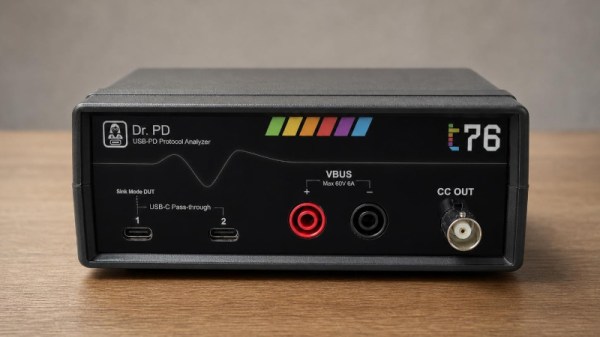
[Marco Tabini] has created Dr. PD, a USB -C PD protocol analyzer. It can sit between USB-C PD source and sink, or emulate a sink in order to characterize a source. It supports an impressive range of USB power protocols, and can work up to the full 48 volt/240 watt limits of the technology. The project is open source and is to be the subject of a crowdfunding campaign should you want one without the extra work.

It’s likely that many of you will have had bad experiences with cheap USB-C PD gear failing to follow standards, being unable to handle the specified current, or just plain supplying the wrong voltage. We have, and while USB-C PD is genuinely a great technology, this regrettable hardware represents its grubby underbelly. This is just the project we need on the bench in our hackerspace.

In the past we’ve written about USB-C PD as a great example of new technology done right.

Two Microcontrollers Talking, All It Needs Is An LED

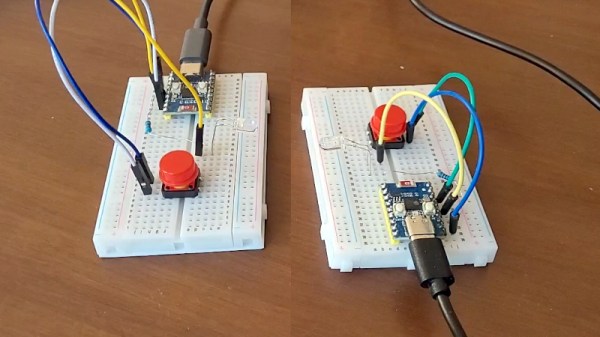
There are some projects that seem at first sight to be easy, but anyone who tries them finds a whole heap of unexpected problems and turns to the off-the-shelf device. PCB antennas for example, or data links using LEDs, whether IR or visible. The latter doesn’t faze [Luca Soltoggio] though, because he has two ESP32s talking to each other using visible light. Best of all, both use a single LED as both transmitter and receiver.

The software is called SecurePair, and is an Arduino library for exchanging keys and communicating with encryption. The LEDs are the cool hardware hack but it’s designed to work with ESPNow or LoRa too, indeed a typical use case would see light for pairing and wireless for the exchange of encrypted data.. In case you were wondering, it relies on the property of an LED that it’s also a photodiode of sorts. Best of all, while the examples have two ESP32s, it’s not limited to that number and many more can join the conversation if needed.

Check out the video below to see it in action — if you’re curious about LEDs as sensors, we’ve been there too.

Continue reading “Two Microcontrollers Talking, All It Needs Is An LED” →

The ESP32, An SDR In Itself

Perhaps the most famous of all the software-defined radio (SDR) receivers is the RTL-SDR, a digital TV receiver on which an undocumented feature was found. Perhaps other radio-enabled chips also have the same undocumented feature? It seems in the case of some members of the ESP32 family, they do. It’s a discovery made independently in two places, by [Espargos], and a Reddit user by the name of [h0m3us3r].

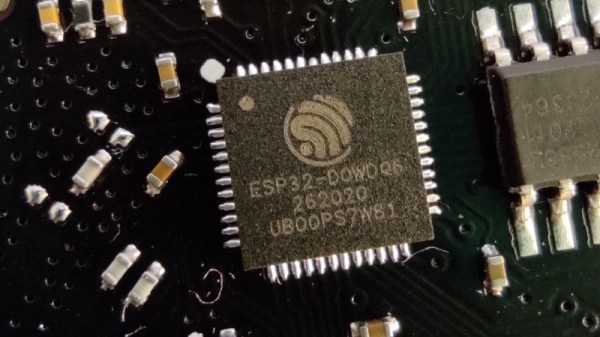
What’s happening is that the undocumented mode taps the I/Q stream off before the WiFi modem, and this can be read and processed by SDR software on an external computer. The undocumented mode can be found on ESP32 chips with the earlier Tensilica hardware onwards, so the low power Bluetooth only chips or the non-radio-equipped P4 won’t work. Sadly it’s also only possible with the receive side, with both 2.4 and 5 GHz bands being supported depending on the microcontroller in question.

This isn’t quite the general purpose SDR we got with the RTL-SDR, but there are still plenty of uses to which it can be put. We’re curious as to whether someone can implement the software side of an SDR on the same chip, but we are guessing that might be beyond their capabilities. Either way, we’re looking forward to what the community does with this new-found knowledge.

Own The OSD Chip In Your Cheap Composite Monitor

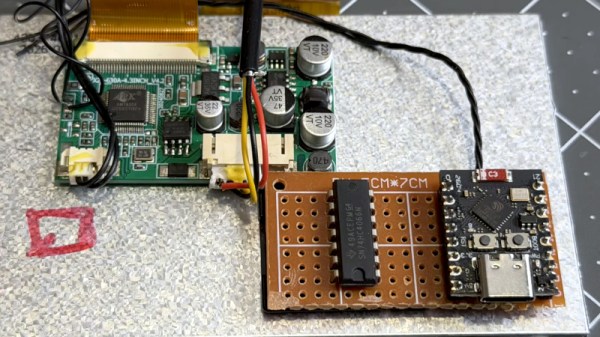
[Ogrinz Labs] has built a Robbie the Robot suit, which is super-cool, but has a huge flaw. When inside the suit, he’s too tall to do what the original Robbie actor did, which was to look through the “mouth” grille. He solved this with an inexpensive automotive reversing camera, but then realised its monitor had a built-in on-screen-display chip. After a lot of work, he’s published a GitHub repository that allows access to this thing for custom on-screen graphics.

The chip in question is an AMT630A, which contains video switching hardware, a graphics system for the on-screen-display, and an 8052 microcontroller core. He didn’t manage to get into the 8052’s brain, but the video below details the long path towards controlling it through an I2C port with an ESP32. The software is available as an Arduino library. His intention is to use it as a display for navigational sensor data to aid in maneuvering Robbie.

Given the status of Robbie as a sci-fi movie icon, it should come as no surprise that we’ve featured this suit before,

Continue reading “Own The OSD Chip In Your Cheap Composite Monitor” →

Is This The Smallest Internet Radio?

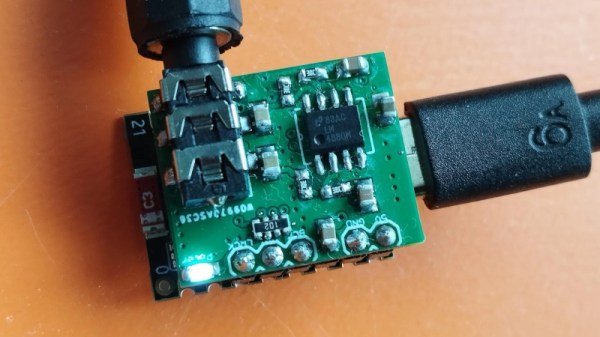
Internet radios have been a thing in some form for the last quarter century, and the advent of cheap networked microcontrollers has made them easier than ever to build. But just how small can one be made? [Milen] has made one that’s about as small as we’ve seen, and put it up on Instructables.

The hardware recipe is straightforward enough; take a microcontroller, connect it to the internet, and have your internet radio software squirt its output to a DAC. In this case the microcontroller is an ESP32-C£ on a very small dev board, and clipped to that is a custom PCB with a PCM5102A I2S DAC and an amplifier. The whole thing is tiny, small enough in fact that the two connectors are significant in size compared to it.

Whether or not it’s a practical device for listening remains to be seen, but it’s certainly tiny. But the question is, could it be made smaller? Perhaps eschewing the connectors would be an easy win, and in return for a loss in quality the ESP has a built-in DAC that’s not intended for audio but can be used. If you have any bright ideas, we’d be interested to hear them.

We’ve seen plenty of internet radios over the years, and for some reason this cassette-shaped one appeals to us.

Hackaday Podcast Episode 389: Spinning Lightfield Displays, And Jenny Visits A Blast Furnace

Another all-European podcast for you this week, as Elliot Williams is joined by Jenny List for an evening looking at the past week in Hackaday. And this week there is a particularly good selection to look at.

A while back we showed you a project that put synthetic aperture radar on a drone, generating extremely detailed imaging of the terrain beneath it. This week we had an update, in which an ingenious positioning accuracy fix gave it an astonishing increase in resolution. On top of that project we have 3D lightfield image display with the unexpected help of a Nipkow mechanical TV scanning drum. Geting your own microprocessor manufactured, DOOM in a database server, and a comprehensive array of unusual sensors in a tricorder project complete the picture.

Finally we have a couple of space stories and Jenny describing the preserved industrial delights of the Ruhr valley in Germany. You’ll want to go there, but first you’ll want to listen to the podcast.

Download it yourself in MP3. It’s wafer thin.

Continue reading “Hackaday Podcast Episode 389: Spinning Lightfield Displays, And Jenny Visits A Blast Furnace” →