A Vacuum Tube Computer For The Home

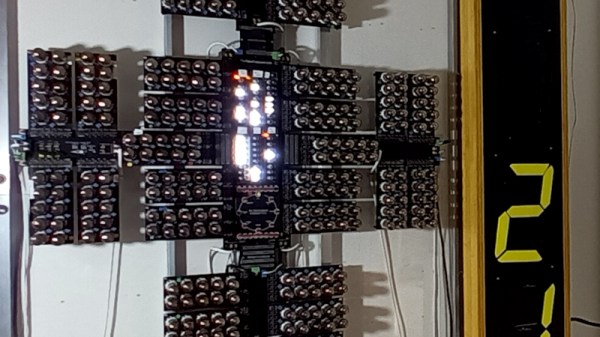
The earliest all-electronic computers used vacuum tubes, and most of us will know about machines such as ENIAC or Colossus. Vast machines that required the budget of a country at war to build, andfill very large rooms. It’s very pleasing then to see that a useful vacuum tube computer can be made which has neither of these requirements, as with this example from [Mike] that uses former eastern bloc double-triodes.

It’s an 8-bit design following a von Neumann architecture with 16 instructions, whose operational block diagram would be instantly recognisable to anyone used to working with a 1970s-era 8-bit microcomputer. It follows a NOR-based design in the same manner as the famous NASA machines from the Apollo programme, and as we understand from the description it uses more modern parts for its I/O circuitry. Physically it’s a surprisingly compact wall-mounted unit, and it has an accompanying ex-British Rail flip-digit display as well as a control panel for a simple airship simulator game. There’s a website with full details, if you are interested.

We like this machine, a lot. It may not be the largest computer we’ve seen and it certainly isn’t the first one with vacuum tubes, but it’s a very impressive achievement to have created it. If tubes in computing interest you meanwhile, we took a trip to see the daddy of them all.

Should [Mike] enter this into the Retrocomputing Challenge? We think so.

How To Talk To A Machine Without Anthropomorphising It

LLMs remain a divisive topic in these times. Perhaps we all know someone who’s become over-infatuated with their new robotic friend, or who believes it has made them a genius. [Emily M. Bender] and [Nanna Inie] have written about how people anthropomorphise the LLMs they interact with, and suggested some language tips to avoid that. It’s a couple of months old, but we think Hackaday readers will find it interesting.

Their analysis is interesting, because it looks at the way people talk about LLMs and highlights the unconscious anthropomorphism. The LLM is a piece of software not a person, so why does it “recognise” when it does “speech recognition”, for example. They suggest “automatic transcription” instead. Even “hallucination” implies cognisance that evidently isn’t there. They admit that their suggestion of “undesirable output” isn’t entirely appropriate. They’re on safer ground with “input” and “output” instead of “prompt” and “response”.

Whatever your views on them, it’s evident that LLM usage will be a feature of the world for the forseeable future. The language surrounding them is however capable of evolving, and maybe some of the suggestions here are worth taking note of.

Grappling with our new electronic overlords? Have a look at our AI for Skeptics series.

The First Spacecraft Launched To Orbit From Europe

The history of European space exploration is a long and distinguished one, with many decades and whole families of launch vehicles. It might therefore come as a surprise that despite all this, it’s taken until 2026 for a European rocket to be launched into orbit from European soil rather than from somewhere close to the Equator. The German company Isar Aerospace launched one of their Spectrum rockets from Andøya Space in Norway and deployed its CubeSat payloads to orbit.

The five satellites were a selection of projects from the German space agency’s Microlauncher Competition, which offers the chance of a launch to start-ups and educational institutions. The press release doesn’t name them, but Wikipedia has the following list: TriSat-S (University of Maribor and SkyLabs); FramSat-1 (NTNU SpaceTeam); Sat1 (TU Wien Space Team); CyBEEsat (TU Berlin); Platform 6 (EnduroSat) and Let It Go (experiment, Dcubed).[46].

Interestingly, the company is also working on a space launch facility in Nova Scotia, Canada, to gain access to lower inclination orbits and to provide Canadians with their own launch capability. More is evidently yet to come.

We’ve mentioned Isar before, when we reported on the building of the spaceport.

Free Your Rotary Telephone From Its Wire

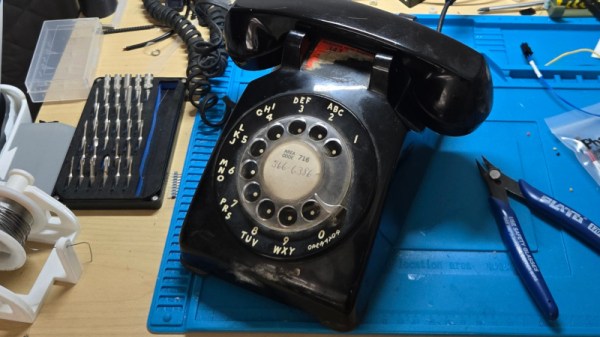
It’s said that a teenager given a rotary telephone in 2026 would be mystified by its operation, yet there are enough surviving instruments for them to be an attractive target for a project. But just what project? [fregacmols] is here with one possibility, turn that old phone into a cellphone.

Connecting to the phone is a subscriber-line interface module, containing all the electronics to simulate a copper phone line. This in turn feeds audio and control wiring to a Lilygo ESP32-S3 board which provides the brains as well as talking to a cellular modem. We especially like that this allows the phone to be used entirely unmodified.

The software does a good job of simulating a North American subscriber line, complete with dial tones, and ringing the phone’s bell on an incoming call. There are a couple of special codes, one to open a wireless network for maintenance, and the other for diagnostic purposes.

Over the years we’ve seen many rotary phone projects, but one which sticks in our mind used an alternative way to connect one to the cellular network.

Hackaday Podcast Ep 385: 3D Printers With Lasers, Wicked RAM Prices, And Reverse Polish Notation

As the calendar turns a leaf into September, Elliot Williams is joined by Jenny List for our weekly look at all things Hackaday.

In the news, our retrocomputing competition is well under way, but there’s plenty of time to get an entry in if you’ve got a cool old-style project to show us. And then Elliot’s been chasing seismic surveyors in Munich, where they’re looking for geothermal energy.

In the stand-out hacks there’s a discussion of smoothing 3D prints using frickin’ lasers, the effect of unreasonably high RAM and storage prices on the single board computer ecosystem, and an unfortunate air conditioning system that’s tricked into believing it’s a hot day. Finally, we look in depth at PETG, and take a dive into reverse Polish notation.

Download your own personal version of the podcast right here.

Continue reading “Hackaday Podcast Ep 385: 3D Printers With Lasers, Wicked RAM Prices, And Reverse Polish Notation” →

The Birds Outside, Drawn For You Automatically

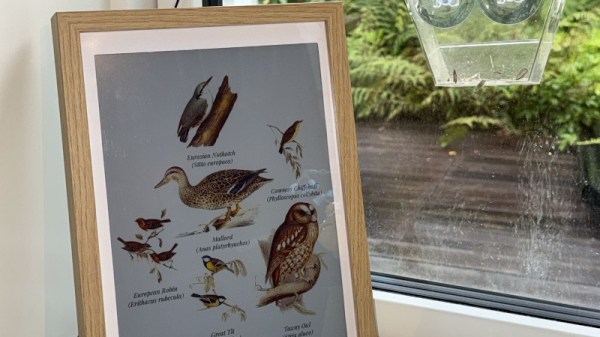
With artificial intelligence being the bête noir of the moment, there are some projects using it which maybe don’t bring much to the table. So it’s nice to see one that uses it in a creative way, and delivers something new. [arnegiacomo]’s e-paper screen is a great example, as it draws a picture in real time of whatever birds are outside.

Behind the quite large screen sits a Raspberry Pi 5, and on that is BirdNet-Go, an AI-powered birdsong classifier. A USB microphone catches the birdsong, and Birdnet comes up with the species. The birds on the display are then those species as pictures from 19th century bird spotters guides, assembled into a collage. You can even see what the current set of birds it hears are, live, and they are a representative cross section of the European birds you’d find in Norway where it’s located.

We like this project, both for the bird book vibe it gives, and the creative use of machine classification. Surprisingly this isn’t the first project in this field we have seen over the years.

A Thoroughly Modern Minimalist Transceiver

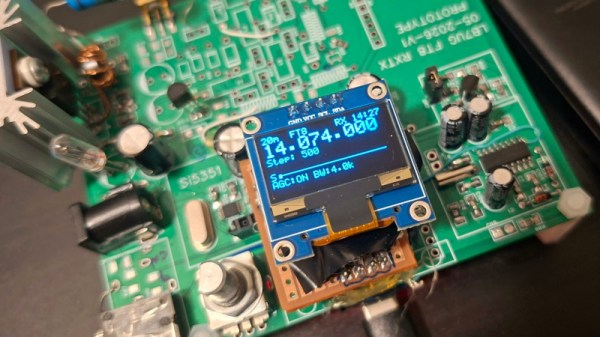
Making a radio is so often a case of taking tried and tested designs and working with them to create something new. It’s a safe way to make something that works. [Riyas] however has gone for an entirely different tack, creating an entirely modern transceiver with as much as possible going on in the silicon.

At its heart are three integrated circuits, the familiar Si5351 as a transmit VFO, an Si4372 receiver, and an RP2040 tying it all together. This microcontroller functions both as controller, and as an ADC to provide a software defined radio via its USB port. The Si4372 having an internal SDR architecture and its output being digitized again is not lost on us.

It’s for digital modes and CW only, but we’d venture the opinion that those are where the interesting stuff is anyway. We certainly like it for its simplicity, and also for the one-cable solution it offers. So many other designs need a sound card and extra cables, this one makes for a lot less clutter. We hope we’ll see more development on this design over time, it could become a favorite in the homebrew rig stakes.

Meanwhile the Si5351 is notoriously annoying to program. A while back we covered a library that might help, if you get stuck.