Brand New Colecovision Console – On A Breadboard

The Colecovision console from the early 1980s is probably not the most memorable platform of its era, but it retains a retrocomputing following to this day. The original hardware can be a bit pricey in 2023, so [nanochess] has built one of his own on a breadboard. It’s fully functional from original Colecovision cartridges, and we see it in the video below the break running Frogger.

Behind the mess of wires is a surprisingly simple circuit with only a few logic chips beyond the Z80 processor, the various memory and EPROM chips, and the video and sound chips. We’re told the complexity is considerably reduced by the use of a Texas Instruments  TMS9118 video controller instead of a 9918.

Had we been building it we would probably have taken the less brave step of using color coded wires for the various signals, because we remember the fun and games associated with wiring old-style 8-bit computers by hand only too well. But we have to admit that it reminds us of a lost youth working out Z80 address decoder schematics, so it’s very pleasing to see one built today.

If you’re hungry for more Coleco goodness, this isn’t the first home made Colecovision we’ve brought you.

Continue reading “Brand New Colecovision Console – On A Breadboard”
When One Cylinder Isn’t Enough: The Briggs And Stratton V8

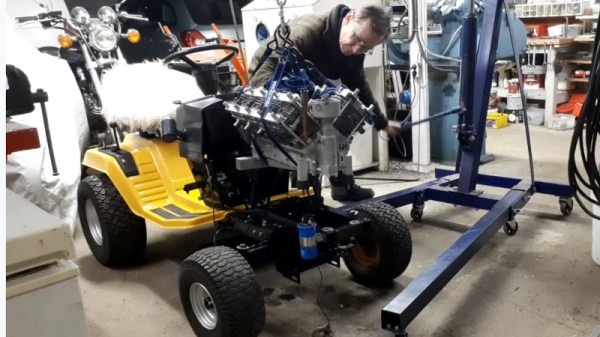
The Briggs & Stratton single cylinder sidevalve engine is one that has been in production in one form or another for over a century, and which remains one of the simplest, most reliable, and easiest to maintain internal combustion engines there is. The little single-cylinder can be found on lawnmowers and other similar machinery everywhere, so it’s rather easy to find yourself in possession of more than one. [Lyckebo Mekaniska] evidently had no shortage of them, because he’s produced a V8 engine for a small lawn tractor using eight of them. A small air-cooled V8 sidevalve is something of a unique engine to be made in the 2020s, and the series of videos is definitely worth a watch from start to finish. We’ve been keeping an eye on this build for a while now, and we’ve embedded it below the break for your entertainment.

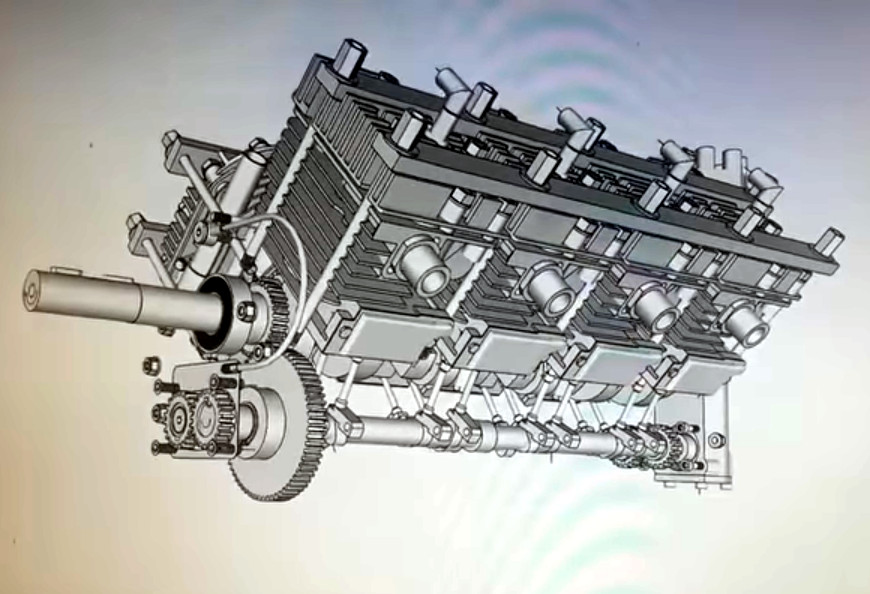
A CAD view of the V8 engine
Clearly a lot of CAD work has gone into this build.

For an engine which uses mass-produced engines for its construction, this one still relies heavily on parts machined from first principles. The cylinder blocks, valves, pistons, and crank rods are Briggs & Stratton, the rest is made in the workshop. It’s a design with the valves on the outside — so instead of the single camshaft you might expect from experience with OHV engines nestling in the V above the camshaft it has two camshafts at the bottom of the crankcase.

The crankcase is cast in sections first, followed by the machining of the crankshaft and camshafts, then the preparation of the cylinders.. The engine is assembled with a home made alternator on its flywheel and a conventional distributor from a donor vehicle. The lubrication system is another work of the machinist’s art, and the simple straight-through exhaust system is more at home on a drag racer than a lawnmower. Finally we see it running, and it sounds the business. Most recently he’s had to deal with a seizure and a replacement cylinder, but now it’s back together and he’s working on an improved cooling system.

All in all this is one heck of a build, and we wish we had some of those skills. We’re not sure whether he’ll mow the lawn with this thing, but one thing’s for sure, lawnmower hacking has quite a past.

Continue reading “When One Cylinder Isn’t Enough: The Briggs And Stratton V8”

Move Over Steel, Carbon-Reinforced Concrete Is Here

Reinforced concrete is the miracle material which made possible so many of the twentieth century’s most iconic structures, but here in this century its environmental footprint makes it something of a concern. As part of addressing this problem, a team at TU Dresden in Germany have completed what is believed to be the world’s first building made with carbon-reinforced concrete, in which the steel rebar is replaced with carbon fiber.

New materials are always of interest here at Hackaday, so it’s worth reading further about the nature of the reinforcement. The carbon fiber is woven into a mesh, or as a composite material that mimics existing rebar structures. These two types of reinforcement can be combined in a composite to produce a concrete structure much lighter than traditional steel-reinforced ones. If you page through the architecture critic description, it’s this lightness which has enabled the curving structure of the Dresden building to be so relatively thin.

The carbon saving comes presumably in the lower energy cost from not smelting iron to make steel, as well as the need for less concrete due to the lightness. All we need now is a low-carbon replacement for Portland cement.

Want to know more about concrete reinforcement? We’ve got you covered.

Floppy-8 Is A Tiny PC In A Floppy Drive

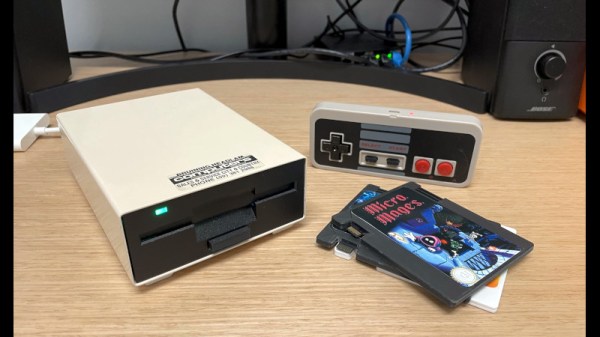
At first sight, Floppy-8 is simply a LattePanda based PC built into the shell of a external vintage floppy drive. Indeed, it’s a very nicely executed LattePanda PC in a floppy, and we’re impressed by it. What turns it from a nifty case mod into something a bit special though, is the way creator [Abraham Haskins] has used floppy-like cartridges in the original floppy slot, as a means of loading software.

The cartridges started out as PCBs in the shape of a floppy with an SD socket on their bottom, and progressed to USB drives on 3D printed cartridges and finally and simplest of all, the same 3D printed cartridges with micro SD cards embedded in their leading edges. All this was necessary to get them thin enough to fit into the existing disk slot — if dimensions weren’t a concern, you could enclose various USB devices into printed cartridges. A script on the computer looks for new card insertion, and runs the appropriate autostart.sh script on the SD card if it finds one. If you don’t need the “disks” to fit into an existing slot, you could print them larger and embed

Beyond the cartridges, the PC itself is assembled on a 3D printed frame inside the case. It’s controlled via Bluetooth, with a pair of knock-off NES controllers for games and an Amazon Fire remote for media. We particularly like the idea of weighting the controllers with ball bearings to give them a little heft.

The LattePanda gives the Raspberry Pi a run for its money in these applications. We particularly liked this portable Macintosh.

A Milliwatt Of DOOM

The seminal 1993 first-person shooter from id Software, DOOM, has become well-known as a test of small computer platforms. We’ve seen it on embedded systems far and wide, but we doubt we’ve ever seen it consume as little power as it does on a specialized neural network processor. The chip in question is a Syntiant NDP200, and it’s designed to be the always-on component listening for the wake word or other trigger in an AI-enabled IoT device.

DOOM running on as little as a milliwatt of power makes for an impressive PR stunt at a trade show, but perhaps more interesting is that the chip isn’t simply running the game, it’s also playing it. As a neural network processor it contains the required smarts to learn how to play the game, and in the simple circular level it’s soon picking off the targets with ease.

We’ve not seen any projects using these chips as yet, which is hardly surprising given their niche marketplace. It is however worth noting that there is a development board for the lower-range sibling chip NDP101, which sells for around $35 USD. Super-low-power AI is within reach.

The Last Meccano Factory Is To Close. Will We Miss It?

If we were to talk to engineers about the childhood toys which most inspired them, it’s likely that the older among them would mention either Meccano or Erector Set. These similar construction toys using metal components originated independently around the turn of the 20th century in both Britain and America, and eventually became part of the same company.

They were a staple of toy shops through the middle of the century, but have steadily declined in popularity over the past few decades. Now news has emerged that the last dedicated Meccano factory, in Calais, France, is to close. The products will still be made, but in other factories alongside other toys. It’s not the end for Meccano or Erector Set, but it’s clear that they are both toys whose time may have passed.

It’s fair to say that the possibilities of those perforated metal sheets and myriad nuts and bolts might seem a little limited for the 2020s child, but it opens the age-old question of what remains to interest young minds in engineering or technology. The obvious answer to that question comes in the form of Lego, evidently so much more fun can be had with plastic bricks.

Did you have Meccano or Erector Set when you were a kid? If so what did you do with it? We’ve seen a few projects using it here over the years.

Header: Alf van Beem, CC0.

This Camera Produces A Picture, Using The Scene Before It

It’s the most basic of functions for a camera, that when you point it at a scene, it produces a photograph of what it sees. [Jasper van Loenen] has created a camera that does just that, but not perhaps in the way we might expect. Instead of committing pixels to memory it takes a picture, uses AI to generate a text description of what is in the picture, and then uses another AI to generate an image from that picture. It’s a curiously beautiful artwork as well as an ultimate expression of the current obsession with the technology, and we rather like it.

The camera itself is a black box with a simple twin-lens reflex viewfinder. Inside is a Raspberry Pi that takes the photo and sends it through the various AI services, and a Fuji Instax Mini printer. Of particular interest is the connection to the printer which we think may be of interest to quite a few others, he’s reverse engineered the Bluetooth protocols it uses and created Python code allowing easy printing. The images it produces are like so many such AI-generated pieces of content, pretty to look at but otherworldly, and weird parallels of the scenes they represent.

It’s inevitable that consumer cameras will before long offer AI augmentation features for less-competent photographers, meanwhile we’re pleased to see Jasper getting there first.