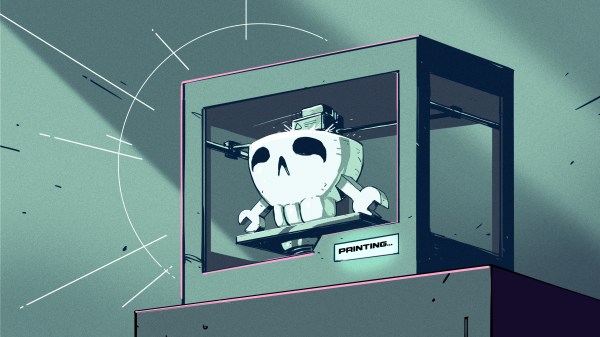
Art of 3D printer in the middle of printing a Hackaday Jolly Wrencher logo

Has FDM 3D Printing Hit Its Peak?

Over the time Hackaday has been in existence, the art of 3D printing has evolved from a relatively crude hit-and-miss affair to something approaching what we all imagined back then. You can’t yet walk up to a Star Trek replicator and ask for a part, but a modern state of the art consumer or prosumer grade printer will deliver consistent high-resolution parts, and in a surprisingly short time. [The Next Layer] asks whether consumer FDM printers have now reached the point at which they’re about as good as they’re going to get, and whether other technologies hold the future.

It’s a fair point to make that the resolution of a consumer FDM printer may be close to its mechanical limit. Techniques such as input shaping and the adoption of better CoreXY mechanisms mean that prints which once might have relied on SLA can be done in FDM. Healthy competition in the marketplace has delivered high quality colour printing, with tool-changing printers being no longer solely the preserve of the professional. He uses the example of a mobile phone to make the point that new machines have less of a wow factor to deliver, as increments have become less grand.

It’s a persuasive argument, and looking at the printers around us we can see it in action. The difference in ability between a 2020-ish and a 2026 FDM printer are far smaller than those between the same time periods in the last decade. Compare a MakerBot Cupcake and an Ultimaker II, or the Ultimaker and a Prusa Mini, and each is light years ahead of the last. But the best the Mini can do is surprisingly not as far behind as you’d expect to that of their latest, or of the equivalent from Bambu Labs.

Does this means that nothing new is coming in 3D printing? Of course not. UV printing is coming through and will deliver incredible results, as will SLS printing. It’s interesting he devotes little time to SLA printing, perhaps because it’s not as easy a process as FDM. He makes the point that we’ve never had it so good, as the high-end FDM features will appear in modestly priced machines, and we have those other technologies to look forward to.

It’s an interesting discussion, and you can see it below the break.
Continue reading “Has FDM 3D Printing Hit Its Peak?” →

How A 1981 RAM Expansion Worked

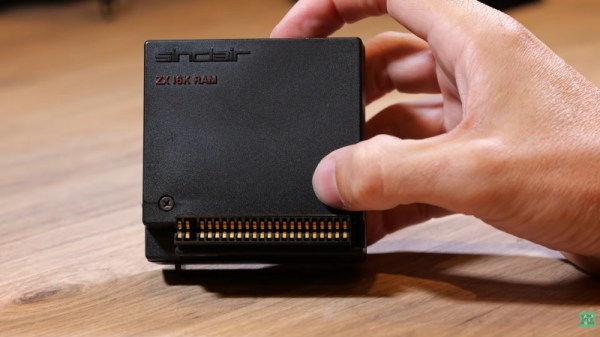
Sir Clive Sinclair and his company were notorious for pushing the limits of electronic parts in search of a low price, and his ZX series 8-bit computers were fine examples of this art. The ZX81 came with a meagre 1K of memory, and a popular upgrade was a 16K RAM pack. [Happy Little Diodes] has opened one up, and to his surprise, found many more parts than expected.

Inside the box is a pair of PCBs connected by ribbon cables, one of which has a selection of 74 chips and the other the 4116 RAM chips and a discrete component power circuit. This complexity comes from that cheapness, the 4116 is an inexpensive DRAM chip and requires an eclectic set of power supplies.

The functions of address selection are straightforward enough, as is the DRAM refresh circuitry. The power supply is clever in that it’s a self-oscillating switcher that provides +12 and -5 volts with a single transistor. We particularly like the quench diode in the 12 V Zener diode regulator  circuit.

The ZX81 gave a huge number of British kids their first taste of computing, and learning to use a limited memory space is something that stays with you for life. The film doesn’t mention the most notorious feature of the 16K pack though, that it had been developed with a machine clamped to the desk. Using one in a real-life location was an exercise in not jogging your machine, because the slightest disturbance would trigger a reset.

The ’81 was also famous for its membrane keyboard. Another popular upgrade back then was a new one.

Continue reading “How A 1981 RAM Expansion Worked” →

It’s Teletext, But On The Radio

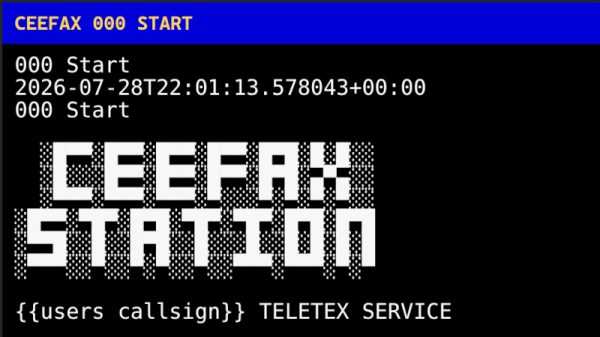
Old-school teletext with its pixelated text and block graphics may now be largely a thing of the past, but that doesn’t mean it’s without enthusiasts or there’s no more life in the idea. [M7TJF] has a project which takes teletext and puts it on amateur radio through the magic of AX.25. It’s called CEEFAX Station, in honor of the BBC’s teletext offering from back in the day.

What you get is a Linux package or a Windows executable, which you run and presumably hook the computer up to a radio. It can either be a transmitting node or a receiving one for browsing pages, and there’s an online map to track who’s doing either and on what frequencies. This is all brand new so there’s not much on there at the moment, but we expect that as people try this mode, this will change.

Sadly it’s a little unclear on how the protocol works and how the pages are encoded, but it’s early days. Meanwhile if you hanker for the real thing, it’s still about in some places.

ReactOS Gets An Upgrade

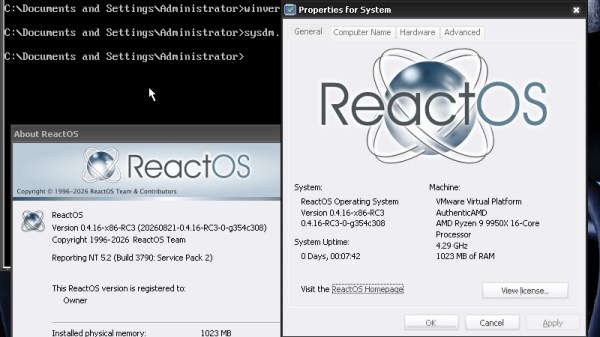
A perennial in the esoteric operating system space is ReactOS, a project with its roots in the 1990s which is doing a pretty good job of creating an open source clone of 32-bit Windows. They have a new version out, and it’s acquired some useful features.

Top of the list is a new graphical installer, removing the need for separate live and install ISOs, followed by improvements in video bug fixes and high definition audio drivers and subsystems. There’s a headless server install too, in which the GUI is suppressed. Perhaps most interesting, they are working on version syncing the open-source projects such as WINE on which they rely, meaning with luck that any improvements there will show up in ReactOS.

A while back we took a look at using ReactOS as a daily, and found it to be quirks aside, as usable as you’rd expect a Windows XP clone to be. Given that there are plenty of pieces of hardware and software around that still need an early-2000s era Windows to run, this remains an OS to keep an eye on.

Digital “Film” For Your Pi Camera

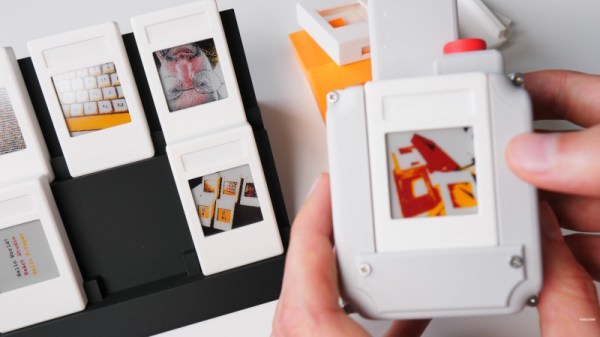
The formula of a Raspberry Pi camera is such that it’s almost a self-assembly kit of parts. Over the years we’ve seen a lot of attempts to make one that’s more impressive, usually due to a different take on a case design. It’s not often we see something genuinely out of the ordinary, and perhaps [Strange Inventions] has made one. He’s produced an instant camera where the “film” is a removable cartridge containing a color e-paper display.

It’s a straightforward enough idea: the camera writes the image to the display, and since these displays are persistent, there it stays. The displays connect via headers, and the cartridge slips in in a similar manner to a console game cartridge. They’re not cheap, but at least unlike a Polaroid or Instax cartridge, they are reusable.

You’ll have to pay up if you want to download the files, but it’s not outrageously expensive if you really want to build one. But perhaps the key here is that it’s not something beyond the abilities of the average Hackaday reader to make their own. We’re sure this idea will be expanded upon by others in due course.

Meanwhile, if it’s simpler instant photography you crave, you can always print the real thing.

Continue reading “Digital “Film” For Your Pi Camera” →

Wikipedia On A Cheap Yellow Display

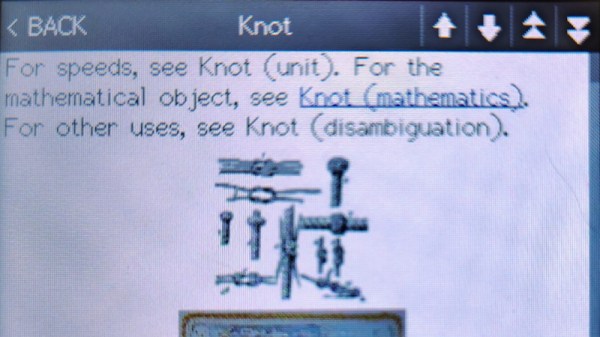
The Cheap Yellow Display (CYD) is a board carrying a slightly older ESP32 variant, a display with a resistive touchscreen, an SD card, and not much else. It’s often used for straightforward microcontroller applications that need a user interface, but that’s not the limit of its possibilities. [Alun Morris] has a CYD on which you can brows an entire offline Wikipedia.

The trick is to take the offline Wikipedia builds from the Kiwix project, and process them further into a custom format suited for a browser firmware on the ESP32. A modern SD card can hold so much data that a full Wikipedia is well within its abilities even with images included.

We like this idea, because it takes the knowledge away from the center of the network to its edge. We expect to see it gaining a following among enthusiasts for offline living, because all that knowledge without a network can only be useful. If you recognize [Alun]’s work, it might be because of his ESP32 web browser.

Wear Your Way Out Of AI Surveilance

For decades now many of us have lived in surveillance societies where it’s difficult not to be within the view of a camera. When being noticed depended on the attention span of a minimum wage security guard perhaps this mattered less, but in an age of AI, the vigilance has become always-on. To address this problem the German designer [Simon Weckert] has created a fabric designed to confuse an AI scanning an image, and cause it to not recognize the wearer as a person.

The result is perhaps best described as “loud”, a pattern of saturated colors that targets the algorithms used in recognition. The tests he shows appear to work, but perhaps the most obvious thing from them is that he sticks out like the proverbial sore thumb to the eye wearing such a… vibrant garment. Also we wonder for how long it will remain effective, as algorithmic improvements seek to mitigate its attack.

This is no doubt only one salvo in what is likely to be an ongoing battle of wits. It’s certainly not the first time we’ve seen things designed to confound an AI.