A Wi-Fi Enabled Dog!

Our canine friends have been at our side for millennia, their prehistoric wolf ancestors evolving alongside us into the breeds we know today. But astoundingly until now no dog has been Wi-Fi enabled, at least according to [Entropy], whose dog [Kaya] now sports a colourful Wi-Fi enabled collar.

Light-up dog collars and harnesses have been with us for a while, and serve the very useful purpose of protecting the animals from accidents by making them visible at night, but [Kaya]’s colar was a particularly disappointing example. Its single light and lacklustre optical fibre coupled with disappointing battery life left much to be desired, so when it broke there was ample excuse to upgrade it. In went a strip of addressable LEDs and an ESP32 module, along with an 18650 lithium-ion cell. We’re a bit unsure whether lights can be controlled from a mobile phone, but perhaps the most significant benefit lies elsewhere. The Wi-Fi hotspot from the ESP32 serves as a beacon to find [Kaya] within a short distance should she wander off, which as any dog owner will tell you can be a boon when they’re investigating some fascinating new smell and ignoring your calls. You can see her modelling the collar in the video below the break.

Canine hacks appear on these pages from time to time. One of our favourites is this not very successful but highly amusing remote controlled dog.

Continue reading “A Wi-Fi Enabled Dog!”

Review: Pine64 Pinecil Soldering Iron

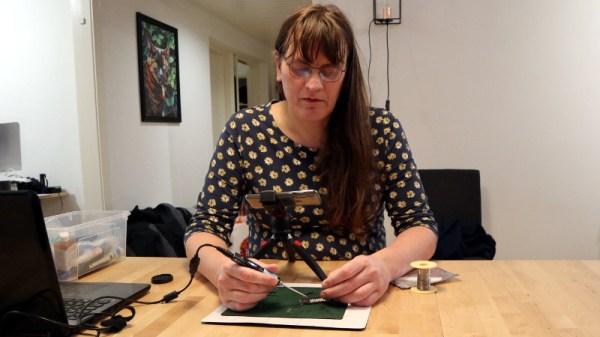
There was a time when decent quality soldering irons were substantial affairs, soldering stations with a chunky base unit containing the electronics and a lightweight handheld iron for the work. That has changed with the arrival of a new breed of microprocessor controlled lightweight handheld irons. There’s a new kid on the block from a company we associate more with open-source phones, laptops, and single board computers, Pine64 have produced the Pinecil. It’s a lightweight handheld iron with some innovative features at an attractive price, but does it raise the bar sufficiently to take on the competition?

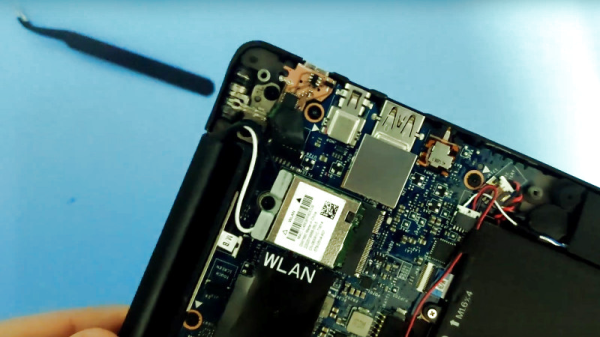
I put the Pinecil through its paces, and and although the device is fully open source, give it a teardown for good measure. Spoiler: it’s my new favorite.
Continue reading “Review: Pine64 Pinecil Soldering Iron”

Never Forget To Turn On The Cooker Hood Again

The cooker hood is a wonderful invention for removing excess fumes and steam from the kitchen. But like all electrically-powered devices, it only works when it is turned on. This was the problem facing [Peter], whose family are enthusiastic cooks who frequently forget to hit that switch. His solution? An automatic cooker hood switch that comes on when the cooker is in use, and stays on long enough afterwards to fully dissipate the fumes.

At its heart is a current transformer on the 3-phase stove power line, and we’re treated to a lesson in reading from these devices with an Arduino. They have a shunt resistor across which to produce a voltage, and their AC output is placed upon a reference DC voltage to supply the microcontroller pin. The impedance is quite high, so when the sensor had to be placed a distance from the microcontroller it necessitated an op-amp buffer. The readings then cause the Arduino to trigger a pair of relays to switch on or off the cooker hood. We can imagine that the family kitchen is thus a much pleasanter environment for it.

Cookers can also provide quite a hazard when they are left on. To that end, we’ve also featured a cooker alarm in the past.

Header image: Pbroks13, CC BY-SA 3.0.

An Arduino And A CD-ROM Drive Makes A CD Player

In an age of streaming media it’s easy to forget the audio CD, but they still remain as a physical format from the days when the “Play” button was not yet the “Pay” button. A CD player may no longer be the prized possession it once was, but it’s still possible to dabble in the world of 120 mm polycarbonate discs if you have a fancy for it. It’s something [Daniel1111] has done with his Arduino CD player, which uses the little microcontroller board to control a CD-ROM drive via its IDE bus.

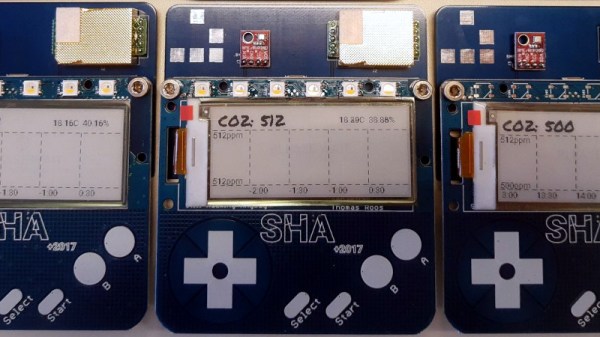
The project draws heavily from the work of previous experimenters, notably ATAPIDUINO, but it extends them by taking its audio from the drive’s S/PDIF output. A port expander drives the IDE interface, while a Cirrus Logic WM8805 S/PDIF transceiver handles the digital audio and converts it to an I2S stream. That in turn is fed to a Texas Instruments PCM5102 DAC, which provides a line-level audio output. All the code and schematic can be found in a GitHub repository.

To anyone who worked in the CD-ROM business back in the 1990s this project presses quite a few buttons, though perhaps not enough to dig out all those CDs again. It would be interesting to see whether the I2S stream could be lifted from inside the drive directly, or even if the audio data could be received via the IDE bus. If you’d like to know a bit more about I2S , we have an article for you.

A Vintage Flip Clock Gets Some Modern Love

There are multiple reasons why we like [iSax]’s rebuild of a Bodet flip clock from the early 1980s. First there’s the retro charm of the timepiece itself, then the electronics used to drive it, its electromechanical month length and leap year system, and finally because here is a maker lucky enough to have a beautiful tabby cat to share the workbench with.

For those of you unfamiliar with a flip clock, these devices have their digits as a series of hinged cards on a central rotor, with each one being exposed in turn as the rotor turns. This one is part of a distributed clock system in which the clients receive a 1 Hz pulse from a central time server to drive their motors, something easily replicated with an Arduino and an H-bridge. Particularly fascinating though is the month length mechanism, part of the calendar rotor system, it has a small DC motor that is engaged to advance the days automatically by whichever number as part of the month transition. Originally this was powered by a couple of AA batteries, which have now been replaced with a small DC to DC converter. You can see it in action in the video below the break.

With or without tabby cats, we see quite a few projects featuring them. If you can’t find one, you can always make your own.

Continue reading “A Vintage Flip Clock Gets Some Modern Love”

A Fresh Linux For The Most Unexpected Platform – The Nintendo 64

Though it was famously started by Linus Torvalds as “a (free) operating system (just a hobby, won’t be big and professional like gnu) for 386(486) AT clones“, the Linux kernel and surrounding operating system ecosystems have been ported to numerous architectures beyond their x86 roots. It’s therefore not unusual to hear of new ports for unsupported platforms, but it is extremely unexpected to hear of one when the platform is a games console from the mid-1990s. But that’s what [Lauri Kasanen] has done, announcing a fresh Linux port for the Nintendo 64.

This isn’t a Linux from 1996 either. The port builds on an up-to-date kernel version 5.10 with his N64 branch and a tantalising possibility that it might be incorporated into the main Linux source for the MIPS-64 processor architecture. That’s right, the Nintendo 64 could be an officially supported Linux platform.

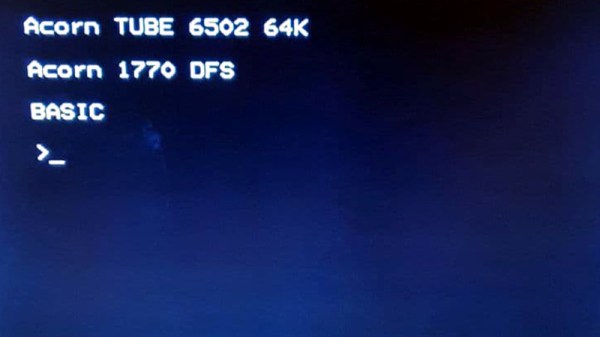
It would be stretching the story a long way to call this any kind of distro, for what he’s produced is a bootloader that loads the kernel and creates a terminal with busybox loaded. With this on your flashcart you won’t be replacing that Raspberry Pi any time soon, so why other than [Lauri]’s “because I can” would you be interested in it? He supplies the answer and it lies in the emulation scene, because having a Linux for the platform makes it so much easier to port other software to it. If this tickles your fancy you can see the source in his GitHub repository, and we’re certainly looking forward to what the community will do with it.

We are more used to seeing the N64 as a subject for case-modding, whether it be as a handheld or a an all-in-one console.

Via Phoronix, and thanks [David Beckershoff] for the tip.

Header image: Evan-Amos, Public domain.

The Internet Of Christmas Tree Watering

There’s nothing quite like a real Christmas tree, but as anyone who’s had one will know there’s also nothing like the quantity of needles that a real tree can shed when it runs short of water. It’s a problem [RK] has tackled, with a Christmas tree water level monitor that has integration with Adafruit’s cloud service to give a handy phone notification when more watering is required.

The real interest in this project lies in the sensor development path. There are multiple ways of water level sensing from floats and switches through resistive and light scattering techniques, but he’s taken the brave step of using a capacitive approach. Water can be used as a dielectric between two parallel metal plates, and the level of the water varies the capacitance. Sadly the water from your tap is also a pretty good conductor, so the first attempt at a capacitive sensor was not effective. This was remedied with a polythene “sock” for each electrode constructed with the help of a heat sealer. The measurement circuit was simply a capacitive divider fed with a square wave, from which an Adafruit Huzzah board could easily derive an amplitude reading that was proportional to the water level. The board then sends its readings to Adafruit.io, from which a message can be sent to a Slack channel with the notification enabled. All in all a very handy solution.

Plant care is a long-running theme in Hackaday projects, but not all of them need a microcontroller.