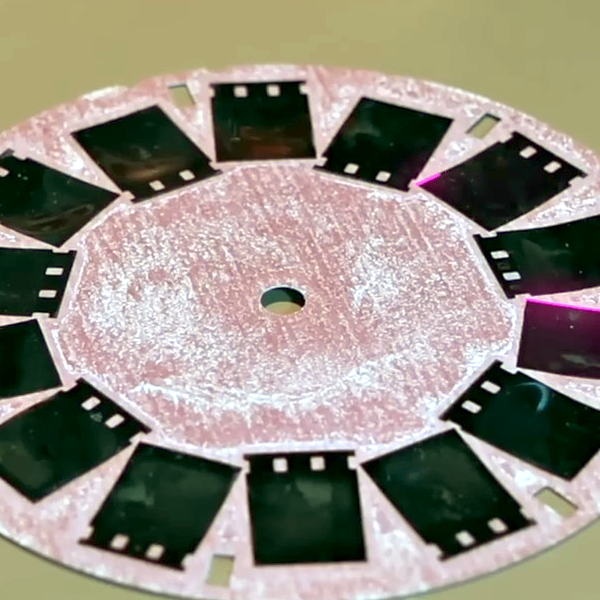
Just Who Makes Tubes These Days?

For most of us, electronic technology comes in the form of solid state devices. Transistors, integrated circuits, microcontrollers. But for the first sixty years or so of the field existing, these devices either hadn’t been invented yet or were at too early a stage in their development to be either cost-effective, or of much use. Instead a very different type of electronic component ruled the roost, the vaccum tube.

A set of electrodes in an evacuated glass envelope whose electrical properties depended on the modulation of the flow of electrons through them, these were ubiquitous in consumer electronics up until the 1960s, and clung on in a few mass-market applications even as far as the mid 1970s. As cheaper and more versatile semiconductors superseded them they faded from electronic parts catalogues, and the industry that had once produced them in such numbers disappeared in favour of plants producing the new devices. Consumer products no longer contained them, and entire generations of engineers grew up never having worked with them at all. If you were building a tube amplifier in the early 1990s, you were a significant outlier. Continue reading “Just Who Makes Tubes These Days?”

The Smell Of Space

In space, so the Alien tagline goes, nobody can hear you scream. One of the most memorable pieces of movie promotion ever, it refers to the effect of the vacuum of space on the things human senses require an atmosphere to experience. It’s a lesson that Joss Whedon used to great effect with theĀ Serenity‘s silent engine light-ups in Firefly, while Star Wars ignored it completely to give us improbable weapon noises in space battles.

Sound may not pass through the vacuum of space, but that’s not to say there are not things other than light for the senses. The Apollo astronauts reported that moon dust released a smell they described as akin to burnt gunpowder once it was exposed to the atmosphere inside their lander, and by now you may have heard that there is a Kickstarter that aims to recreate the smell as a fragrance. Will it replace the cloying wall of Axe or Lynx Africa body spray that pervades high-school boys’ changing rooms, or is it a mere novelty?

Continue reading “The Smell Of Space”

The Game Boy As A Midi Synthesiser

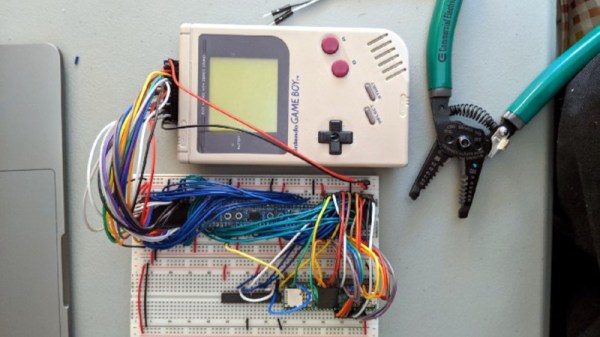
In the world of chiptune music there are many platforms to choose from, each with their own special flavour tot heir sound. The Game Boy has a particular following, but it differs from some of its contemporary platforms in having a custom sound chip built into the same silicon as its processor. You can’t crank open a Game Boy and lift out the sound chip for your own synth project, instead you must talk to it through the Game Boy’s Z80 processor. This is something [Adil Soubki] knows well, as he’s completed a project that turns the handheld console into a MIDI synthesiser.

A Game Boy was designed to play games and not as a developer’s toy, so it doesn’t exactly roll out the red carpet for the hacker. He’s got under the console’s skin by mapping a section of its memory address map to the pins on a Teensy microcontroller board, and running some Game Boy code that reads the vaues there and uses them to configure the sound hardware. The Teensy handles the translation between MIDI and these byte values, turning the whole into a MIDI synthesiser. It’s a succesful technique, as can be seen in the video below the break. Best of all, the code is available, so you can have a go for yourself.

We’ve featured Game Boy synths before here at Hackaday, but usually they have been of the more conventional variety.

Continue reading “The Game Boy As A Midi Synthesiser”

Folding@Home And Rosetta, For ARM

Most readers will be aware of the various distributed computing projects that provide supercomputer-level resources to researchers by farming out the computing tasks across a multitude of distributed CPUs and GPUs. The best known of these are probably Folding@Home and Rosetta, which have both this year been performing sterling service in the quest to understand the mechanisms of the SARS COVID-19 virus. So far these two platforms have remained available nearly exclusively for Intel-derived architectures, leaving the vast number of ARM-based devices out in the cold. It’s something the commercial distributed-computing-on-your-phone company Neocortix have addressed, as they have successfully produced ARM64 clients for both platforms that will be incorporated into the official clients in due course.

So it seems that mundane devices such as mobile phones and the more capable Raspberry Pi boards will now be able to fold proteins like a boss, and the overall efforts to deliver computational research will receive a welcome boost. But will there be any other benefits? It’s a Received Opinion that ARM chips are more power-efficient than their Intel-derived cousins, but will this deliver more energy-efficient distributed computing? The answer is “probably”, but the jury’s out on that one as computationally intensive tasks are said to erode the advantage significantly.

Folding@Home was catapulted by the influx of COVID-19 volunteers into first place as the world’s largest supercomputer earlier this year, and we’re pleased to say that Hackaday readers have played their part in that story. As this is being written the July 2020 stats show our team ranked at #39 worldwide, having racked up 14,005,664,882 points across 824,842 work units. Well done everybody, and we look forward to your ARM phones and other devices boosting that figure. If you haven’t done so yet, download the client and join us..

Via HPCwire. Thanks to our colleague [Sophi] for the tip.

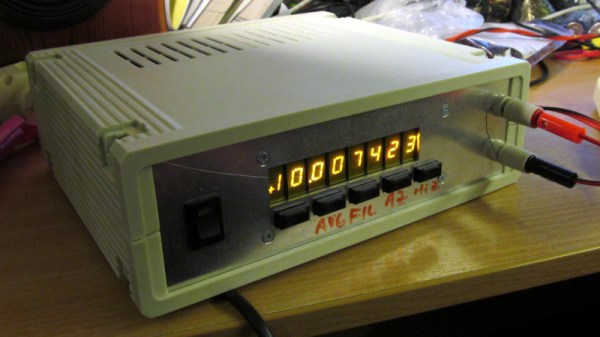
A DIY 6.5-Digit Multimeter Is A Lesson In Clever Circuitry

A multimeter is an easy prospect, right? Back in the day you could make one fairly easily with a decent panel meter and a set of precision resistors, and now a digital one can be had for throwaway prices from China.

But what if instead of a cheap-and-cheerful bench instrument your needs extend to a high-precision device, a really good multimeter? It’s a path [jaromir.sukuba] has trodden with his 6.5 digit multimeter project, and along the way he’s offered us a fascinating window into their design that should be of interest to any electronic engineer even if they never intend to build a multimeter.

The range selection network of switches and resistors, microcontroller, and seven-segment displays are universal to a multimeter design, meaning that there is nothing too special about them in a high-precision instrument except that here he’s using an FPGA for timing.

Where the meat lies in this project is in the ADC and its associated voltage reference, and for that he takes a surprising turn. Instead of taking an off-the-shelf ADC part from one of the usual manufacturers, he’s created his ADC from scratch using op-amps, and to understand why that is the case he takes us on a journey into the world of dual-slope integrating ADCs. These circuits are very well explained in a 1989 HP journal article (PDF, page 8), and are a clever design that measures the time taken to charge and discharge a capacitor from the voltage to be measured and compares it to the same time from the reference voltage.

The beauty of it comes out in the HP article, that the mathematics of the charge/discharge cycle cancel out any effects of the analogue component values, allowing the much higher precision of the reference and the clock timing to dictate that of the reading. We look forward to seeing more of this project.

It’s surprising how few home-made multimeters we have on these pages, perhaps because of those cheap ones. Of the few we’ve had, perhaps this state-based Nixie one is most unusual.

Digital Caliper Talks For Accessibility, With This App

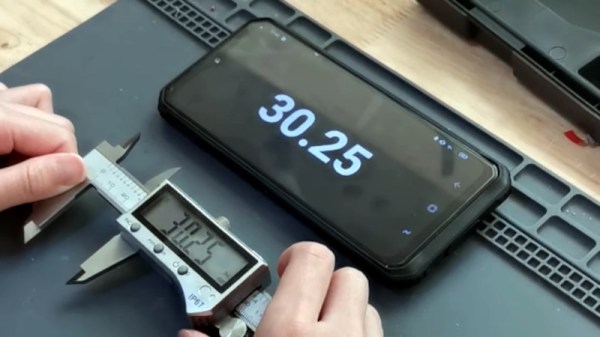
A good instrument stays with its owner for a lifetime, becoming part of their essential trusted toolkit to be consulted as a matter of habit. If you use a caliper to measure dimensionsĀ  you’ll know this, and a quick glance at its scale or digital display will be second nature. But if you aren’t fortunate enough to have the eyesight to see the caliper, then it’s off-limits, and that’s something [Naomi Wu] has addressed with her open-source accessible speaking caliper app. It’s an Android app that connects to digital calipers that contain Bluetooth connectivity, and as well as speaking aloud the caliper reading it also displays it in very large text on the device screen. As well as the source link from which you can build the app, it’s available for installation directly from the Google Play Store.

If you’re used to [Naomi] from her video tours of the electronics businesses in her native Shenzhen, her eye-catching wearable projects, or her exploits with an industrial CNC machine in her living room, you might be interested to know that aside from this app she’s been a long-time proponent of open-source in China. She was responsible among other projects for the Sino:bit educational computer board, which holds the distinction for her of having secured the first ever Chinese OSHWA certification.

You can see the caliper app in action below the break.

Continue reading “Digital Caliper Talks For Accessibility, With This App”

A Homebrew Radio, As All The Best Homebrew Radios Should Be

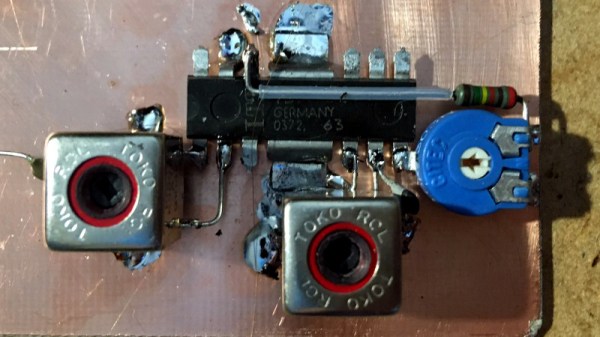
It started with an old TV sound chip, and some curiosity. The TDA1701 that [Philip Bragg] found in a box of junk is a complete FM IF strip and audio power amplifier from the golden age of analogue PAL televisions, and while it was designed for the 5.5 MHz or 6 MHz FM subcarrier of European broadcast TV, he found it worked rather well at the more usual 10.7 MHz of a radio receiver. There followed a long thread detailing the genesis bit-by-bit of a decent quality VHF radio receiver, built dead-bug-style on a piece of PCB material.

The TDA1701 was soon joined by a couple of stages of IF amplification with a ceramic filter, and then by several iterations of a JFET mixer. A varicap tuned MOSFET RF amplifier followed, and then a local oscillator. Finally it became a fully-functional FM radio, with probably far better performance than most commercial radios. He admits tuning is a little impractical though, with what appears to be a cermet preset potentiometer covering the entire band.

We suspect this project isn’t finished, and we hope he posts the schematic. But it doesn’t really matter if he doesn’t, because the value here isn’t in the design. Instead it lies in the joy of creating an ad-hoc radio just for the fun of it, and that’s something we completely understand.

We’ve covered a lot of radios in our time, and while it might be the first to feature a TV sound chip, it’s not the first built on bare PCB.