Open Source Commercial Synthesisers You Will Love

Drumboy and Synthgirl from Randomwaves are a a pair of compact electronic instruments, a drum machine and a synthesiser. They are commercial products which were launched on Kickstarter, and if you’re in the market for such a thing you can buy one for yourself. What’s made them of interest to us here at Hackaday though is not their musical capabilities though, instead it’s that they’ve honoured their commitment to release them as open source in the entirety.

So for your download, you get everything you need to build a pair of rather good 24-bit synthesisers based upon the STM32 family of microcontrollers. We’re guessing that few of you will build your own when it’s an easier job to just buy one from Randomwaves, and we’re guessing that this open-sourcing will lead to interesting new features and extensions from the community of owners.

It will be interesting to watch how this progresses, because of course with the files out there, now anyone can produce and market a clone. Will AliExpress now be full of knock-off Drumboys and Synthgirls? It’s a problem we’ve looked at in the past with respect to closed-source projects, and doubtless there will be enterprising electronics shops eyeing this one up. By our observation though it seems to be those projects with cheaper bills of materials which suffer the most from clones, so perhaps that higher-end choice of parts will work in their favour.

Either way we look forward to more open-source from Randomwaves in the future, and if you’d like to buy either instrument you can go to their website.

Thanks [EilĂ­s] for the tip.

A Blacksmith Shows Us How To Choose An Anvil

No doubt many readers have at times wished to try their hand at blacksmithing, but it’s fair to say that acquiring an anvil represents quite the hurdle. For anyone not knowing where to turn there’s a video from [Black Bear Forge], in which he takes us through a range of budget options.

He starts with a sledgehammer, the simplest anvil of all, which we would agree makes a very accessible means to do simple forge work. He shows us a rail anvil and a couple of broken old anvils, before spending some time on a cheap Vevor anvil and going on to some much nicer more professional ones. It’s probably the Vevor which is the most interesting of the ones on show though, not because it is particularly good but because it’s a chance to see up close one of these very cheap anvils.

Are they worth taking the chance? The one he’s got has plenty of rough parts and casting flaws, an oddly-sited pritchel and a hardy hole that’s too small. These anvils are sometimes referred to as “Anvil shaped objects”, and while this one could make a reasonable starter it’s not difficult to see why it might not be the best purchase. It’s a subject we have touched on before in our blacksmithing series, so we’re particularly interested to see his take on it.

Continue reading “A Blacksmith Shows Us How To Choose An Anvil”

A Cheap Yellow Display Makes A Video Walkie Talkie

The ESP32 series of microprocessors with their cheap high-power cores and built-in wireless networking have brought us a wide variety of impressive projects over the years. We’re not sure we’ve quite seen the like of [Jonathan R]’s video walkie talkie before though, a pair of units which as you might guess, deliver two-way video and audio communications.

The trick involves not one but two ESP32s: an ESP32-S3 based camera module, and a more traditional Tensilica ESP32 in a screen module. It’s an opportunity for an interesting comparison, as one device uses the Cheap Yellow Display board, and the other uses an Elecrow equivalent. The audio uses ESP-NOW, while the video uses WiFi, and since the on-board audio amplifiers aren’t great, there’s a small amp module.

The video below has a comprehensive run-down including the rationale behind the design choices, as well as a demonstration. There’s a small lag, but nothing too unacceptable for what is after all an extremely cheap device. Perhaps after all this time, the video phone has finally arrived!

Continue reading “A Cheap Yellow Display Makes A Video Walkie Talkie”

Jenny’s (Not Quite) Daily Drivers: Raspberry Pi 1

An occasional series of mine on these pages has been Daily Drivers, in which I try out operating systems from the point of view of using them for my everyday Hackaday work. It has mostly featured esoteric or lesser-used systems, some of which have been unexpected gems and others have been not quite ready for the big time.

Today I’m testing another system, but it’s not quite the same as the previous ones. Instead I’m looking at a piece of hardware, and I’m looking at it for use in my computing projects rather than as my desktop OS. You’ll all be familiar with it: the original Raspberry Pi appeared at the end of February 2012, though it would be May of that year before all but a lucky few received one. Since then it has become a global phenomenon and spawned a host of ever-faster successors, but what of that original board from 2012 here in 2025? If you have a working piece of hardware it makes sense to use it, so how does the original stack up? I have a project that needs a Linux machine, so I’m dusting off a Model B and going down memory lane.

Continue reading “Jenny’s (Not Quite) Daily Drivers: Raspberry Pi 1”

Repairing Classic Sound Cards

Sound hardware has been built into PC motherboards for so long now it’s difficult to remember the days when a sound card was an expensive add-on peripheral. By the mid to late 1990s they were affordable and ubiquitous enough to be everywhere, but three decades later some of them are starting to fail. [Necroware] takes us through the repair of a couple of Creative Labs Sound Blaster 16s, which were the card to have back then.

The video below is a relaxed look at typical problems afflicting second-hand cards with uncertain pasts. There’s a broken PCB trace on the first one, which receives a neat repair. The second one has a lot more wrong with it though, and reveals some surprises. We would have found the dead 74 series chips, but we’re not so sure we’d have immediately suspected a resistor network as the culprit.

Watching these cards become sought-after in the 2020s is a little painful for those of us who were there at the time, because it’s certain we won’t be the only ones who cleared out a pile of old ISA cards back in the 2000s. If you find one today and don’t have an ISA slot, worry not, because you can still interface it via your LPC bus.

Continue reading “Repairing Classic Sound Cards”

A Mouse, No Hands!

There are some ideas which someone somewhere has to try. Take [Uri Tuchman]’s foot mouse. It’s a computer mouse for foot operation, but it’s not just a functional block. Instead it’s an ornate inlaid-wood-and-brass affair in the style of a very fancy piece of antique footwear.

The innards of an ordinary USB mouse are placed in something best described as a wooden platform heel, upon which is placed a brass sole with a couple of sections at the front to activate the buttons with the user’s toes. The standout feature is the decoration. With engraving on the brass and inlaid marquetry on the wood, it definitely doesn’t look like any computer peripheral we’ve seen.

The build video is below the break, and we’re treated to all the processes sped up. At the end he uses it in a basic art package and in a piloting game, with varying degrees of succes. We’re guessing it would take a lot of practice to gain a level of dexterity with this thing, but we salute him for being the one who tries it.

This has to be the fanciest peripheral we’ve ever seen, but surprisingly it’s not the first foot mouse we’ve brought you.

Continue reading “A Mouse, No Hands!”

Farewell Economy 7, A Casualty Of The Long Wave Switch-Off

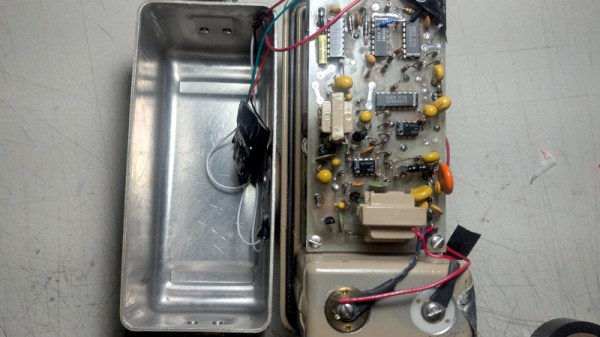
If you paid attention to advertising in 1980s Britain, you were never far from Economy 7. It was the magic way to heat your house for less, using storage heaters which would run at night using cheap electricity, and deliver warmth day-long. Behind it all was an unseen force, a nationwide radio switching signal transmitted using the BBC’s 198 kHz Long Wave service. Now in 2025 the BBC Radio 4 Long Wave service it relies on is to be turned off, rendering thousands of off-peak electricity meters still installed, useless. [Ringway Manchester] is here to tell the tale.

The system was rolled out in the early 1980s, and comprised of a receiver box which sat alongside your regular electricity meter and switched in or out your off-peak circuit. The control signal was phase-modulated onto the carrier, and could convey a series of different energy use programs. 198 kHz had the useful property due to its low frequency of universal coverage, making it the ideal choice. As we’ve reported in the past the main transmitter at Droitwich is to be retired due to unavailability of the high-power vacuum tubes it relies on, so now time’s up for Economy 7 too. The electricity companies are slow on the uptake despite years of warning, so there’s an unseemly rush to replace those old meters with new smart meters. The video is below the break.

The earliest of broadcast bands may be on the way out, but it’s not entirely over. There might even be a new station on the dial for some people.

Continue reading “Farewell Economy 7, A Casualty Of The Long Wave Switch-Off”