The Nintendo Game Boy Color Is An Aircon Remote

Those of you who are familiar with 1990s handheld consoles may recall that Nintendo’s Game Boy Color had an infra-red receiver and transmitter. The thought of a handheld computer with infra-red capabilities interested [jg], who immediately set about converting it into a remote control for an air conditioner.

The Game Boy doesn’t have dedicated infra-red remote control hardware, instead the IR diodes appear to be connected to I/O lines. Thus the bitstream bas to be bit-banged, and takes the processor’s entire attention when transmitting. The software is neatly placed on a reprogrammed bootleg cartridge.

It’s an interesting read in terms of the approach to reverse engineering, for example finding the parameters of 37 kHz infra-red remote control by trial and error rather than by a quick read up on the subject, or searching for information on National air conditioners and finding nothing, but not searching the National brand itself to find that a search on Panasonic air conditioners would likely give all the information needed. But the end result operates the appliance, so it’s good to record a success.

This isn’t the first time we’ve seen a Game Boy control something, though we can’t recall seeing another using the IR. Need a brilliant overview of the Game Boy?  We’ve got you covered.

Thanks [Roel] for the tip.

Header image: Evan-Amos / Public domain.
ReactOS: Dipping A Toe In A Millennium-era Open Source Dream

Do you remember when trying a new OS meant burning a CD? Not merely downloading an ISO and mounting it on a USB drive, but taking a circle of polycarbonate and hoping you didn’t get a buffer underrun as the file you’d spent an entire day downloading was burned onto it. A couple of decades ago that was how we’d take a look at a new Linux distro, and at the time we considered it to be nothing short of incredible that such a thing was possible. One of the ISOs I remember downloading back then was an early version of ReactOS, a project with the lofty aim of creating an open-source equivalent of Windows NT. You might think that in the nearly two decades since then it would have become an irrelevance and its contributors moved on to other work, but no. ReactOS is very much still with us, and indeed has just seen a new release. Version 0.4.13 is the latest in a long line of incremental updates, and remembering those early ReactOS ISOs when I saw their announcement, I thought I’d give it a spin. The result was both a peek at the current state of the project, and a chance to think about the place of a Windows clone in 2020. Continue reading “ReactOS: Dipping A Toe In A Millennium-era Open Source Dream”

Brain Transplant Makes One Arcade Machine Play Games From Another

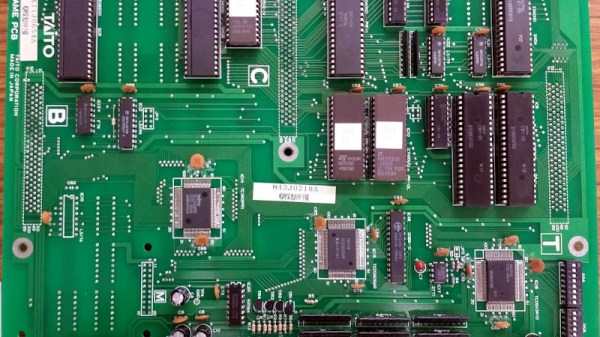
We’re used to games consoles in which the same hardware plays a variety of different games, but if we were to peer inside arcade cabinets of an older vintage we’d find custom boards unique to every game. Some boards from the same manufacturers shared common hardware traits even if they weren’t identical though, and [twistedsymphony] has taken advantage of this to make one vintage Taito game — Gun & Frontier — run on the hardware for another, Ah Eikou no Koshien. It’s a fascinating tale across a forum thread, that’s well worth a read even if you will never touch a vintage arcade board.

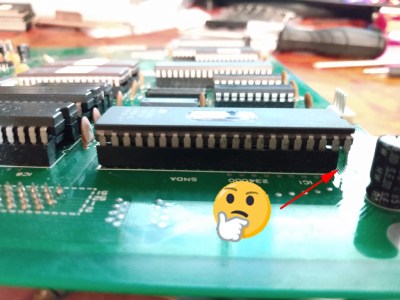
We might expect that the tool of choice would be a logic analyser or similar, but unexpectedly the solution to this hack was found in MAME. The arcade emulator conceals a wealth of information about these boards, from which you can discover their differences and try out possible solutions. The hardware hacks are surprisingly straightforward, a few bodge wires and an extra address line for a larger ROM. A programmable logic array required dumping and rewriting to fix a graphics corruption issue and a little bit of ROM tweaking after emulating a controller problem in MAME was required, but it seems that yes, one game can run on another. Certainly less painful than the Taito hack that required a chip to be decapped.
[via r/ReverseEngineering]

A LoRa IM-Me For The End Of The World

Enshrined in the hacker hall of fame, the IM-Me was an instant messaging toy that turned out to be extremely hackable. You could easily ditch its instant messaging platform to turn it into a little spectrum analyser. Of course what’s old is new again, and in this age where we no longer have the Nokia 3110, the Sidekick, or even Blackberries, how shall we get our fix of those wireless gadgets with physical keyboards?

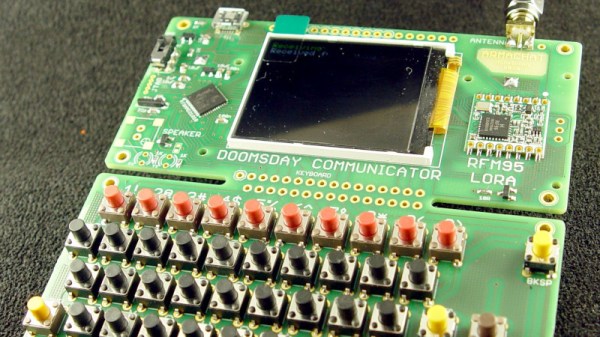
What would happen if a hacker had a go at creating one of those? [Bobricius]’ Armachat is an instant messaging platform that uses LoRa as its over-the-air protocol, and is powered by a Microchip ATSAMD21x18 ARM Cortex M0 microcontroller alongside an RFM95 LoRa module.

The IM-Me, a free text chat device in the age of per-message charges, was the sweat heart of hardware hacking back in 2010

There are two versions of the device for hand and pocket, both of which come with QWERTY keyboards made with momentary-action switches, 18650 cell power, and LCD screens. The idea is that it could form a robust communication system when many others have failed.

As it stands they have a simple text messaging app in the firmware, but there are other features yet to come. Perhaps the most interesting is a possible store-and-forward meshing system in the future, which would make this a powerful comms tool in so many circumstances. Both of [Bobricius’] devices can be seen in the video below the break — no word from him on the possibility of a pink case option. Meanwhile [Bobricius] has appeared on these pages many times before. With so many to choose from it’s hard to pick one, but his Nixie-like LED display is quite memorable.

Continue reading “A LoRa IM-Me For The End Of The World”

In-Depth Design Of A Flyback Converter

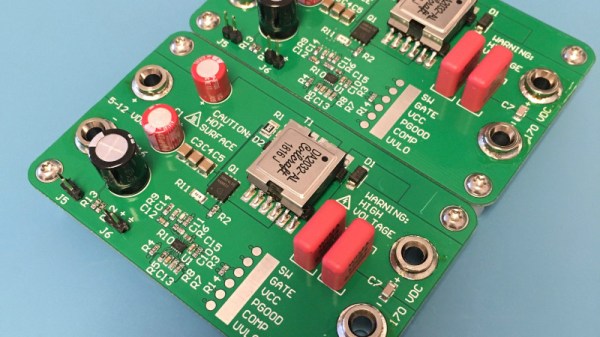
It is tempting to think of analogue and digital domains as entirely distinct, never to touch each other except like a cold war Checkpoint Charlie, through the medium of an ADC or DAC. In reality there are plenty of analogue effects upon digital circuitry which designers must be aware of, but there is one field in which the analogue and the digital are intricately  meshed. Switch mode power supplies use digital techniques to exploit the analogue properties of components such as inductors and capacitors, and can be astoundingly clever in the way they do this to extract the last fraction of a percent efficiency from their conversion. Thus their design can be something of a Dark Art, so it’s always interesting to have a good read explaining some of the intricacies. [James Wilson] has built a flyback step-up converter to power Nixie tubes, and his write-up follows the whole process in great depth.

This type of converter seems at first glance to be a simple step-up design with a transformer that has a primary and secondary, where in fact it relies on the collapse in magnetic field during the off period of its duty cycle to provide a spike in voltage and thus a step-up beyond that you’d expect from the transformer alone. The write-up takes us through all this starting from a theoretical perspective, and then goes further into the realm of component selection and the effects of component properties on the waveforms involved. If you have ever battled ringing in a switch mode power supply you may recognise some of this.

If this field interests you, then there is probably no better place to send you for a start than Jim Williams’ 1987 app note 25 for Linear Technology: “Switching Regulators for Poets“.

So. You Bought A VNA. Now What?

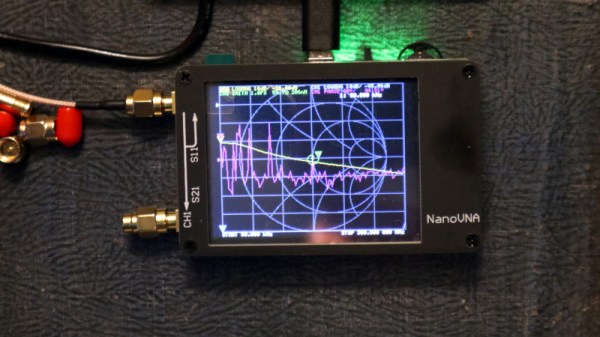
It’s never too late in life for new experiences, but there’s a new experience I had a few weeks ago that I wasn’t expecting. I probably received my first piece of test equipment – a multimeter –  in the early 1980s, and since then every time I’ve received a new one, whether an oscilloscope, logic analyser, spectrum analyser or signal generator, I’ve been able to figure out how to use it. I have a good idea what it does, and I can figure out whatever its interface may be to make it do what I want it to. My new experience came when I bought a piece of test equipment, and for the first time in my life didn’t have a clue how to use it.

That instrument is a Vector Network Analyser, or VNA, and it’s worth spending a while going through the basics in case anyone else is in the same position. My VNA is not a superlative piece of high-end instrumentation that cost the GDP of a small country, it’s the popular $50 NanoVNA that has a fairly modest frequency range and performance, but is still a functional VNA that can take useful measurements. But I’m a VNA newbie, what does a VNA do? Continue reading “So. You Bought A VNA. Now What?”

New Part Day: The MSC313E Is A Computer On A Chip

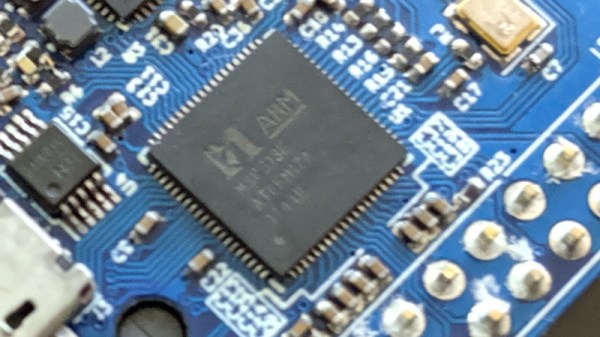
As the onward march of technology delivers ever more powerful semiconductors, it can be instructive to keep an eye on the periphery of the system-on-chip market for niche-application devices which may have an application in our sphere. Just such a chip is the Mstar MSC313E, a SoC designed for use in IP cameras that packs an ARM Cortex A7 and 64 MB of memory, 16 MB of flash, Ethernet, USB, and all the other usual interfaces you’d expect from a microprocessor. It’s available in a QFN package which makes it tantalisingly within the reach of the hardware hacker community, so naturally there is significant interest in unlocking its secrets. A cheap and accessible part with enough power to run a stripped-out GNU/Linux operating system has to be worth a second look!

QFNs are not the easiest packages to hand solder, but if you also find yourself in that position there is at least the prospect of a ready to go development board. The BreadBee is a small PCB that packs in the chip with all its interfaces including Ethernet and USB brought out for experimentation. If you don’t fancy building one, you don’t even have to: it’s soon to be crowdfunded.

One might ask what the point is of Yet Another Linux Capable Microcontroller Platform, given the plethora of Raspberry-pi and competitor boards. The answer to that is simple enough and contains within it the essence of hardware hacking: because it is there. We might never see it again save for in a few outlying projects, or perhaps it might find a niche in our world and become popular, without this early work we’ll never know. While we’re at it, this isn’t the first such SoC that’s emerged; we’ve previously seen an action cam chip give us a hand-solderable Linux single board computer.

Thanks [anonymouse] for the tip.