Perfect Cheese Every Time With This Temperature Controller

Anyone who is from a background in which cheesemaking is a feature will tell you that it is an exact science in which small differences in parameters can make a huge difference in the resulting cheese, to the extent that entire batches can be rendered inedible. In particular the temperature at which the milk is held can be crucial to the production of individual styles of cheese. A friend of [William Dudley]’s had this problem, as a dairy farmer and artisinal cheesemaker they had to carefully control their vat with a set of profiles depending upon the recipe in use. This was achieved using an Arduino Mega 2650 and a thermocouple to control the heat source for the hot water in the outer wall of the vat.

A cheap K-type thermocouple amplifier proved unsatisfactory, so a Sparkfun item was substituted. A relay, Ethernet adaptor, and LCD display provided power control, access to a web interface, and user feedback respectively. Four buttons to select programs were added, and the whole was neatly boxed up to survive the dairy and put to work. In tests with a saucepan it was configured as a PID controller, but the real vat proved to have a much greater thermal inertia so a simpler bang-bang home thermostat style approach was used. Temperatures are logged in an eeprom for later retrieval via the web interface.

We don’t see the cheeses produced, but we’re sure they must be worth the effort. Blessed may be the cheesemakers, but doubly blessed are they who have a little help from an Arduino.

Hello: A Mini Badge For CCCamp

Badgelife culture is our community’s very own art form, with a plethora of designs coming forth featuring stunning artwork, impressive hardware, and clever software tricks. But sometimes a badge doesn’t need a brace of LEDs or a meme-inspired appearance to be a success, it just needs to be very good at what it does.

A perfect example is [Gavan Fantom]’s Hello mini badge. The hardware is fairly straightforward, it’s just a small square PCB sporting a LPC1115 microcontroller, 8Mb Flash chip, piezo speaker, and an OLED display. Its functionality is pretty simple as well, in that it exists to display text, images, or short animations. But the badge hides a very well-executed firmware that provides a serial terminal and zmodem file upload capability as well as an on-device interface via a small joystick. Power comes from a 500 mAh lithium-polymer cell, for which the badge integrates the usual charger and power management hardware.

There’s a variety of possibilities for the badge, but we’d guess that most owners will simply use it to display their name with perhaps a little animation. A bit of nifty processing of some video could perhaps get something approaching watchable video on it though, opening up the entertaining possibility of displaying demos or other video content.

[Gavan] will have some of the Hello badges at the upcoming CCCamp hacker camp in Germany if you’re interested, and should be easy enough to find in the EMF village.

An All-In-One Conference Video Streaming Box

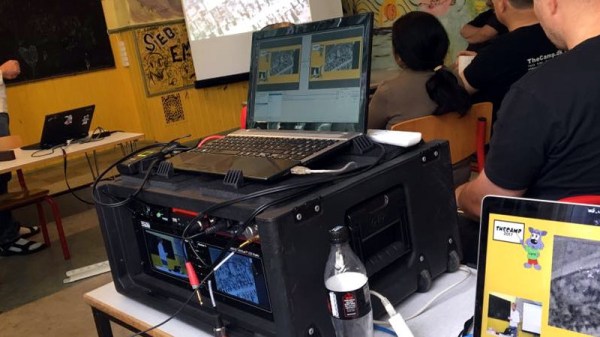
When running a hacker camp or other event, one of the many challenges faced by the organisers concerns the production and distribution of event videos. As the talks are recorded they must be put online, and with a load of talks to be processed it quickly becomes impractical to upload them one by one through a web interface such as that provided by YouTube. At the BornHack 2019 hacker camp in Denmark they were using a particularly well-integrated unit to do the video uploading in real time, and its creator [Mikkel Mikjær Christensen]  was good enough to share the video we’ve put below the break, a talk he gave about it at The Camp 2017, a Danish open source software camp.

It takes the viewer through the evolution over several years, from simple camcorders with integrated microphones and post-event processing, through a first-generation system with a laptop and rack-mount monitors, and into a final system in a rugged portable case with a significantly powerful laptop running OBS with a hardware MPEG encoder. Careful choice of power supplies and the use of good quality wireless microphones now give instantaneous video streaming to events such as BornHack without the need for extensive infrastructure.

If you were wondering where you might have heard that name before, [Mikkel] is the [Mike] from the Retrocomputing with Mike YouTube channel. It’s being honest to say that more of our conversation was about retrocomputers than the video box.

Continue reading “An All-In-One Conference Video Streaming Box”

Turning Scrap Metal Into Something To Work With

Blacksmiths will frequently work to a customer’s commission, and sometimes those commissions can be somewhat unusual. [Copperrein] had just such a piece of work come his way, a ceremonial sword to be made from a supplied collection of iron and steel items. To render them into something useful he had to melt them together, and the story of how he did that is particularly interesting.

We’re introduced to the Aristotle furnace, a fairly simple top-fed air blast charcoal furnace capable of melting almost any ferrous scrap into a so-called “bloom”, a lump of iron with some slag and carbon inclusions. These furnaces are often built as holes in the ground, but he’s made his atop a portable forge at working height to save bending over it for seven hours.

The source material was a very mixed bag, so the first order was to strip it in an acid bath of any coatings which might contaminate the resulting bloom. The parts, including things as diverse as a huge wrought-iton bolt, a scythe blade, and a pair of dividers, were then cut into small pieces one by one and fed into the furnace. They melt as they progress down through the furnace, resulting in a bloom of iron. The bloom is impure and will need significant working to expel any inclusions, but the final result will be something like the wrought iron of old. Let’s hope he has a power hammer, working the bloom would be hard work by hand!

If this catches your attention, you may be interested in a bit of blast furnace iron smelting. And of course, there is also our ongoing blacksmithing series to get you going at the anvil. You could even make a nail.

Via Reddit.

Thanks [Mike] for the tip.

Turning A Sony Into A Leica Through Extreme Camera Modding

The quality of a photograph is a subjective measure depending upon a multitude of factors of which the calibre of the camera is only one. Yet a high quality camera remains an object of desire for many photographers as it says something about you and not just about the photos you take. [Neutral Gray] didn’t have a Leica handheld camera, but did have a Sony. What’s a hacker to do, save up to buy the more expensive brand? Instead he chose to remodel the Sony into a very passable imitation.

This is a Chinese language page but well worth reading. We can’t get a Google Translate link to work, but in Chrome browser, right clicking and selecting “translate” works. If you have a workaround for mobile and other browsers please leave a comment below.

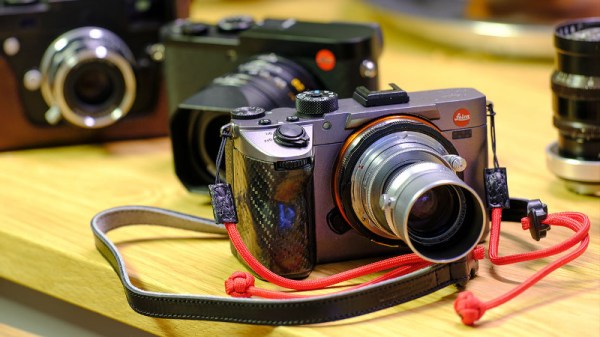
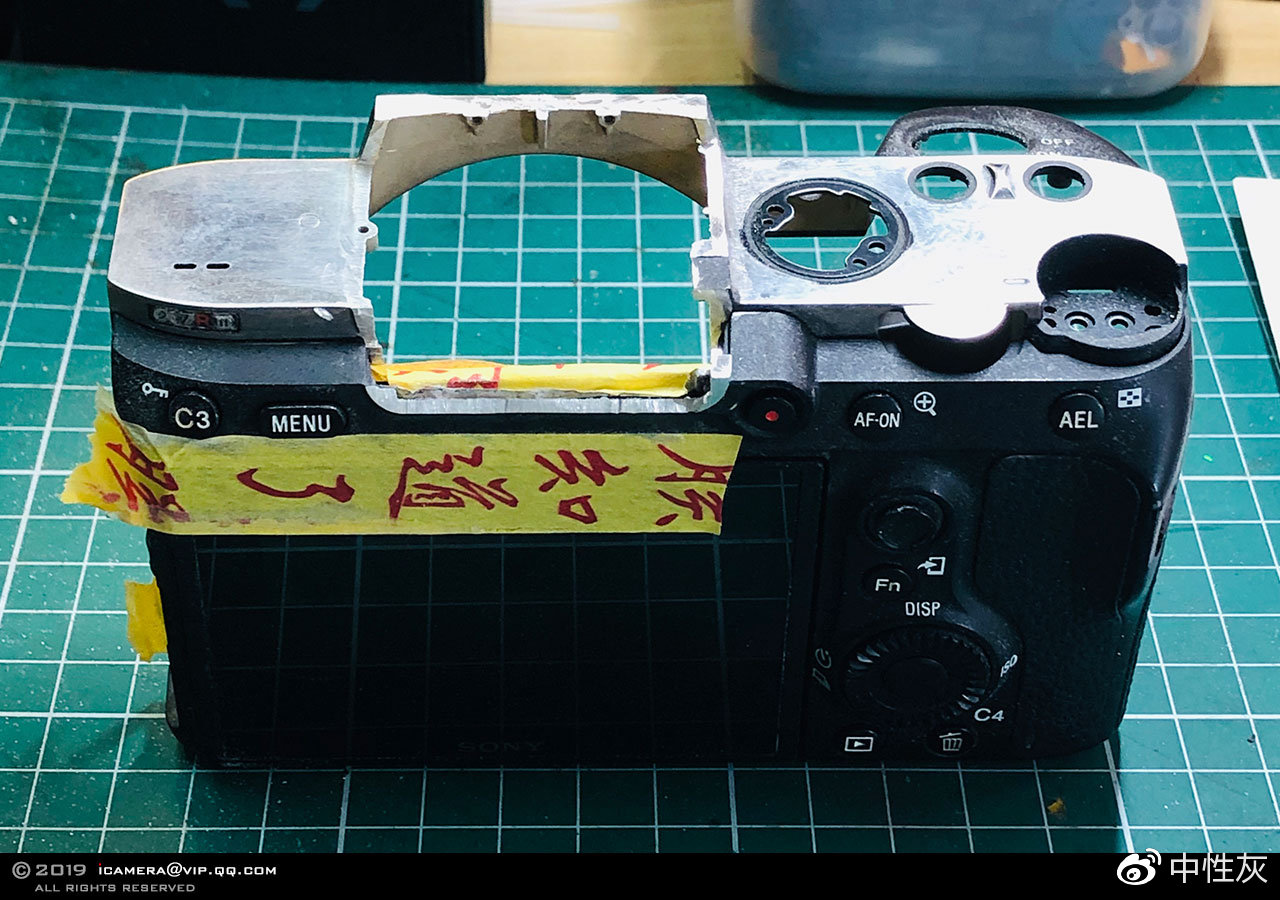
The Sony A7R is hardly a cheap camera in the first place, well into the four-figure range, so it’s a brave person who embarks on its conversion to match the Leica’s flat-top aesthetic. The Sony was first completely dismantled and it was found that the electronic viewfinder could be removed without compromising the camera. In a bold move, its alloy housing was ground away, and replaced with a polished plate bearing a fake Leica branding.


Extensive remodelling of the hand grip with a custom carbon fibre part followed, with significantly intricate work to achieve an exceptionally high quality result. Careful choice of paint finish results in a camera that a non-expert would have difficulty knowing was anything but a genuine Leica, given that it is fitted with a retro-styled lens system.

We’re not so sure we’d like to brace Leica’s lawyers on this side of the world, but we can’t help admiring this camera. If you’re after a digital Leica though, you can of course have a go at the real thing.

Thanks [fvollmer] for the tip.

Safety Systems For Stopping An Uncontrolled Drone Crash

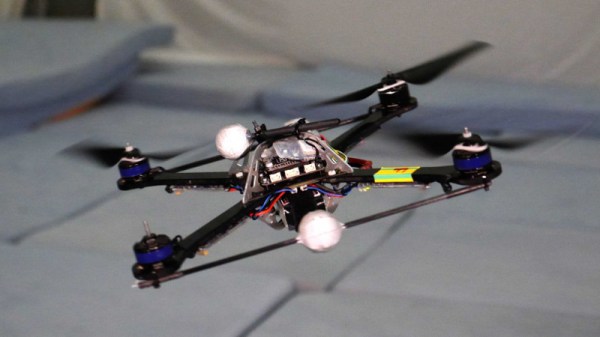
We spend a lot of time here at Hackaday talking about drone incidents and today we’re looking into the hazard of operating in areas where people are present. Accidents happen, and a whether it’s a catastrophic failure or just a dead battery pack, the chance of a multi-rotor aircraft crashing down onto people below is a real and persistent hazard. For amateur fliers, operating over crowds of people is simply banned, but there are cases where professionally-piloted dones are flying near crowds of people and other safety measures need to be considered.

We saw a skier narrowly missed by a falling camera drone in 2015, and a couple weeks back there was news of a postal drone trial in Switzerland being halted after a parachute system failed. When a multirotor somehow fails while in flight it represents a multi-kilogram flying weapon widow-maker equipped with spinning blades, how does it make it to the ground in as safe a manner as possible? Does it fall in uncontrolled flight, or does it activate a failsafe technology and retain some form of control as it descends?

Continue reading “Safety Systems For Stopping An Uncontrolled Drone Crash”

What Happens To Tesla When The Sleeping Auto Giants Awake?

The history of automotive production is littered with the fallen badges of car companies that shone brightly but fell by the wayside in the face of competition from the industry’s giants. Whether you pine for an AMC, a Studebaker, or a Saab, it’s a Ford or a Honda you’ll be driving in 2019.

In the world of electric cars it has been a slightly different story. Though the big names have dipped a toe in the water they have been usurped by a genuinely disruptive contender. If you drive an electric car in 2019 it won’t be that Ford or Honda, it could be a Nissan, but by far the dominant name in EV right now is Tesla.

Motor vehicles are standing at the brink of a generational shift from internal combustion to electric drive. Will Tesla become the giant it hopes, or will history repeat itself?

Continue reading “What Happens To Tesla When The Sleeping Auto Giants Awake?”