Making a GPS clock is a relatively straightforward process on the face of it. Buy a GPS module for a few dollars, hook it up to a microcontroller board of your choice, pick the appropriate library and write a bit of code, et voila! A clock with time-wonk bragging rights!
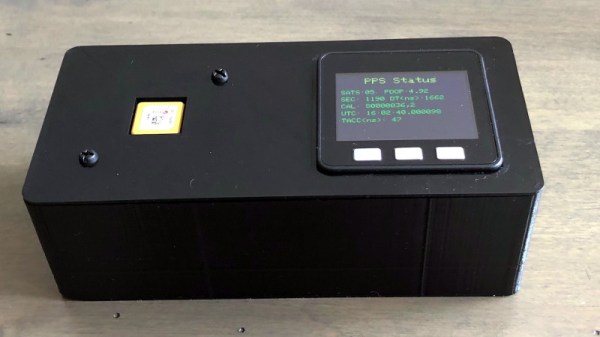
Of course, your GPS clock will always tell the right time, but it won’t be really right. Your microcontroller will introduce all sorts of timing errors and jitter, so at best it’ll only be nearly right. [Rick MacDonald] has been striving to quantify and minimise these errors in his OpenPPS project, which aims to be as accurate a GPS time and frequency reference as possible.
In a very comprehensive multi-page write-up, he details his progression, through the GPS modules he used, his experience with timing jitter when he used an ESP32 alone to process their output, and then his experiments with an FPGA and then temperature-compensated oscillators. It moves from being a mere description of a GPS clock into a fascinating run-down of both GPS timing itself and the development pitfalls he encountered along the way. At the end of it all he has a GPS clock in a smart 3D-printed enclosure which he admits as yet doesn’t do anything more than tell the time, but as he points out it’s a clock with minimised jitter, delay, and drift, and it remains an ongoing project that will evolve into a full-blown time and frequency standard.
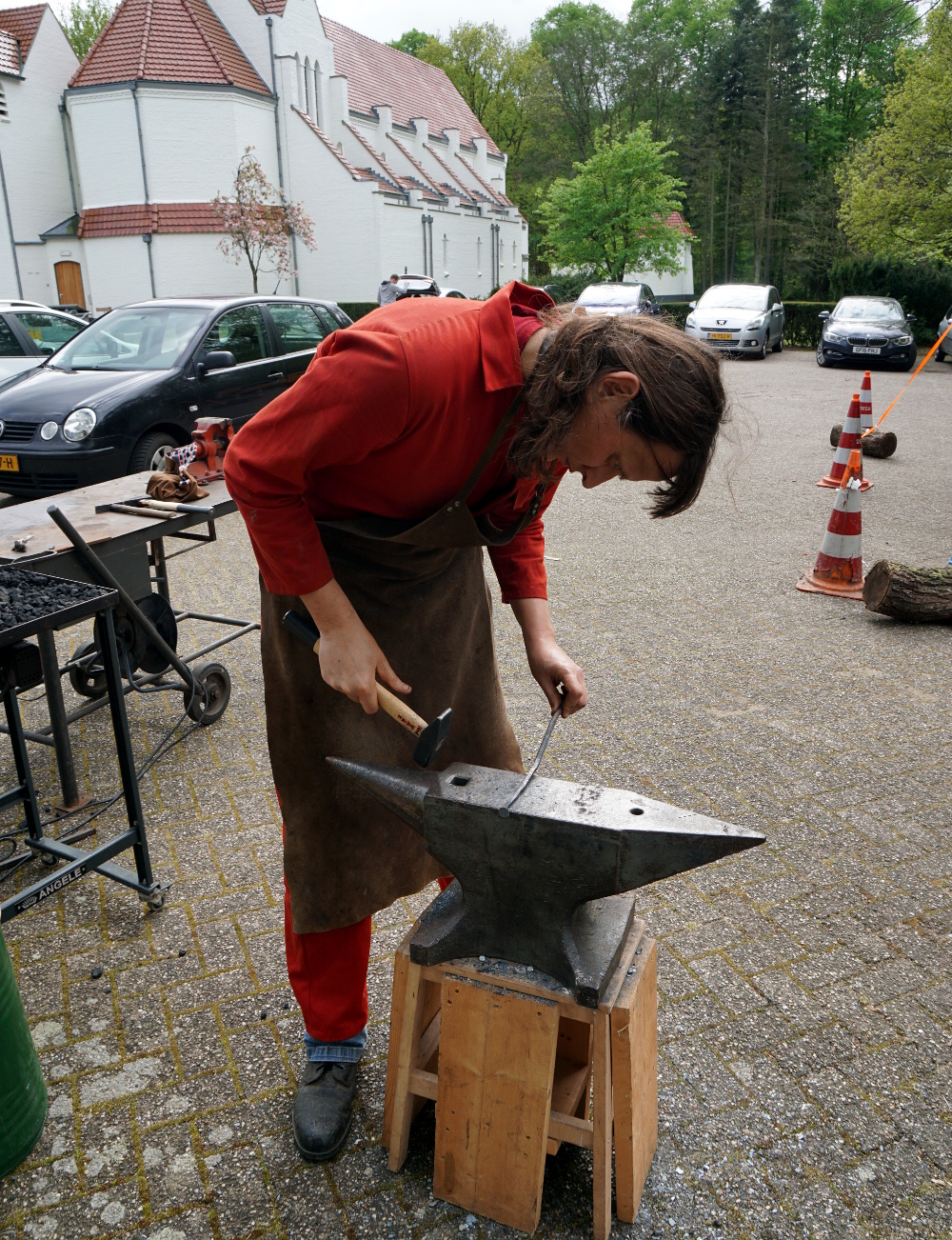
Regular readers will recognise this as the third part of a series exploring blacksmithing for those who have perhaps always fancied having a go but have never quite known where to start. It’s written from a position of the unusual experience of having grown up around a working forge, my dad may now be retired but he has a blacksmith specialising in architectural ironwork.
So far in this series we’ve looked in detail at the hearth and anvil that you might find in a typical forge, and delivered some pointers as to where you might look to find or even construct your own.Those are the signature pieces of equipment you’ll find in a forge, but with them alone you can still not be a blacksmith.
If I Had A Hammer…
An array of hammers of different weights and types.
Given an anvil, a hearth, and a vat of water to quench hot work in, and you’re almost set for your forge, but not quite. Most of a modern blacksmith’s workshop is the standard metalworking assortment of welders and angle grinders, but there is a set of tools that remain essential for blacksmithing alone. Your hammers are what connect you to the work, and can be as individual as the preferences of the blacksmiths themselves. There is no “right” answer to the question of what hammer you should use, instead you should use the one that works best for you. I instinctively favour a round-faced ball-peen hammer because that’s what my dad mostly used, but for example my Dutch friends use square faced cross-peen hammers. Blacksmiths will often make their own hammers to suit their needs, for example my dad made more than one using the high-quality steel of vehicle half-shafts as a starting point. Hardening them is a specialist skill in its own right, and I remember quite a few experiments before he perfected it.
It may well be stating the obvious, but the weight of the hammer influences how much energy it can impart to the work, and in turn the size of work that can be done. Casting an eye over my dad’s hammers the three workaday weights were 2 pound, 3 pound, and 4 pound (roughly 1 kg, 1.5 kg, and 2 kg), allowing a variety from fine work to heavier hitting of larger pieces. In a recent project, making a mediaeval nail, I selected an unsubtle lump hammer to draw out the larger square stock, and a much smaller one to finish it up, create the fine point, and relatively thin head. These are only a subsection of the hammers at his disposal though, like most blacksmiths he has a variety for all tasks, up to sledgehammers. I have frequently taken my turn either holding a piece with tongs while he used a sledgehammer, or on the sledgehammer myself.
Tongs, for Hot Gripping Moments
A selection of tongs, including some designed for very specific tasks. Our thanks to [Igor Nikolic] for making this picture possible.The constant companion to a blacksmith’s hammer is a pair of tongs. These can be bought from blacksmith’s suppliers, but making a pair can be a task within the reach of most smiths. Two identical sides are made from pieces of stock, with long thin handles, a flat piece to form the hinge, and whatever jaw piece is required. It feels like cheating to form the hole for the hinge on a drill press rather than on the anvil with a punch, but riveting it with a short piece of bar is a straightforward enough process. Blacksmiths will have a huge array of tongs with different jaws for specific jobs, built up over years as jobs demand it. If you cast your mind back to the Finnish smith pictured halfway down the first installment of this series, you’ll find several racks of tongs. A later episode of this series will look at making a set of tongs, though we can’t promise in advance the quality of the finished article.
A final moment for today should be spent on the subject of protective equipment. The hazards of blacksmithing are relatively uncomplicated, but some basic protective clothing is still very much worth having. The most obvious hazard is heat, you will be working in a noisy environment with red hot metal and fire. Though you will generate fewer sparks than you’d expect, I have a blacksmith’s leather apron and a set of fire-resistant overalls. Both of these are readily available from blacksmith’s supply stores, and are well worth the investment. There are also a lot of heavy and sharp items involved, not to mention hot particles on the floor. For that reason I also have a set of steel-toecapped workboots rated for hot particles. They aren’t the most elegant of footwear, but they have saved me from a few nasty moments.
I do not have any face protection specifically for blacksmithing, but depending on the work in hand there may be some sparks created. A polycarbonate face shield rated for hot particles should be available from any safety equipment supplier, and shouldn’t cost too much, and is an essential thing to own if you are doing any grinding or rotary wire brushing. Beyond that, there are also leather gloves designed for handling hot metal. I don’t use them because I prefer the feel of the hammer directly and am happy to use a pair of tongs to hold hot pieces of steel.
We’ve taken you through the basic workshop equipment of a blacksmith over the last few episodes of this series, and you should now have a basic idea of the safety kit you would be well advised to own. From this foundation we’ll next take you into the forge and start looking at a few blacksmithing techniques and simple projects, and along the way we’ll see some of the materials involved, too.
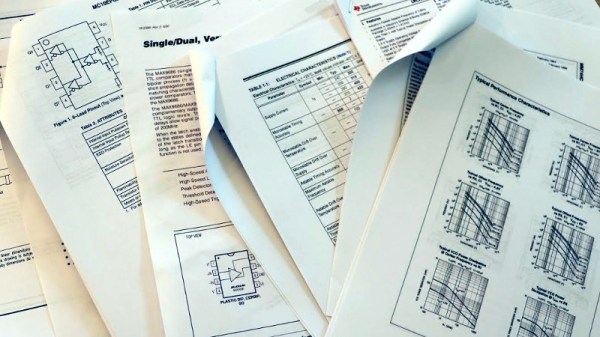
Selecting electronic components can be a frustrating process, one of trawling through the websites of distributors such as DigiKey, Mouser, or RS, and then poring over manufacturer data sheets. These documents produced as detailed guides to the technical specifications of a device contain enough to give an engineer everything they need to incorporate it into their designs.
Unfortunately many datasheets fall short of the ideal, and have instead become marketing documents designed to “win the socket”. This is a problem that vexes Boldport’s [Saar Drimer], and he has written a personal manifesto outlining his vision to make the world of datasheets a better place.
It’s a common-sense designer’s wishlist, and it’s one we could completely get behind. Chief among his desires are web-readable datasheets as well as the ubiquitous PDFs, with full data in human and machine readable forms instead of tiny printed graphs and tables. He also makes a plea for better UX testing to combat the scourge of the inaccurate pad layout, to which we’d add providing footprints ready-made for all popular CAD packages. These and the rest of his manifesto would be a game-changer, and wouldn’t displace the existing paper or PDF sheet for those who still use them. Whether or not the manufacturers will take heed is anyone’s guess, but to have such an ideal laid out is a start.
If you’re not familiar with [Saar]’s work, you’re in for a treat. Boldport produce some of the most beautiful artistic PCBs, and we’ve featured them before more than once.
Thanks to our colleague [Ted Yapo] for the header image.
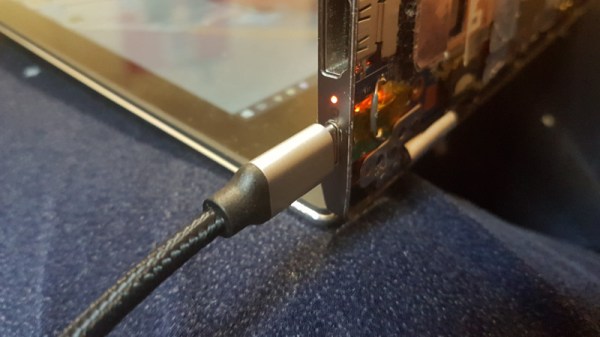
It’s a very brave person who takes a Dremel or similar to the case of their svelte new laptop in the quest for a new connector, it sounds as foolhardy as that hoax from a while back in which people tried to drill a 3.5mm jack into their new iPhones. But that’s what [BogdanTheGeek] has done, in adding a USB-C port to his Acer.
Of course, the port in question isn’t a fully functioning USB-C one, it’s a power supply jack, and it replaces the extremely unreliable barrel jack the machine was shipped with. He’s incorporated one of those little “ZYPDS” USB-C power delivery modules we’ve no-doubt all seen in the usual cheap electronic sources, and in a move of breathtaking audacity he’s cut away part of the Acer mainboard to do so. He’s relying on the laptop’s ability to accept a range of voltages, and presumably trusting his steady hand with a rotary tool. Some Kapton tape and a bit of wire completes the work, and with a carefully reshaped hole in the outer case he’s good to go.
The result is beautifully done, and a casual observer would be hard pressed to know that it hadn’t always been a USB-C port. We’re sure there will come a moment at which someone will plug in a USB-C peripheral and expect it to work, it’s that good.
The tech world has a love for Messianic figures, usually high-profile CEOs of darling companies whose words are hung upon and combed through for hidden meaning, as though they had arrived from above to our venture-capital-backed prophet on tablets of stone. In the past it has been Steve Jobs or Bill Gates, now it seems to be Elon Musk who has received this treatment. Whether his companies are launching a used car into space, shooting things down tubes in the desert, or synchronised-landing used booster rockets, everybody’s talking about him. He’s a showman whose many pronouncements are always soon eclipsed by bigger ones to keep his public on the edge of their seats, and now we’ve been suckered in too, which puts us on the spot, doesn’t it.
Your Johnny Cab is almost here
The latest pearl of Muskology came in a late April presentation: that by 2020 there would be a million Tesla electric self-driving taxis on the road. It involves a little slight-of-hand in assuming that a fleet of existing Teslas will be software upgraded to be autonomous-capable and that some of them will somehow be abandoned by their current owners and end up as taxis, but it’s still a bold claim by any standard.
Here at Hackaday, we want to believe, but we’re not so sure. It’s time to have a little think about it all. It’s the start of May, so 2020 is about 7 months away. December 2020 is about 18 months away, so let’s give Tesla that timescale. 18 months to put a million self-driving taxis on the road. Can the company do it? Let’s find out.
If you have a modern function generator on your bench it is quite likely to contain a direct-digital synthesis circuit that creates arbitrary waveforms using a microprocessor controlled DAC. If you have a cheap function generator it’s likely to contain a one-chip solution that generates approximations to sine and triangle waveforms through modifying a square wave with a set of filters.
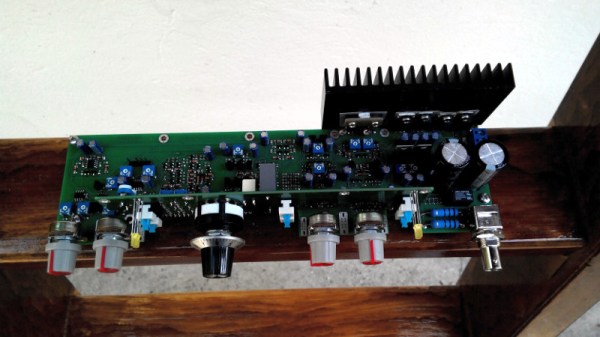
These methods both produce adequate waveforms for most of your function generator needs, but they are both far from perfect for the purist. Both methods introduce some distortion, and to address this [michal777] has produced a generator that takes the process back to basics with all stages implemented using building block ICs and transistors. The circuit follows the same square-wave-modifying path as the cheaper integrated devices, but with significant attention paid to the design to ensure that it does as good a job as possible. It also makes for a fascinating dive into function generator design.
The generator hardware has been neatly fitted onto a PCB with a riser for a set of front panel controls. He shares a few pictures of previous designs. We particularly like one that appears to have been fitted into a redundant cooking pot.
We’ve brought you a few function generators over the years. If you’ve got one of the cheaper examples, we’ve even covered how you might improve it a little.
As the UK’s aviation regulator, the Civil Aviation Authority is tasked with “making aviation better for those who choose to fly and those who do not”. Their latest plan to further this mission comes in the form of a drone registration tax. The proposal, which is open to online responses until 7 June, seeks to pass on the cost of a drone registration system to those who register themselves.
Proposals for a drone registration scheme have been in the works for a while now, and if enacted it would go into effect on 1 November. Owners of craft weighing more than 250 g (0.55 lbs) would have to fork out £16.50 ($21.50) per year, ostensibly to pay for the administration of the scheme. The CAA are basing this rate on as many as 170,000 people registering. In the US, the FAA has a drone registration program in place that requires registration based on the same 250 g weight guideline, but only charges $5 (£3.82) for a 3-year license, about thirteen times less than the CAA proposal.
Long-time readers will be familiar with our ongoing coverage of the sometimes-farcical saga of drone sightings in British skies. Airports have been closed (and implausible excuses have been concocted), but one thing remains constant: no tangible proof of any drone has yet been produced. Faced with a problem it doesn’t fully understand, the British Government is looking to this registration program.
It goes without saying that people misusing drones and endangering public safety should be brought to justice as swiftly as possible. But our concern is that the scale of the problem has been vastly over-represented, and that this scheme will do little to address either the problem of bogus drone sightings or the very real problem of criminal misuse of drones for example to smuggle contraband into prisons. It’s difficult to think this measure will have an effect on the number of incidents blamed on drones, and the high cost included in the proposal is a troubling burden for enthusiasts who operate responsibly.



![A selection of tongs, including some designed for very specific tasks. Our thanks to [Igor Nikolic] for making this picture possible.](https://hackaday.com/wp-content/uploads/2019/04/tong-selection.jpg)