A Parallel Port Synthesiser For Your DOS PC

It is a great shame that back in the days when a typical home computer had easy low-level hardware access that is absent from today’s machines, the cost of taking advantage of it was so high. Professional PCBs were way out of reach of a home constructor, and many of the integrated circuits that might have been used were expensive and difficult to source in small quantities.

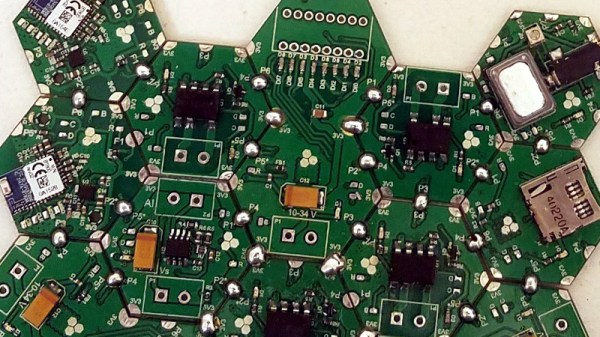
Here in the 21st century we have both cheap PCBs and easy access to a wealth of semiconductors, so enthusiasts for older hardware can set to work on projects that would have been impossible back in the day. Such an offering is [Serdef]’s Tiny Parallel Port General MIDI Synthesizer for DOS PCs, a very professionally produced synth that you might have paid a lot of money to own three decades ago.

At its heart is a SAM2695 synthesiser chip, and the board uses the parallel port as an 8-bit I/O port. The software side is handled by a TSR (a Terminate and Stay Resident driver loaded at startup, for those of you who are not DOS aficionados), and there are demonstrations of it running with a few classic games.

If the chip used here interests you, you might like to look at a similar project for an Arduino. The Kickstarter we covered is now long over, but you can also find it on GitHub.

Review: FG-100 DDS Function Generator

I don’t have a signal generator, or more specifically I don’t have a low frequency signal generator or a function generator. Recently this fact collided with my innocent pleasure in buying cheap stuff of sometimes questionable quality. A quick search of your favourite e-commerce site and vendor of voice-controlled internet appliances turned up an FG-100 low frequency 1Hz to 500kHz DDS function generator for only £15 ($21), what was not to like? I was sold, so placed my order and eagerly awaited the instrument’s arrival.

The missing function generator is a gap in the array of electronic test instruments on my bench, and it’s one that maybe isn’t as common a device as it once might have been. My RF needs are served by a venerable Advance signal generator from the 1960s, a lucky find years ago in the back room of Stewart of Reading, but at the bottom end of the spectrum my capabilities are meagre. So why do I need another bench tool?

It’s worth explaining what these devices are, and what their capabilities should be. In simple terms they create a variety of waveforms at a frequency and amplitude defined by their user. In general something described as a signal generator will only produce one waveform such as a sine or a square wave, while a function generator will produce a variety such as sine, square, and sawtooth waves. More accomplished function generators will also allow the production of arbitrary waveforms defined by the user. It is important that these instruments have some level of calibration both in terms of their frequency and the amplitude of their output. It is normal for the output to range from a small fraction of a volt to several volts. How would the FG-100 meet these requirements? Onward to my review of this curiously inexpensive offering.

Continue reading “Review: FG-100 DDS Function Generator”

Retrotechtacular: The Saturn Propulsion System

“We choose to go to the Moon in this decade and do the other things, not because they are easy, but because they are hard; because that goal will serve to organize and measure the best of our energies and skills, because that challenge is one that we are willing to accept, one we are unwilling to postpone, and one we intend to win, and the others, too”

When President Kennedy gave his famous speech in September 1962, the art of creating liquid-fueled rocket engines of any significant size was still in its relative infancy. All the rocketry and power plants of the Saturn series of rockets that would power the astronauts to the Moon were breaking entirely new ground, and such an ambitious target required significant plans to be laid. What is easy to forget from a platform of five decades of elapsed time is the scale of the task set for the NASA engineers of the early 1960s.

The video below the break is from 1962, concurrent with Kennedy’s speech, and it sets out the proposed development of the succession of rocket motors that would power the various parts of the Saturn family. We arrive at the famous F-1 engine that would carry the mighty Saturn 5 and start its passengers on their trip to the Moon at a very early stage in its development, after an introduction to liquid rocket engines from the most basic of first principles. We see rockets undergoing testing on the stand at NASA’s Huntsville, Alabama facility, along with rather superlative descriptions of their power and capabilities.

The whole production is very much in the spirit of the times, though unexpectedly it makes no mention whatsoever of the Space Race with the Soviet Union, whose own rocket program had put the first satellite and the first man into space, and which was also secretly aiming for the moon. It’s somewhat jarring to understand that the people in this video had little idea that such an ambitious program would be as successful as it became, or even that in the wake of Kennedy’s assassination the following year there would be such an effort to fulfill the aim set out in his speech to reach the moon within the decade.

The moon landings, and the events and technology that made them possible, are a subject of considerable fascination for our community. We must have covered innumerable stories about artifacts from the Apollo era in these pages, and no doubt more will continue to come our way in the future. Films like this one do not tell us quite the same story as does a real artifact, but their values lies in capturing the optimism of the time. Anything seemed possible in 1962, and those who lived through the decade were lucky enough to see this proven.

Fifty years from now, what burgeoning engineering efforts will we look back on?

Continue reading “Retrotechtacular: The Saturn Propulsion System”

HFT On HF, You Can’t Beat It For Latency

If you are a radio enthusiast of A Certain Age, you may well go misty-eyed from time to time with memories of shortwave listening in decades past. Countries across the world operated their own propaganda radio stations, and you could hear Radio Moscow’s take on world events, the BBC World Service responding, and Radio Tirana proudly announcing that every Albanian village now had a telephone. Many of those shortwave broadcast stations are now long gone, but if you imagine the HF spectrum is dead, think again. An unexpected find in an industrial park near Chicago led to an interesting look at the world of high-frequency trading, or HFT, and how they have moved to using shortwave links when everyone else has abandoned them, because of the unparalleled low latency they offer when communicating across the world.

Our intrepid tower-hunter is [KE9YQ], who was out cycling and noticed a particularly unusual structure adorned with a set of HF beams. These are the large directional antennas of the type you might otherwise expect to see on the roof of an embassy or in the backyard of a well-heeled radio amateur, and were particularly unusual in this otherwise unexciting part of America. There followed an interesting process of tracking down the site’s owners via the FCC permits for its operation, leading to the deduction of its purpose. With other antenna-hunters on the lookout for corresponding sites elsewhere in the world, it seems that this unusual global network hiding in plain sight could soon be revealed.

Unsurprisingly we’ve not covered many shortwave HFT stories. There are however other higher-latency ways to cross the world on HF.

Via SWLing Post, and thanks [W6MOQ] for the tip.

Flashing An LED The Widlar Way

Regular Hackaday readers will be familiar with the work of Boldport’s [Saar Drimer] in creating beauty in printed circuit board design. A recent work of his is the Widlar, a tribute to the legendary integrated circuit designer [Bob Widlar] in the form of a development board for his μA723 voltage regulator chip.

The μA723 is a kit of parts from which almost any regulator configuration can be made, but for [tardate]  it represented a challenge. The μA723 is so versatile that what you can create is only limited by the imagination of the builder. Having done the ordinary before, [tardate] looked toward something unconventional.

The result is modest, a simple LED flasher using the error amplifier as a not-very-good op-amp, building an oscillator at a frequency of about 2 Hz. This is pretty neat and if you are used to the NE555 as the universal integrated circuit, perhaps it’s time to set it aside for the obviously far-more-useful μA723.

Here at Hackaday we harbour at least one fan of the μA723, not to mention also of artful PCBs. If the Widlar looks familiar, we featured the switch mode regulator from the μA723 data sheet on it a few months ago.

Disclosure: [Jenny List] wrote the documentation for Boldport’s Widlar kit.

Biasing That Transistor: The Common Base Amplifier

We’ve previously remarked upon a generation lucky enough to be well-versed in microcontrollers and computersised electronics through being brought up on the Arduino or the Raspberry Pi but unlucky enough to have missed out on basic electronics such as how to bias a transistor, and to address that gap we’ve taken a look at the basics of transistor biasing.

All the circuits we worked with in the previous article had the transistor’s emitter taken to ground, took their input from the base, and their output from the collector. This configuration, called a Common Emitter amplifier is probably the most common, but it is far from the only way to use a transistor. Once you have set up the bias voltage as we described to the point at which the transistor is in its linear region, there are several other ways in which the device can be used as an amplifier. The subject of this article is one of these configurations, so described because it takes the transistor’s base to the ground instead of the emitter, as a Common Base amplifier. Continue reading “Biasing That Transistor: The Common Base Amplifier”

Double The Resolution, From An Arduino ADC

Analog-to-digital converters, or ADCs, are somewhat monolithic devices for most users, a black box that you ask nicely for the value on its input, and receive a number in return. For most readers, they will be built into whatever microcontroller is their platform of choice, and their resolution will be immutable, set by whatever circuitry is included upon the die. There are a few tricks that can be employed to get a bit more from a stock ADC though, and [Neris] has taken a look at a couple of them.

The first circuit doubles the resolution of an ADC, in this case, that of the Atmel chip in an Arduino, by converting its output from an integer to a signed integer. It performs this task with a precision rectifier, rectifying around a zero-crossing point half-way through the range of the analog value to be read and supplying a sign bit to the Arduino. The Arduino measures the rectified analog value to an integer, and applies the appropriate sign from the supplied bit value.

The second circuit takes a variation on the same technique but with two ADCs instead of one. A pair of PIC chips are used with their voltage references stacked one above the other, by taking both readings in combination a result with double the resolution can be derived.

You might ask why bother with these techniques. After all, there are plenty of higher-resolution ADCs on the market. But they’re useful techniques to know, should you ever need to extract the proverbial quart from a pint pot.

If ADCs are a mystery to you, you’re in luck. [Bil Herd] gave us a comprehensive introduction to the subject.