Diodes: The Switch You Never Knew You Had

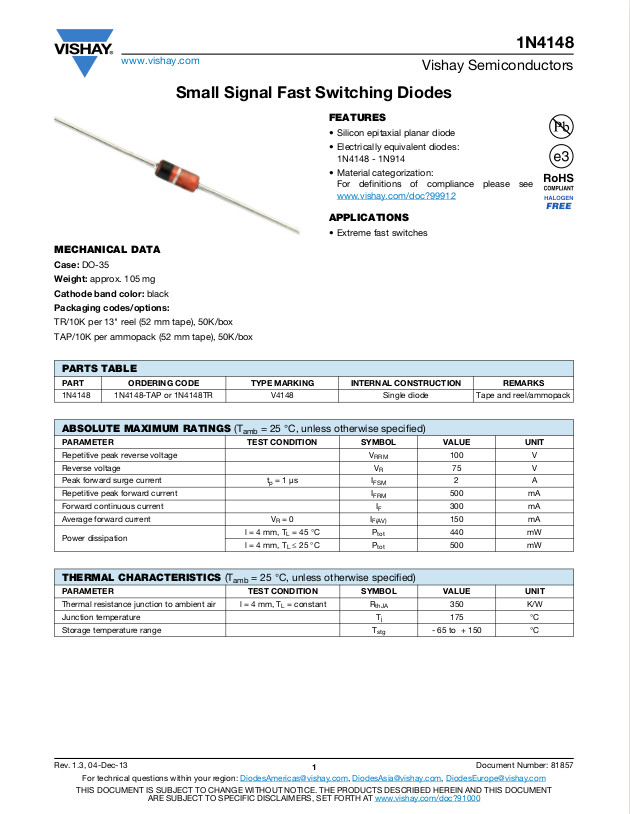
Vishay's take on the 1N4148 data sheet (PDF), describing it as a switching diode.
Vishay’s take on the 1N4148 data sheet (PDF), describing it as a switching diode.

When looking across the discrete components in your electronic armory, it is easy to overlook the humble diode. After all, one can be forgiven for the conclusion that the everyday version of this component doesn’t do much. They have none of the special skills you’d find in tunnel, Gunn, varicap, Zener, and avalanche diodes, or even LEDs, instead they are simply a one-way valve for electrical current. Connect them one way round and current flows, the other and it doesn’t. They rectify AC to DC, power supplies are full of them. Perhaps you’ve also used them to generate a stable voltage drop because they have a pretty constant voltage across them when current is flowing, but that’s it. Diodes: the shortest Hackaday article ever.

Not so fast with dismissing the diode though. There is another trick they have hiding up their sleeves, they can also act as a switch. It shouldn’t come as too much of a shock, after all a quick look at many datasheets for general purpose diodes should reveal their description as switching diodes.

So how does a diode switch work? The key lies in that one-way valve we mentioned earlier. When the diode is forward biased and conducting electricity it will pass through any variations in the voltage being put into them, but when it is reverse biased and not conducting any electricity it will not. Thus a signal can be switched on by passing it through a diode in forward bias, and then turned off by putting the diode into reverse bias.

Continue reading “Diodes: The Switch You Never Knew You Had”

That NASA EM Drive Paper: An Expert Opinion

A week or two ago we featured a research paper from NASA scientists that reported a tiny but measurable thrust from an electromagnetic drive mounted on a torsion balance in a vacuum chamber. This was interesting news because electromagnetic drives do not eject mass in the way that a traditional rocket engine does, so any thrust they may produce would violate Newton’s Third Law. Either the Laws Of Physics are not as inviolate as we have been led to believe, or some other factor has evaded the attempts of the team to exclude or explain everything that might otherwise produce a force.

As you might imagine, opinion has entrenched itself on both sides of this issue. Those who believe that EM drives have allowed us to stumble upon some hitherto undiscovered branch of physics seized upon the fact that the NASA paper was peer-reviewed to support their case, while those who believe the mechanism through which the force is generated will eventually be explained by conventional means stuck to their guns. The rest of us who sit on the fence await further developments from either side with interest.

Over at Phys.org they have an interview from the University of Connecticut with [Brice Cassenti], a propulsion expert, which brings his specialist knowledge to the issue. He believes that eventually the results will be explained by conventional means, but explains why the paper made it through peer review and addresses some of the speculation about the device being tested in space. If you are firmly in one of the opposing camps the interview may not persuade you to change your mind, but it nevertheless makes for an interesting read.

If EM drives are of interest, you might find our overview from last year to be an illuminating read. Meanwhile our coverage of the NASA paper should give you some background to this story, and we’ve even had one entered in the Hackaday Prize.

Sintering Sand WIth A Laser Cutter

We are all used to Fused Deposition Modeling, or FDM, 3D printers. A nozzle squirts molten material under the control of a computer to make 3D objects. And even if they’re usually rather expensive we’re used to seeing printers that use Stereolithography (SLA), in which a light-catalysed liquid monomer is exposed layer-by layer to allow a 3D object to be drawn out. The real objects of desire though are unlikely to grace the average hackspace. Selective Laser Sintering 3D printers use a laser on a bed of powder to solidify a 3D object layer by layer.

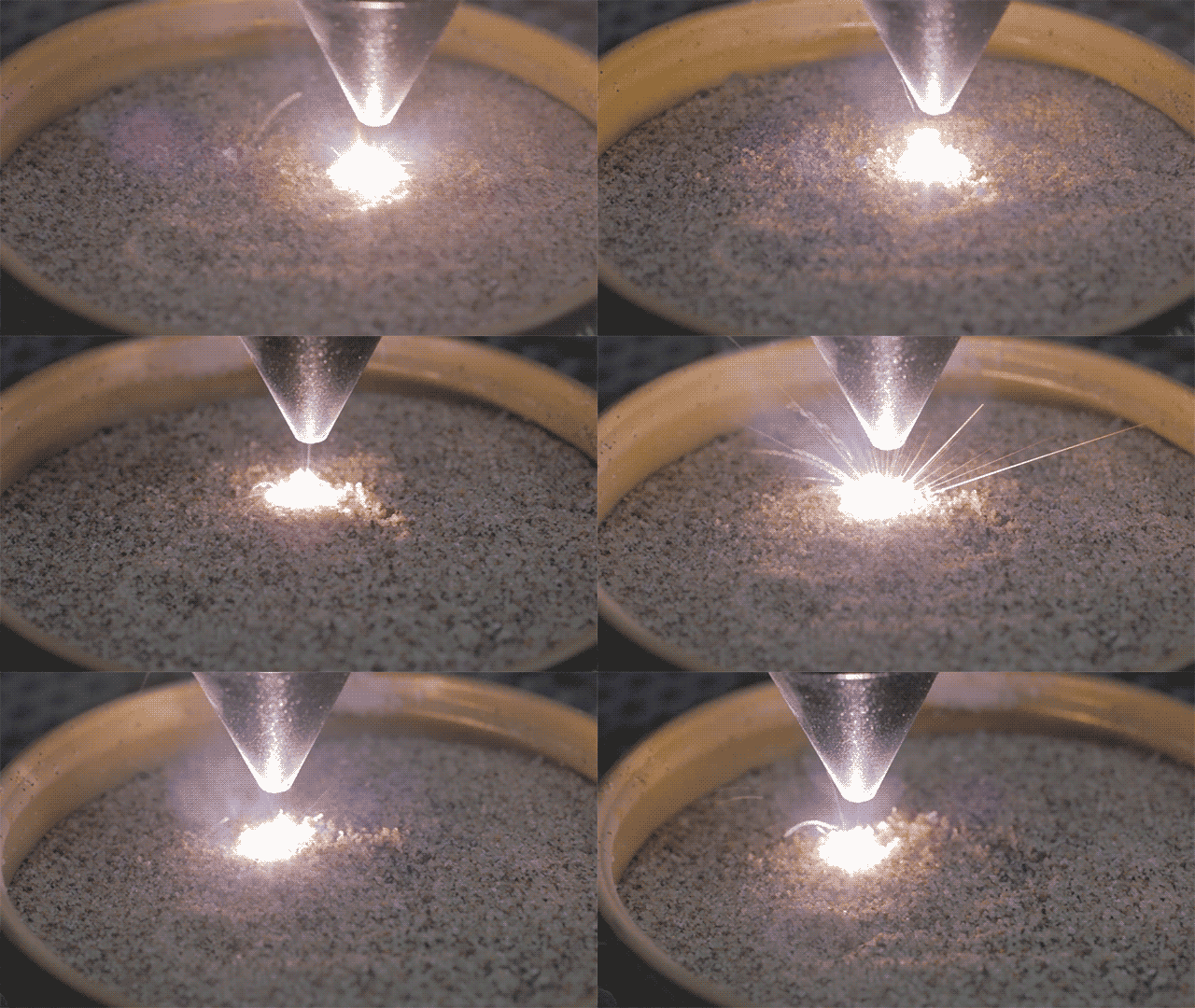
The laser creating a ring.

While an SLS printer may be a little beyond most budgets, it turns out that it’s not impossible to experiment with the technology. [William Osman] has an 80 W laser cutter, and he’s been experimenting with it sintering beach sand to create 2D objects. His write-up gives a basic introduction to glassmaking and shows the difference between using sand alone, and using sodium carbonate to reduce the melting point. He produces a few brittle barely sintered tests without it, then an array of shapes including a Flying Spaghetti Monster with it.

The results are more decorative than useful at the moment, however it is entirely possible that the technique could be refined. After all, this is beach sand rather than a carefully selected material, and it is quite possible that a finer and more uniform sand could give better results. He says that he’ll be investigating its use for 3D work in the future.

We’ve put his video of the whole process below the break, complete with worrying faults in home-made laser wiring. It’s worth a watch.

Continue reading “Sintering Sand WIth A Laser Cutter”

An Amateur Radio Repeater Using An RTL-SDR And A Raspberry Pi

An amateur radio repeater used to be a complex assemblage of equipment that would easily fill a 19″ rack. There would be a receiver and a separate transmitter, usually repurposed from commercial units, a home-made logic unit with a microprocessor to keep an eye on everything, and a hefty set of filters to stop the transmitter output swamping the receiver. Then there would have been an array of power supply units to provide continued working during power outages, probably with an associated bank of lead-acid cells.

More recent repeaters have been commercial repeater units. The big radio manufacturers have spotted a market in amateur radio, and particularly as they have each pursued their own digital standards there has been something of an effort to provide repeater equipment to drive sales of digital transceivers.

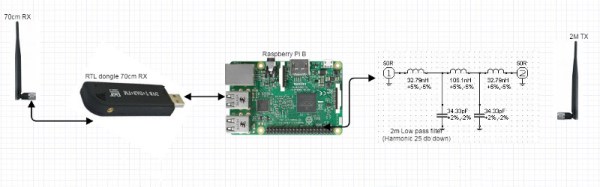
But what if you fancy setting up a simple repeater and you have neither a shed full of old radios or a hotline to the sales department of a large Japanese manufacturer? If you are [Anton Janovsky, ZR6AIC], you make your own low-powered repeater using an RTL-SDR, a low-pass filter, and a Raspberry Pi.

[Anton]’s repeater is a clever assemblage through pipes of rtl_sdr doing the receiving, csdr demodulating, and [F5OEO]’s rpitx doing the transmitting. As far as we can see it doesn’t have a toneburst detector or CTCSS to control its transmission so it is on air full-time, however we suspect that may be a feature that will be implemented in due course.

With only a 10 mW output this repeater is more of a toy than a useful device, and we’d suggest any licensed amateur wanting to have a go should read the small print in their licence schedule before doing so. But it’s a neat usage of a Pi and an RTL stick, and with luck it’ll inspire others in the same vein.

We’ve touched on the Pi as a transmitter before, from a straightforward broadcast FM unit to crossing continents with WSPR, and even transmitting digital TV in another [F5OEO] hack.

Crypto Features: They’re Not For Girls

If you have worked in an office that contained a typewriter, the chances are you’ve been in the workplace for several decades. Such has been the inexorable advance of workplace computing. It’s a surprise then to discover that one of the desirable toys from many decades ago, the Barbie Typewriter, is still available. Are hipster parents buying toy versions of vintage office machinery for their children to use in an ironic fashion?

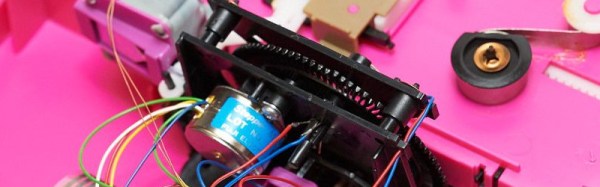
Gone though are the plastic versions of mechanical typewriters that would have been the property of a 1970s child. The modern Barbie typist has an electronic typewriter at her fingertips, with a daisy-wheel printer. We’re treated to a teardown of the recent models courtesy of Crypto Museum, who reveal a hidden feature, Barbie’s typewriter can encrypt and decrypt messages.

Now the fact that a child’s toy boasts a set of simple substitution cyphers is hardly the kind of thing that will set the pulses of Hackaday readers racing, after all simple letter frequency analysis is hardly new. But of course, the Crypto Museum angle is only part of this story.

This toy is made in a suitably eye-watering shade of pink, and sold by Mattel with Barbie branding. But it didn’t start life as a Barbie product, instead it’s licensed from the Slovenian manufacturer Mehano. The original toy makes no secret of the crypto functions, but though they persist in the software on the Barbie version they are mysteriously absent from the documentation. The achievements of American women are such that they have given us high-level languages and compilers, or their software has placed men on the Moon, yet it seems when they are young a brush with elementary cryptology is beyond them in the way that it isn’t for their Slovenian sisters. This is no way to nurture a future Grace Hopper or Margaret Hamilton, though sadly if your daughter is a Lisa Simpson this is just one of many dumbed-down products she’ll be offered.

If you see a Barbie electronic typewriter in a yard sale or similar, and you can pick it up for a few dollars, buy it. It’s got a simple daisywheel printer mechanism that looks eminently hackable. Just don’t buy it for your daughter without also printing out the Crypto Museum page for her as the missing manual.

When the Martian lander running her code has touched down safely, you’ll be glad you did.

Via Adafruit.

Taking It To Another Level: Making 3.3V Speak With 5V

If your introduction to digital electronics came more years ago than you’d care to mention, the chances are you did so with 5V TTL logic. Above 2V but usually pretty close to 5V is a logic 1, below 0.8V is a logic 0. If you were a keen reader of electronic text books you might have read about different voltage levels tolerated by 4000 series CMOS gates, but the chances are even with them you’d have still used the familiar 5 volts.

This happy state of never encountering anything but 5V logic as a hobbyist has not persisted. In recent decades the demands of higher speed and lower power have given us successive families of lower voltage devices, and we will now commonly also encounter 3.3V or even sometimes lower voltage devices. When these different families need to coexist as for example when interfacing to the current crop of microcontroller boards, care has to be taken to avoid damage to your silicon. Some means of managing the transition between voltages is required, so we’re going to take a look at the world of level shifters, the circuits we use when interfacing these different voltage logic families.

Continue reading “Taking It To Another Level: Making 3.3V Speak With 5V”

Body Cardio Weighing Scale Teardown

If you weigh yourself by standing on a bathroom scale, not liking the result, then balancing towards one corner to knock a few pounds off the dial, you are stuck in a previous century. Modern bathroom scales have not only moved from the mechanical to the electronic, they also gather body composition measurements and pack significant computing power.

Yet they’re a piece of domestic electronics that sits in our bathroom and rarely comes under scrutiny. How do they work, and what do they contain? The team at November Five tore down a top-of-the-range Withings Body Cardio scale to find out.

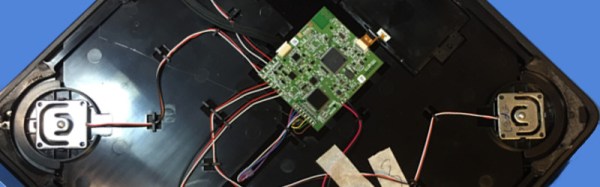
After a struggle with double-sided sticky pads, the scale revealed its secrets: a simple yet accomplished device. There are four load cells and the electrodes for the body measurement, and the PCB. On the board is a 120 MHz ARM Cortex M4 microcontroller, a wireless chipset, battery management, and the analogue measurement chipset. This last is particularly interesting, a Texas Instruments AFE4300, a specialised analogue front-end for this application. It’s a chip most of us will never use, but as always an obscure datasheet is worth a read.

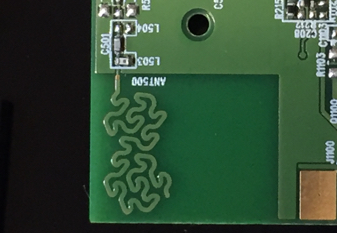
The rather pretty fractal antenna.

Finally, the wireless antenna is not the normal simple angular trace you’ll be used to from the likes of ESP8266 boards, but an organic squiggle. It’s a fractal antenna, presumably designed to present a carefully calculated bandwidth to the chipset. A nice touch, though one the consumer will never be aware of.

We’ve shown you quite a few bathroom scales over the years. There was this wisecracking Raspberry Pi scale, this scale reverse engineered to gather weight data, and this one laid bare for use as a controller.