Do You Miss The Sound Of Your Model M?

There is one aspect of desktop computing in which there has been surprisingly little progress over the years. The keyboard you type on today will not be significantly different to the one in front of your predecessor from the 1970s. It may weigh less, its controller may be less power-hungry, and its interface will be different, but the typing experience is substantially identical. Or at least, in theory it will be identical. In fact it might be worse than the older peripheral, because its switches are likely to be more cheaply made.

The famous buckled springs in operation. Shaddim [CC BY-SA 3.0], via Wikimedia Commons.
The famous buckled spring in operation. Shaddim [CC BY-SA 3.0], via Wikimedia Commons.
Thus among keyboard aficionados the prized possessions are not necessarily the latest and greatest, but can often be the input devices of yesteryear. And one of the more famous of these old keyboards is the IBM Model M, a 1984 introduction from the computer behemoth that remains in production to this day. Its famous buckled-spring switches have a very positive action and a unique sound that once heard can never be forgotten.
Continue reading “Do You Miss The Sound Of Your Model M?”

Get To Know Voltage Regulators With A 723

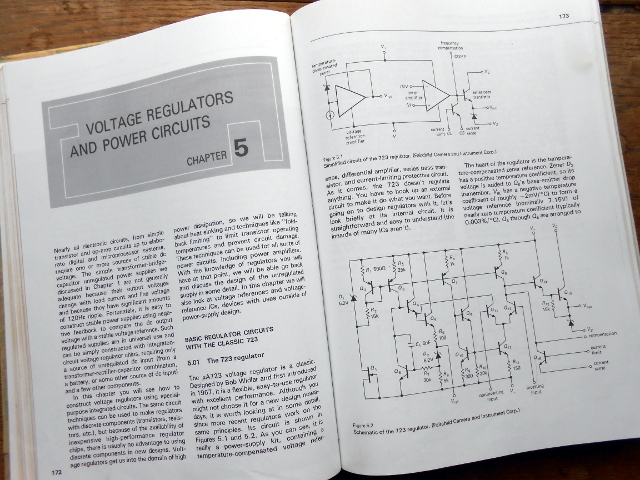
“Chapter 5; Horowitz and Hill”. University students of all subjects will each have their standard texts of which everyone will own a copy. It will be so familiar to them as to be referred to by its author as a shorthand, and depending on the subject and the tome in question it will be either universally loathed or held onto and treasured as a lifetime work of reference.

For electronic engineers the work that most exemplifies this is [Paul Horowitz] and [Winfield Hill]’s The Art Of Electronics. It definitely falls into the latter category of course books, being both a mine of information and presented in an extremely accessible style. It’s now available in its third edition, but the copy in front of me is a first edition printed some time in the mid 1980s.

The Art of Electronics, on regulators.

Chapter 5 probably made most of an impression on the late-teenage me, because it explains voltage regulation and power supplies both linear and switching. Though there is nothing spectacularly challenging about a power supply from the perspective of experience, having them explained as a nineteen-year-old by a book that made sense because it told you all the stuff you needed to know rather than just what a school exam syllabus demanded you should know was a revelation.

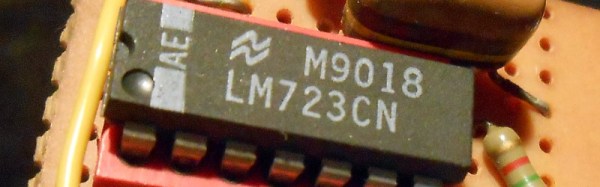
On the first page of my Art of Electronics chapter 5, they dive straight in to the μA723 linear voltage regulator. This is pretty old; a design from the legendary [Bob Widlar], master of analogue integrated circuits, which first made it to market in 1967. [Horowitz] and [Hill] say “Although you might not choose it for a new design nowadays, it is worth looking at in some detail, since more recent regulators work on the same principles“. It was 13 years old when they wrote that sentence and now it is nearly 50 years old, yet judging by the fact that Texas Instruments still lists it as an active product without any of those ominous warnings about end-of-life it seems plenty of designers have not heeded those words.

So why is a 50-year-old regulator chip still an active product? There is a huge range of better regulators, probably cheaper and more efficient regulators that make its 14-pin DIP seem very dated indeed. The answer is that it’s an incredibly useful part because it does not present you with a regulator as such, instead it’s a kit of all the parts required to make a regulator of almost any description. Thus it is both an astonishingly versatile device for a designer and the ideal platform for anyone wanting to learn about or experiment with a regulator.
Continue reading “Get To Know Voltage Regulators With A 723”

Arm Thrusters, For Underwater Super Powers!

Most of us will have spent the idle hours of our youth while sitting in a room where a teacher was standing at the blackboard explaining iambic pentameter or the Diet of Wurms, daydreaming about the amazing exploits we could have created if only we had an Evil Lair stuffed with all the tools our fertile imaginations demanded. [James Bond] would have had nothing on us, our personal [Q] branch would have ensured we would have had the coolest gadgets on the planet.

As grown-ups we have some of the resources to make this a reality, yet somehow we’ve never made good on the dream. We spend our time creating IoT clocks or novelty electronic Christmas ornaments, and Mr. [Bond] still has a monopoly on the really cool stuff. Fortunately [PeterSripol] has struck a blow on our behalf, because he’s created a pair of arm-mounted underwater thrusters (YouTube, embedded below) that should leave [007] feeling definitely a bit [006.5].

The thrusters themselves came from a Kickstarter purchase that he left on the shelf for a while without an application. Then with only a short time before a trip to Hawaii, he set to work to do something with them, and the arm thrusters were the result.

He makes extensive use of components from the world of radio controlled models, with battery packs and speed controllers mounted in a waterproof food container at his belt, and a pair of handheld microswitch controllers. There is an Arduino which presumably produces the PWM signal, and we are treated to an in-depth look at his waterproofing efforts for the various connectors and switches. After a false start with battery polarity and a cracked impeller housing the device works, and we see it in use on a suitably tropical though not quite sun-kissed beach.

The thrusters appear to work very well, and we’d say they look a lot of fun to use. Sadly the exercise is brought to a halt when a control wire is sucked into a propeller, but we’re sure that’s only a minor setback. We’ve posted the video below the break, take a look.

Continue reading “Arm Thrusters, For Underwater Super Powers!”

Demystifying Amateur Radio Callsigns

Regular Hackaday readers will be familiar with our convention of putting the name, nickname, or handle of a person in square brackets. We do this to avoid ambiguity as sometimes names and particularly nicknames can take unfamiliar forms that might be confused with other entities referred to in the text. So for example you might see them around [Bart Simpson], or [El Barto]. and occasionally within those brackets you’ll also see a capitalised string of letters and numbers after a name. For example the electronic music pioneer [Bob Moog, K2AMH], which most of you will recognise as an amateur radio callsign.

Every licenced radio amateur is issued one by their country’s radio authority as a unique identifier, think of it as similar to a car licence plate. From within the amateur radio bubble those letters and numbers can convey a significant amount of information about where in the world its user is located, when they received their licence, and even what type of licence they hold, but to outsiders they remain a mysterious and seemingly random string. We’ll now attempt to shed some light on that information, so you too can look at a callsign in a Hackaday piece or anywhere else and have some idea as to its meaning.

Continue reading “Demystifying Amateur Radio Callsigns”

Controlling Your Instruments From A Computer: Doing Something Useful

Do you know how to harvest data from your bench tools, like plotting bandwidth from your oscilloscope with a computer? It’s actually pretty easy. Many bench tools make this easy using a standard protocol with USB to make the connection.

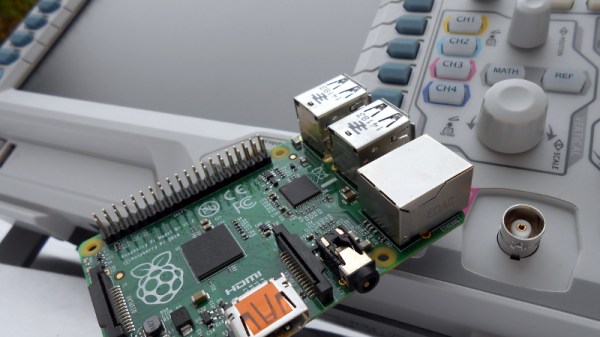
In the previous installment of this article we talked about the National Instruments VISA (Virtual Instrument Software Archetecture) standard for communicating with your instruments from a computer, and introduced its Python wrapper with a simple demonstration using a Raspberry Pi. We’ll now build on that modest start by describing a more useful application for a Raspberry Pi and a digital oscilloscope; we’ll plot the bandwidth of an RF filter. We’ll assume that you’ve read the previous installment and have both Python and the required libraries on your machine. In our case the computer is a Raspberry Pi and the instrument is a Rigol DS1054z, but similar techniques could be employed with other computers and instruments.

Continue reading “Controlling Your Instruments From A Computer: Doing Something Useful”

Diamond Batteries That Last For Millennia

Like many industrialized countries, in the period after the Second World War the United Kingdom made significant investments in the field of nuclear reactors. British taxpayers paid for reactors for research, the military, and for nuclear power.

Many decades later that early crop of reactors has now largely been decommissioned. Power too cheap to meter turned into multi-billion pound bills for safely coping with the challenges posed by many different types of radioactive waste generated by the dismantling of a nuclear reactor, and as the nuclear industry has made that journey it in turn has spawned a host of research projects based on the products of the decommissioning work.

One such project has been presented by a team at Bristol University; their work is on the property of diamonds in generating a small electrical current when exposed to radioactive emissions. Unfortunately their press release and video does not explain the mechanism involved and our Google-fu has failed to deliver, but if we were to hazard a guess we’d ask them questions about whether the radioactivity changes the work function required to release electrons from the diamond, allowing the electricity to be harvested through a contact potential difference. Perhaps our physicist readers can enlighten us in the comments.

So far their prototype uses a nickel-63 source, but they hope to instead take carbon-14 from the huge number of stockpiled graphite blocks from old reactors, and use it to create radioactive diamonds that require no external source. Since the output of the resulting cells will be in proportion to their radioactivity their life will be in the same order of their radioactive half-life. 5730 years for half-capacity in the case of carbon-14.

Of course, it is likely that the yield of electricity will not be high, with tiny voltages and currents this may not represent a free energy miracle. But it will be of considerable interest to the designers of ultra-low-maintenance long-life electronics for science, the space industry, and medical implants.

We’ve put their video below the break. It’s a straightforward explanation of the project, though sadly since it’s aimed at the general public it’s a little short on some of the technical details. Still, it’s one to watch.

Continue reading “Diamond Batteries That Last For Millennia”

A Different Sort Of Word Clock

Our wonderfully creative community has a penchant for clocks. We have seen so many timepieces over the years that one might suppose that there would be nothing new, no instrument of horology that would not elicit a yawn as we are presented with something we’ve seen many times before.

Every once in a while though along comes a project that is different. A clock that takes the basic idea of a timepiece and manages to present something new, proving that this particular well of projects has not yet quite run dry.

Such a project is the circular word clock made by [Roald Hendriks]. Take a conventional circular wall clock and remove the hands and mechanism, then place LEDs behind the numbers. Add the words for “Quarter”, “Half”, etc. in an inner ring, and place LEDs behind them. Hook all these LEDs up to a microcontroller with a real-time clock, and away you go with a refreshingly novel timepiece.

[Roald]’s clock has the wording in Dutch, and the brain behind it is an Arduino Uno with the relevant driver ICs. He’s provided a video which we’ve put below the break, showing the clock in operation with its various demo modes.

Continue reading “A Different Sort Of Word Clock”