Binary Keyboard Is The Purest Form Of Input Device

You may be a hardcore keyboard aficionado whose buckled-spring switches will be pried from your cold dead hands, but there is a new model on the street that relegates your blank-key Das Keyboard or your trusty IBM Model M to the toy chest.

The new challenger comes from Reddit user [duckythescientist], who has created a minimalist three-key binary keyboard. It features a 0 key, a 1 key, a return key, and nothing else. Characters are entered as ASCII or Unicode, and the device emulates either a QWERTY or Dvorak keyboard layout to the host computer’s USB interface. It couldn’t be a simpler layout to learn, though we’d concede that not everyone has the entire binary Unicode table memorised.

The keys are mounted in a custom 3D printed case, and the electronics come from the creator’s own “tinydev” board based on an ATtiny85. All the code is available in a GitHub repository, and there is a very short video of its Unicode ability below the break.

Continue reading “Binary Keyboard Is The Purest Form Of Input Device”
Motorcycling Like It’s 1905 With A Home Made Engine

The modern motorcycle represents the pinnacle of over a century of refinement in design and manufacture of its every component. A modest outlay will secure you a machine capable of three figure speeds with impeccable handling, breathtaking acceleration and stopping power, that somehow seems also to possess bulletproof reliability that will take it to a hundred thousand miles of faithful transport.

At the dawn of the internal combustion engine age it was a different matter. Machines were little more than bicycles with rudimentary engines attached, brakes and tyres were barely capable of doing the job demanded of them, and the early motorcyclists were a hardy and daring breed.

You might think that this article would now head into retrotechtacular territory with a nostalgic look at an early motorcycle, but instead its subject has a much more recent origin. We happened upon [Buddfab]’s contemporary build of a 1905-era motorcycle, and we think it’s a bike you’d all like to see.

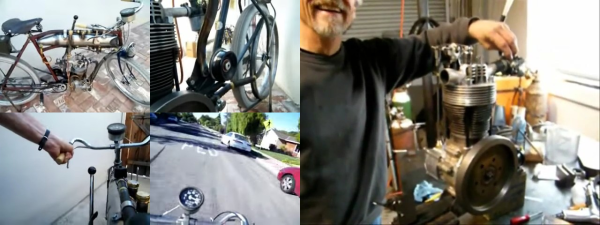
The bike itself is a faithful reproduction of a typical Edwardian machine. It has a modified bicycle frame with a belt drive and springer front forks. That’s all very impressive, but the engine is a masterpiece, crafting a more modern parts bin into something resembling a 1905 original. He’s taken the cylinder, piston, and half a cylinder head from an aircooled VW flat four and mated it with the crankshaft of a 125cc Honda, welding the two connecting rods together to join German and Japanese parts. With a custom-made crankcase, Lucas points, and the carburetor from a British Seagull outboard motor it both looks and sounds like an original, though we’d expect it to be significantly more reliable.

You can see videos of both bike and engine below the break, as he takes it for a spin through American suburbia. Sadly we’ll never see it passed to the definitive writer on early motorcycles for an expert view, but it would fool us completely.

Continue reading “Motorcycling Like It’s 1905 With A Home Made Engine”

3D Printed Diffuser Lights Up This Magnifier

If you are working with surface mount electronics and don’t have the handy heritage of a pulp-comic superhero to give you super-high-resolution eyesight, then you will quickly find yourself needing a magnifying glass. And since you’ll be using both hands doing the soldering, you’ll need some way to hold it.

There are multiple solutions to this problem on the market, from headband magnifiers and inspection magnifiers on arms to cheap “Helping hands”. They all have their strengths and weaknesses, but none of them appealed to our reader [Anil], who wanted an illuminated magnifier to fit the Hobby Creek arm on his Pana-Vise.

His solution was to 3D print a surround for a lens from a set of helping hands. This is no simple print though, it’s made of three layers. There is a translucent diffuser, a layer that holds a set of LEDs and attaches to the arm, and a cover to hold the lens in place. Power for the LEDs comes via USB.

The print itself was a bit tricky, his diffuser used T-glase translucent filament, and was fused to the PLA LED ring in a single print from his dual-extruder printer. He takes us through the various steps he needed to get it right, and shows us a few of his failed prototypes. The resulting magnifier looks to be a useful addition to his bench, he’s made the STL files available towards the bottom of his post so you can have a go at making one for yourself.

This is the kind of simple hack that can make life so much easier for the SMD constructor. We’ve had  another set of augmented helping hands featured here in the past, and of course there’s the ultimate portable SMT station. If SMD soldering is new to you, please also read our SMD guide for the nervous.

Giant Spider Roams The Streets

There is a giant spider the size of  a house stretching its massive, delicate legs as it parades through the French city of Nantes. Is the Arthropod Apocalypse upon us? Fortunately not, for this arachnid is the latest in a series of performance pieces by a French theatre company, La Machine.

Like the rest of La Machine’s productions, this spider is a large hydraulically controlled model driven not by a computer with a single operator but by a team of operators perched inside and underneath the mechanism who turn the operation of the spider’s legs into a piece of complex choreography. They in turn are aided by a team on the street who ensure that any manoeuvres are executed safely. The spider only gives the appearance of walking as it is supported on a hydraulic arm from a wheeled vehicle that carries its power plant, so freed of the requirement for support from its legs it can move with extreme grace.

The video below shows the spider inching its way underneath a set of tram cables. There is more video on the page linked above.

Continue reading “Giant Spider Roams The Streets”

The Raspberry Pi 3 Compute Module Is On Its Way

The Raspberry Pi Foundation founder Eben Upton has revealed in an interview with PCWorld that there will be a new version of the organisation’s Compute Module featuring the faster processor from the latest Raspberry Pi 3 boards, and it will be available “In a few months”.

The Compute Module was always something of an odd one out among the Raspberry Pi range, being a stripped-out Raspberry Pi chipset on a SODIMM form factor card without peripherals for use as an embedded computer rather than the standalone card with all the interfaces we are used to in the other Pi boards. It has found a home as the unseen brains behind a selection of commercial products, and though there are a few interface boards for developers and experimenters available for it we haven’t seen a lot of it in the world of hackers and makers. Some have questioned its relevance when the outwardly similar Pi Zero can be had for a lower price, but this misses the point that the two boards have been created for completely different markets.

The Pi 3’s 1.2 GHz 64-bit quad-core ARM Cortex-A53 BCM2837 SoC will certainly up the ante in the Compute module’s market, but it will be interesting to see what changes if any they make to its form factor. The Foundation’s close ties with Broadcom mean that they have done an impressive job in maintaining backward compatibility at a hardware level between the different generations of their product, but it is unclear whether this extends to the possibility of the new module maintaining a pin-for-pin compatibility with the old. We’d expect this to be an unlikely prospect.

It is certain that we will see a new generation of exciting commercial products emerging based around the new module, but will we see it making waves within our domain? This will depend on its marketing, and in particular the price point and quantity purchase they set for it. The previous board when added to a Compute Module Development board was an expensive prospect compared to a Raspberry Pi Model B that became more unattractive still as newer Pi boards gained more capabilities. If they price this one competitively and perhaps if any cheaper open hardware breakout boards emerge for it, we could have a valuable new platform on our hands.

Here’s our coverage of the original Compute Module launch, back in 2014.

[via Liliputing and reddit].

BCM2837 image: By Jose.gil (Own work) [CC BY-SA 4.0], via Wikimedia Commons.

This Motorless Pull-Behind Mower Is Made From Junk

Cutting a field of grass is a straightforward and satisfying process, given a suitably powered mover. A tractor with a rotary topper to hang on its three-point linkage and power-take-off will make short work of the task.

[Donn DIY] had an agricultural quad-bike, but when it came to mowing its lack of a power-take-off meant it wasn’t much use. When he saw a home-made mower for a quad-bike online he had to give it a go himself, and came up with his own take on a mower made from junk.

He started with the rear axle and differential from a Russian built Lada, which he reconditioned, before mounting in a wooden jig with its input shaft pointing upwards. He then made a frame for three mower shafts, onto which he mounted his custom-made rotors and their machined bearing housings. Some pulley machining, and he could then link the rotor shafts to the differential with a series of V-belts and a further shaft to step up the rotor speed.

He wasn’t finished there, after the rotors came a lever mechanism for lifting the cutters off the ground, and a pair of weight baskets to ensure traction was maintained. The result is a mover that takes its drive from its wheels, and cuts grass very effectively when towed behind the quad-bike. The unguarded blades would probably give a farm insurance assessor an apoplexy, but for the purposes of the video below the break at least we can see everything.

Continue reading “This Motorless Pull-Behind Mower Is Made From Junk”

Nirvana Like You’ve Never Heard Them Before

If you were an early 1990s youth, the chances are [Nirvana]’s Smells Like Teen Spirit is one of those pieces of music that transports you straight back to those times. As your writer it evokes a student radio studio and the shelves of its record library, and deafening badly-lit discos with poorly adjusted PA systems and unpleasantly sticky dance floors.

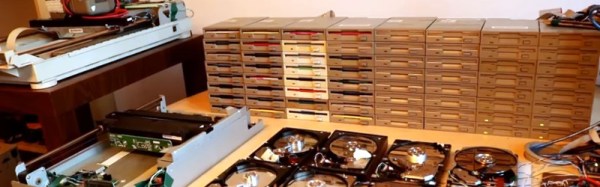
One of our finds this morning therefore comes as an evocative diversion, Smells Like Teen Spirit on [SileNT]’s Floppotron. The Floppotron is a music player composed of a huge array of floppy drives, hard drives, and a couple of flatbed scanners. The scanners are controlled by off-the-shelf Arduino boards and the hard drives have ATMega16s with H-bridge drivers.

This build is the most refined floppy drive organ we’ve seen yet. The floppies are divided into single-voice blocks of eight controlled by an ATMega16, with dynamic volume envelopes mad possible by the number of simultaneously running drives, so the sounds can fade in and out like “natural” musical instruments. The hard drives and scanners are run against their mechanical stops, providing percussion. All the boards are daisychained via SPI to an Arduino that acts as a PC interface, and the PC schedules the performance with a Python script.

He’s provided a couple of pieces as YouTube videos, the floppy motors work particularly well for [Nirvana]’s grunge, but perhaps a bit more mechanical for Hawaii Five-O. This last track will be more evocative than the first if you attended a particular university in the North of England where it was the end-of night record played as the lights came up in one of the discos that had a much better-adjusted PA because the technician knew what she was doing. For those of you with different childhoods, there’s also the Imperial March.

Continue reading “Nirvana Like You’ve Never Heard Them Before”