Installing Android On Your Nintendo Switch, Because Why Not?

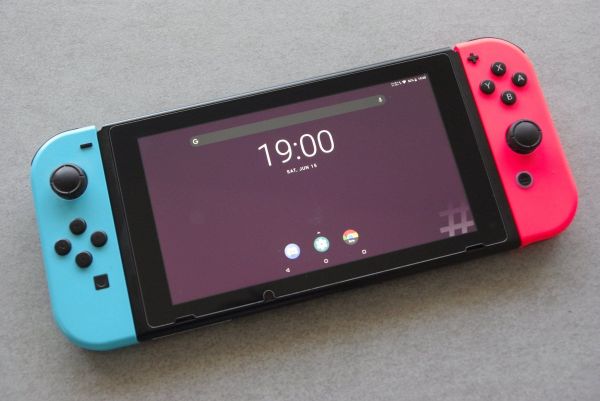
In a continuing trend of ‘but does it run Android?’, enterprising folk over at the XDA-Developers forum have found a way to get LineageOS (the successor to CyanogenMod) installed and running on the Nintendo Switch using Switchroot source code. Promising to release the necessary files to replicate this effort has obviously made other people at XDA-Developers forum as well as on Reddit rather excited.

As for the question of ‘why?’, one has to remember that internally the Nintendo Switch is an Nvidia Tegra X1-based system with a Maxwell GPU, making it definitely one of the nicer ARM-based portable systems out there if one wants to do some Android-based gaming. Even better, the entire Nvidia Shield TV-derived ROM runs from the SD card, so just popping out this SD card is sufficient to return to playing Switch games.

Currently a few nagging issues still have to be worked out with this ROM, such as touchscreen issues, sleep mode not working, auto-rotation not working as communication with the sensor needs to be figured out, and so on. This should make it clear that it won’t be a production ready piece of software, but definitely something that should be used at your own risk.

While it shouldn’t harm the Switch, one should probably not try it on a Switch one cares deeply about. Just in case.
PC And Console Gaming United Courtesy Of Origin

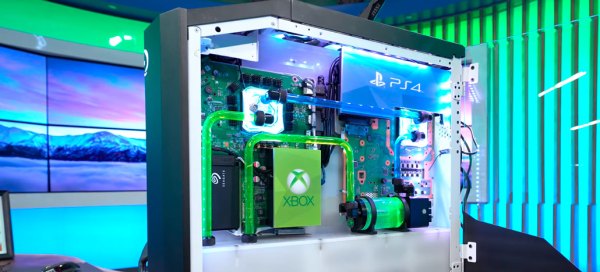
When folk at Origin PCs realized that their company was about to celebrate its 10th anniversary of making custom (gaming) PCs, they knew that they had to do something special. Since one thing they did when the company launched in 2009 was to integrate an XBox 360 into a gaming PC, they figured that they might as well refresh and one-up that project. Thus 2019’s Project ‘Big O’ was born.

Naturally still featuring a high-end gaming PC at its core, the show piece of the system is that they also added an XBox One X, Playstation 4 Pro and Nintendo Switch console into the same full-tower GENESIS chassis. For this they had to strip the first two consoles out of their enclosures and insert them into the case each along with their own (appropriately colored) watercooling loop. Unfortunately the optical drives got ditched, presumably because this made things look cleaner.

The Switch was not modded or even cracked open. Instead a Switch dock was installed in the front of the case, allowing one to dock the Switch in the front of the case, and still use it in a mobile fashion after undocking it. Meanwhile an Ethernet and HDMI switch simplify the interfaces to this gaming system a lot, requiring one to only plug in a single HDMI and Ethernet cable to plug in all capable platforms. The result is a pretty sleek-looking system, definitely an eye-catcher.

Since Origin will never, ever, sell the Big O to customers as it’s just a promotional item, it does tickle the imagination. Case-modding and combining multiple computers (often an ATX and mini-ITX) system into a single case is nothing new, but aspects such as having a dockable Switch feature, this clean aesthetic and overall functionality makes one wonder what an enterprising hobbyist could accomplish here.

Continue reading “PC And Console Gaming United Courtesy Of Origin”

XFM: A 32-Voice Polyphonic FM Synthesizer On An FPGA

There’s something about Frequency Modulation (FM) synthesizer chips that appeals to a large audience. That’s one of the reasons behind [René Ceballos]’s XFM project, aiming to duplicate on an FPGA the sound of pure-FM synthesizer chips of the past such as the Yamaha DX series, OPL chip series and TX81Z/802/816. The result is a polyphonic, 32-voice, 6-operator FM synthesizer stereo module.

The project page goes into a lot of detail about the design choices which ultimately led to XFM being implemented on an FPGA, instead of using a dedicated DSP or MCU. Coming from the world of virtual synthesizers running on PCs, [René ]’s first impulse was to implement something on a Raspberry Pi or equivalent. Unfortunately these boards require a lot of power (ruling out battery-powered operation) and can hardly be called real-time, which led [René ] to abandon this attempt.

The design choice against the use of an MCU is simple: though capable of real-time processing, they lack the necessary power to make them a good choice for audio-processing. Working through the calculations to determine what kind of processing power would be needed, it was found that around 650 MIPS would be needed, a figure which most MCUs struggle to achieve a fraction of.

As one of the further requirements for XFM was that it should be as cheap as possible, this ruled out as too expensive the DSP chips which do have the power and hardware features needed. The component chosen was a Xilinx Spartan 6 FPGA, which though somewhat infamous and shunned in FPGA circles turns out to be a very economical option for this project.

Continue reading “XFM: A 32-Voice Polyphonic FM Synthesizer On An FPGA”

Brain-Computer Interfaces: Separating Fact From Fiction On Musk’s Brain Implant Claims

When it comes to something as futuristic-sounding as brain-computer interfaces (BCI), our collective minds tend to zip straight to scenes from countless movies, comics, and other works of science-fiction (including more dystopian scenarios). Our mind’s eye fills with everything from the Borg and neural interfaces of Star Trek, to the neural recording devices with parent-controlled blocking features from Black Mirror, and of course the enslavement of the human race by machines in The Matrix.

And now there’s this Elon Musk guy, proclaiming that he’ll be wiring up people’s brains to computers starting next year, as part of this other company of his: Neuralink. Here the promises and imaginings are truly straight from the realm of sci-fi, ranging from ‘reading and writing’ to the brain, curing brain diseases and merging human minds with artificial intelligence. How much of this is just investor speak? Please join us as we take a look at BCIs, neuroprosthetics and what we can expect of these technologies in the coming years.

Continue reading “Brain-Computer Interfaces: Separating Fact From Fiction On Musk’s Brain Implant Claims”

Make Your Own SPL DB Meter With A Microphone And MCU

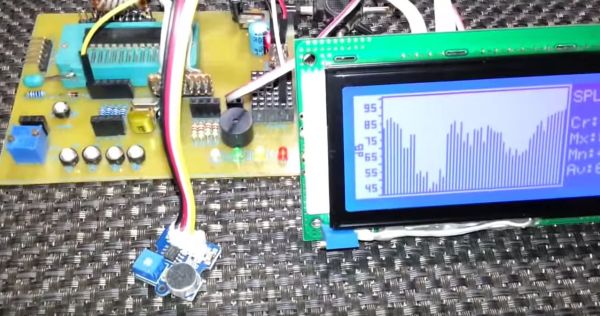
Measuring equipment such as SPL (Sound Pressure Level) decibel meters may seem daunting, but this article by [Shawon M. Shahryiar] shows that making your own need only have two essential ingredients: a microphone and a microcontroller. Obviously the microphone is for measuring the sound pressure level, and its output is then fed into the ADC of the microcontroller which does some math before sending the result to a display.

[Shawon] runs through all of the theory behind the calculations that have to be performed, before showing the C code that runs on the PIC18F242 8-bit MCU targeted by the prototype setup. The display is a graphical LCD type, capable of displaying the text with values as well as bar graphs indicating the measured levels. For the measurements themselves, the RMS value is taken of 16 ADC samples while the algorithm takes into account the specifications of the Seeed-sourced microphone module, specifically its average 50 dB sensitivity rating.

Although a full schematic is not provided, the essentials are all there for anyone to build their own SPL dB meter using virtually any microphone and MCU with built-in ADC. As the article also notes, opting for a higher quality microphone will yield better result and of course a faster MCU will offer more options, including FFT processing. Since the code itself is fairly basic, it should be easy enough to port it to an ARM-based MCU, which would allow one to use for example a TFT LCD.

Take a peek after the break for a video of the article’s SPL dB meter in action.

Continue reading “Make Your Own SPL DB Meter With A Microphone And MCU”

5G Power Usage Is Making Phones Overheat In Warm Weather

As reported by ExtremeTech, the brand new 5G network is running into a major snag with mobile devices as Qualcomm 5G modems literally cannot handle the heat. After just a few minutes of use they’re going into thermal shutdown and falling back to measly 4G data rates. Reports by both PCMag and the Wall Street Journal (paywall) suggest that 5G-enabled phones consistently see problems when used in environments where temperatures hit or exceed 29.5 °C (85.1 °F).

The apparent cause is the increased power draw required by current 5G modems which make heavy use of beam forming and other advanced technologies to increase reception and perform processing on the received data. Unlike 4G and older technologies, 5G needs to have multiple antennas (three or more) to keep a signal, especially when you grab your shiny new smartphone with your millimeter-wave blocking hands.

The spin-off from all of this seems to be that perhaps 5G technology isn’t ready for prime-time, or that perhaps our phones need to have bigger batteries and liquid cooling to keep the 5G modem in it happy. Anyone up for modding a liquid cooling loop and (tiny) radiator into their phone?

Create A Low-Cost, High-Accuracy LCR Meter With An STM32 MCU

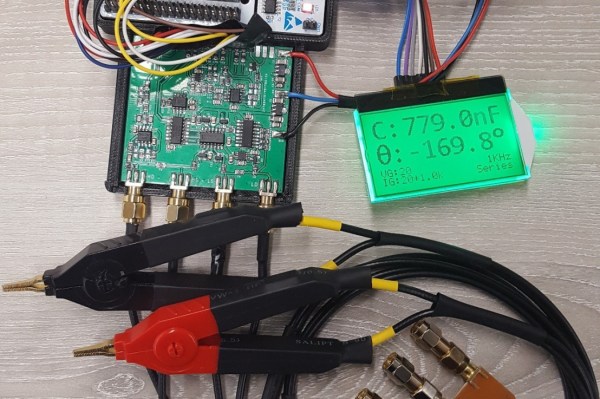
Having a good LCR meter was something which [Adil] had wanted for his personal lab, so as any good university student (and former Hackaday contributor) does, he ended up building his own. Using a Nucleo-F446RE board for the MCU side and a custom PCB for the side that does the actual measuring, he created a meter that reportedly comes pretty close to commercial meters, and for the low price of £55.

Running through some of the theory behind the design as well some design choices, the resulting product is then presented. The choice to not using a standard current shunt, but instead a transimpedance amplifier (TIA) is explained as well. Unfortunately there are no schematics or source code, and the text is somewhat unclear on some points, failing to explain some acronyms that’d make it hard for someone who is not active in this field to understand the full design.

We hope that [Adil] can address those points and provide design files and source code, as it does look like a very interesting project!