One Way To Reuse Your Christmas Lights Post-holiday

[Andrew] shows us one way to reuse all those strands of Christmas lights you used for decoration this year. He had a friend that was helping with stage props for a local musical and ended up using his skills to build a lighted sign with some animation capabilities.

The original plan was to cut out letters for a sign by hand and ring them with white Christmas lights. It is possible to hand cut parts reasonably well, but [Andrew] knew he could get a much better result in less time using a CNC ShopBot to make them. He didn’t know the spacing for the lights so waited and drilled holes for them by hand. Each strand is connected to a relay, then driven by an Arduino. They turned out great as you can see in the clip after the break.

This is a timely hack, because it uses plain old while incandescent bulb strands which will be going on sale in the next few days. Usually you can get them on clearance for a dollar or less so plan ahead and hit the big box store early. Continue reading “One Way To Reuse Your Christmas Lights Post-holiday”
Reduced-cost Braille Display For Use With Computers

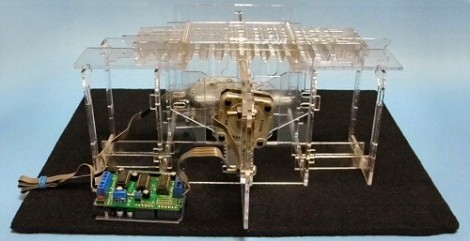
Apparently a Braille computer display can cost several thousand dollars. That’s why [David Pankhurst] is working on a low-cost alternative. His offering is an open source version he calls the Audrey Braille Display.

The concept is quite good. This prototype has one line of six Braille characters. Each character is made of two sliding strips containing eight arrangements of bumps. These can make up any character when positioned correctly. Two motors do all the work, one engages a single strip to reposition it, the other moves the first motor to select which strip should move. This is explained quite well in [David’s] most recent post. Or you can get a preview of the physical build here.

The concept is sound, but the refresh rate must be very slow. We wonder if there’s a way to keep one motor stationary and use solenoids to engage a drive shaft on the individual slide rods? This way, every row could be changed at the same time, disengaging when the appropriate slot is reached.

This hardware is much needed until developing Braille technologies actually come to market.

[via Dangerous Prototypes]

[Scot] Whips Up Breakout Board For His ARM Breakout Board

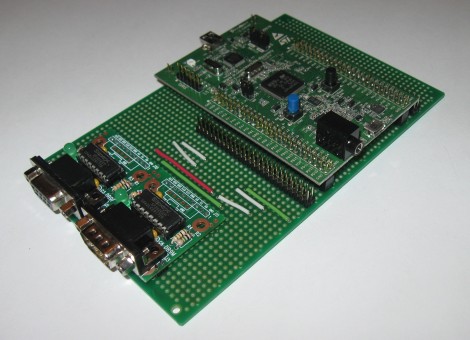
[Scot Kornak] got his hands on the new STM32 Discovery Board. He got his as a free giveaway, but at only $18 he probably would have picked one up anyway. His one complaint about the device is that he dual pin-headers which break out the ARM processor’s pins are not the most convenient for hooking up external components. He decided to make his own breakout board which would give him a more robust solution for the components he uses all the time.

The protoboard that he chose as a base is quite interesting. It’s made for interfacing DIL pin headers just like the ones on the STM32F4 Discovery board. Each row of the dual header is carried down the board perpendicular to those headers. [Scot] cut the traces underneath the STM32 board to isolate the right and left sides. He then added RS232 hardware to one side, while including another pair of DIL headers to break out the rest of the unused pins.

This is all he’s got so far, but there’s plenty of room on the base board to add more as the need arises.

Animated LED Buckyball

This animated LED buckyball has little to do with modeling a carbon molecule but a lot to do with adding some excitement to your party decor. [Tim] felt that the LED cube hacks had run their course, so took on the challenge of a sphere made out of pentagonal and hexagonal components instead.

As with many LED projects, finding a good diffuser is paramount. [Tim] decided to go with hot glue sticks, which do a great job of both diffusing, and piping the light from RGB LEDs. The unintended consequence of this choice is that the shape sags under the weight of 90 glue cylinders.

At the end of each glue segment you’ll find a tiny surface-mount RGB LED and controller combo. This is [Tim’s] own design and in bulk it gets the cost of each node down to about one dollar. With the help of a soccer ball as an assembly jig he finished off the construction and wrote some code to produce the eye-pleasing animations seen after the break.

Continue reading “Animated LED Buckyball”

Make Any Scrap Of Paper Sticky With 2000 Volts

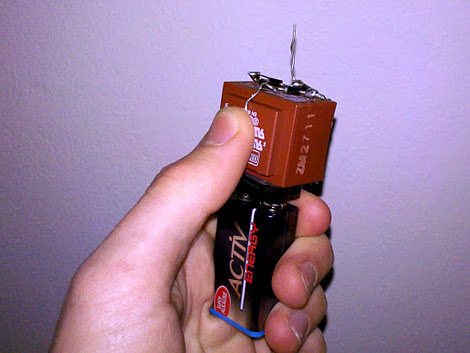
Who needs chemistry when a little bit of physics will do? Instead of brewing up a batch of weak adhesive to make his own post-it notes, [Valentin] built this handheld device to add an electrostatic charge to bits of paper. Just give them a couple of seconds to charge and they’ll stick to the wall with ease.

The charging circuit is pretty simple, involving a transformer, transistor, resistor, and four diodes for rectification. He walks us through the build process, free forming the circuit using the transformer housing as a base. Once the circuit is fully assembled, a 9 volt battery connector is added and the fragile parts are hot-glued in place. It boosts the output voltage all the way up to 2 kV, but it’s still safe because it’s at a very low current.

The concept is akin to the high-voltage bulletin board seen last month. We wonder how long the notes will stay in place without an active electrical connection to keep the charge?

Bitbuf Delivers Some Of The Best Chiptune Effects Around

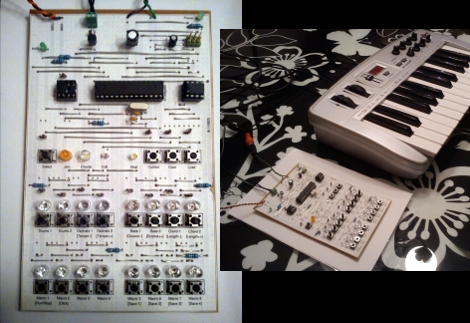
Wow. And furthermore, WOW! Just looking at that clean prototype you know that a lot of work has gone into the project, but when you hear this chiptune MIDI device you’ll really be impressed. We know what you’re thinking, but really, you’ve got to hear this to appreciate the quality [Linus Akesson] achieved in this synthesizer. You can catch it after the break.

He does a great job of showing off the different waveforms that can be produced by the ATmega88 on this board. But there’s much more. It also serves as a 16 frame, 16 channel sequencer for creating and layering your own loops.

He mentions that eight oscillators are used for the waveform generation. We don’t see hardware for this on the board. Either we’re missing it, or these oscillators are being created with software? If you have an idea of how this works please clue us in by leaving a comment.

Continue reading “Bitbuf Delivers Some Of The Best Chiptune Effects Around”

How To Etch Your Own Solder Paste Stencils

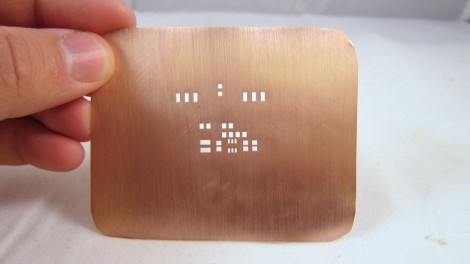
We’re kind of surprised we haven’t covered this concept before since it only uses techniques that are commonly avaialable for home PCB fabrication. [Ray] made this solder paste stencil out of a sheet of copper using the same etching techniques you would for a circuit board. He designed and printed a resist pattern, with toner everywhere except the places where there should be holes in the stencil. He transferred the toner to the copper using an iron.

The difference here should be obvious; this a thin copper sheet with no substrate. Because of that, you must protect the copper surface before etching. he covered the entire thing, both sides, in packing tape. After that it’s into the Cupric Chloride bath to dissolve the exposed parts. Once the tape and toner has been removed you can scree a precise amount of solder paste onto your boards.

This isn’t for everyone, but if you’re assembling many boards it’s not a bad approach. If the stencil is no longer used it can be recycled, but we do wonder how corrosion on the copper will affect the stencil’s performance.

The idea for this technique came to [Ray] from a guide that’s been around for years.