[Dino] Celebrates The 131st Anniversary Of The Photophone

photophone_demonstration

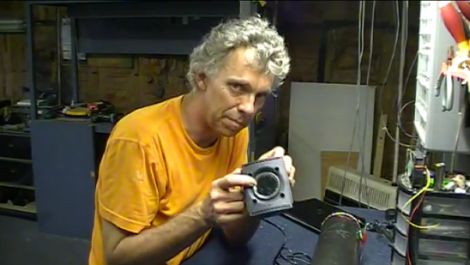
[Dino Segovis] wrote in to share yet another installment of his Hack a Week series, though this one is quite timely.

It was 131 years ago today that [Alexander Graham Bell] unveiled the Photophone to the world. A precursor to fiber optic technology, [Bell’s] incredibly important invention can be easily replicated in your garage, as [Dino] shows us.

The original Photophone was constructed using a megaphone and crystalline selenium cells at the focal point of the receiver, however this version can be made with easy to obtain parts. [Dino] rigged his laptop up to a speaker on which he mounted a mirror, before setting it out in the sun. The vibrations of the mirror modulate the sunlight, reflecting it onto a solar cell positioned at the end of a long, black PVC tube. The solar cell’s leads are fed into an amplifier followed by a speaker, which broadcasts the audio.

The demonstration goes off without a hitch, and while some might be underwhelmed by the technolgy, imagine how incredible it would have looked 131 years ago!
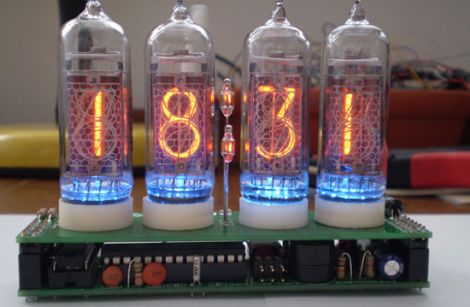

Warm Tube Clock, Take 2

warm_nixie_v2

[Mure] wrote in to let us know he has put the finishing touches on the second iteration of his Warm Tube Nixie clock. We featured his original creation here last year, and while many things remain the same, he has still found a few things that he was able to improve on.

The first notable feature is the new real time clock. Instead of using a discrete crystal to keep time and a temperature sensor for compensation, he has opted to use a DS3231 RTC IC. It is far more accurate than the crystal, and it features a built-in temperature sensor as well. The alarm functionality has been simplified too, moving the controls into firmware rather than having to use a sliding switch to do so.

With the mainboard redesign, it would have been easy to leave behind the nixie “shields” he created for his first clock, but with a focus on interoperability, he chose to make this clock fully compatible with version one’s shields and vice versa.

While the changes aren’t groundbreaking, it’s nice to see a project like this undergo continued refinements. If you want to build a clone of this clock, [Mure] has made sure that all of the schematics and source code are available on his site.

Continue reading to see a brief video demo of the clock in action.

Continue reading “Warm Tube Clock, Take 2”

Kinect-driven Cart Makes Shopping A Snap

wi_go

[Luis de Matos] is working on a neat Kinect project called Wi-GO that aims, as many do, to enhance the lives of individuals with disabilities. While the Wi-GO project is geared towards disabled persons, it can be quite helpful to the elderly and pregnant women as well.

Wi-GO is a motorized shopping cart with a Kinect sensor mounted on the back. The sensor interfaces with a laptop and functions much as you would as you would expect, scanning the area in front of the cart for objects and people. Once it identifies the individual it is meant to help, the cart diligently follows behind as the person goes about their typical shopping routine. The robot keeps a safe distance to avoid collisions, but remains within reach so that it can be used to carry goods.

If you take a look a the video below, you can see Wi-GO in action. It starts off by showing how difficult it would be for an individual in a wheel chair to use a shopping cart alone, and follows up by showing how much easier things are with Wi-GO in tow.

While the project is only in prototype form at the moment, we suspect that it will only be a matter of time until you see devices like Wi-GO in your local supermarket.

Continue reading “Kinect-driven Cart Makes Shopping A Snap”

DIY Inkjet Printer Begs To Be Hacked

diy_inkjet

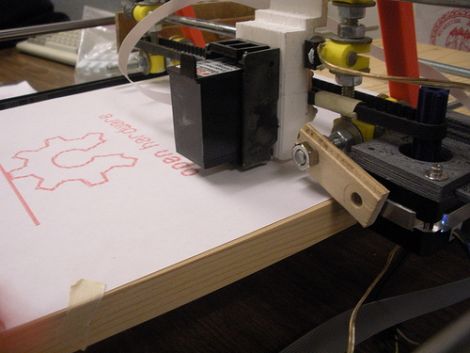
[Nicholas C Lewis, Patrick Hannan, Jared Knutzen, and Joy Markham], students from the University of Washington, have recently taken the wraps off a project which they have been collaborating on, a DIY inkjet printer. The group set out to construct a low cost, open source inkjet printer for personal use that utilizes standard inkjet technology. Their working prototype, pictured above, satisfies all of those requirements, making it an ideal device for the at-home hobbyist.

The printer was constructed from easy to obtain components such as steel rods and stepper motors, along with other parts that can be printed using a RepRap or similar machine. An Arduino Mega manages the steppers and repurposed print head, recreating whatever Processing-generated image it has been given.

The printer is quite a hit so far, and people are already talking about adapting the design to print on spherical objects (think EggBot), to create direct etch resist PCBs, and more. We think it would make a great direct to garment printer with just a few small tweaks.

Check out the short video embedded below to see the printer in action.

[via Make]

Continue reading “DIY Inkjet Printer Begs To Be Hacked”

Simple VGA Interface For Tiny FPGA Boards

fpga_vga_adapter

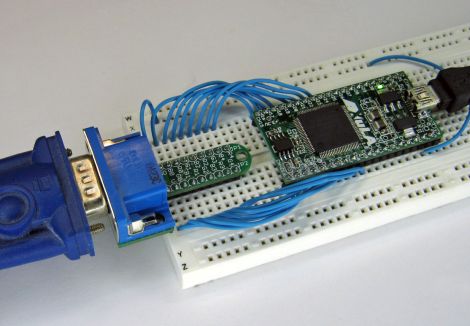
[devb] has been playing around with XESS FPGA boards for ages, and as long as he can remember, they have had built-in VGA interfaces. His newest acquisition, a XuLA FPGA board, doesn’t have any external parts or ports aside from a USB connector. He needed to get video output from the board, so he decided to build a VGA interface himself.

He prototyped a 512-color VGA interface board which worked just fine, but he thought it would be way too cumbersome to use for each and every project. To keep life simple, he designed a small PCB that integrates a VGA connector and all of the resistors he needed to get the signal from the FPGA. His boards plug directly into a breadboard, so only a handful of wires is needed to connect the FPGA to a monitor.

As you can see on his site, the adapter works quite well, allowing the FPGA to put out a crisp 800×600 image with little fuss. [devb] has also posted all of his design files on his site in Eagle format for anyone interested in replicating his work.

Trick Mouse Keeps The Screen Saver At Bay

mouse_wiggler

[Jerry] wrote in to share a little device he built to solve a problem he was having at work. You see, every computer in his office has a policy-enforced idle timeout, requiring the user to enter a password in order to regain access to their desktop.

This is a huge pain, since he sporadically uses an old computer for the sole purpose of monitoring some applications running in his data center. With the computer timing out every 10 minutes, he is constantly required to enter his password in order to take a 10 second glance at the screen to ensure everything is OK.

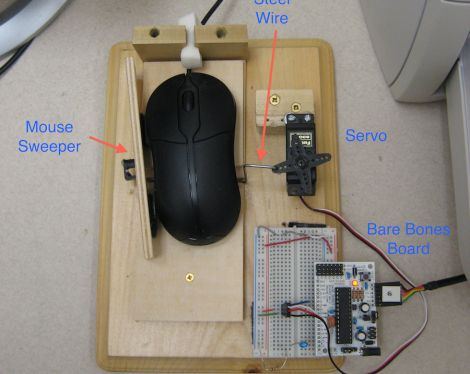
Rather than circumvent the screen saver using a local security policy or by implementing a microcontroller-based signal generator, he opted to create a mechanical solution instead. His computer’s optical mouse resides inside a wooden frame, and is periodically swept from side to side by an ATmega-controlled servo, keeping the screensaver permanently at bay.

Call it a hack, call it a kludge, call it what you will. All we know is that while we might have done it a little differently, it works just fine for [Jerry], and it generates all sorts of interesting conversation to boot.

Stick around for a quick video demonstration of his mouse wiggler box.

Continue reading “Trick Mouse Keeps The Screen Saver At Bay”

Kickstarter Roundup: Wednesday, June 1st

We have been getting tons of emails lately recommending we take a look at various Kickstarter projects. We used to ignore them since they all boil down to a request for project funding, but since there are so many cool projects out there, we figured we might as well share a couple. Some of these projects have already met their funding goals, but we thought they were worth a mention anyhow.


Solar Powered Coffee Roasting

solar_coffee_roaster

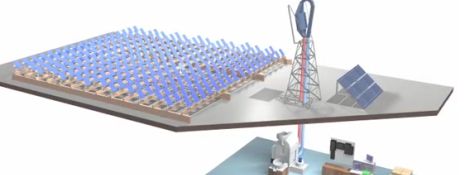
We’re all about both coffee and alternative energy, so this one caught our eye right away. While this coffee roaster won’t exactly fit on your back porch, it would be perfect for a coffee shop located in a sunny locale. Based off “power tower” solar concentrator systems, this rooftop-mounted solar harvester has big potential. Pair this with sopme sustainably-grown coffee, and you’ve got quite the tasty combo.


HexBright – an open source flashlight

hexbright

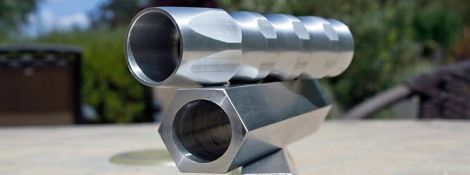
What do you get when you combine milled aluminum hex bar and a Cree XM-L LED? A lightweight, extremely bright flashlight that won’t roll away on you. The HexBright puts out 500 lumens and sports a built-in rechargeable battery that can be topped off via your computer’s USB port. Not only that, the high-end version can be programmed to support any pattern or brightness that you choose.  We’ll take two, thanks.


Arduino Project Board

arduino_project_board

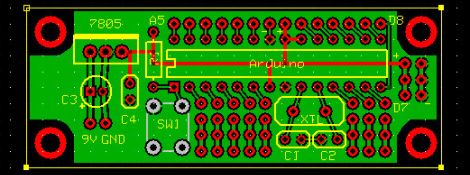
[Randy Sarafan] of Clap-off bra fame is working on a slimmed-down Arduino board for use in the final stages of project development. He really doesn’t see the need to put an entire Arduino development board into his finished projects and often makes a quick perfboard circuit for his builds once he is finished prototyping. He’s grown tired of the process and developed a small circuit board that has all the connectivity he needs, without all the extra bits found on Arduino development boards.