VCF East 2021: Preserving Heathkit’s 8-Bit Computers

To say the Heathkit name is well known among Hackaday readers would be something of an understatement. Their legendary kits launched an untold number of electronics hobbies, and ultimately, plenty of careers. From relatively simple radio receivers to oscilloscopes and televisions, the company offered kits for every skill level from the post-war era all the way up to the 1990s.

So it’s hardly a surprise that in 1977, seeing the success of early home computers like the Altair 8800 and IMSAI 8080, Heathkit decided to join the fray with a computer kit of their own. But by that point the home computing market had started to shift from a hobbyist’s pursuit to something the whole family could enjoy. Compared to the Apple II and TRS-80, both of which also launched in 1977, Heathkit’s machine seemed like the product of a bygone era.

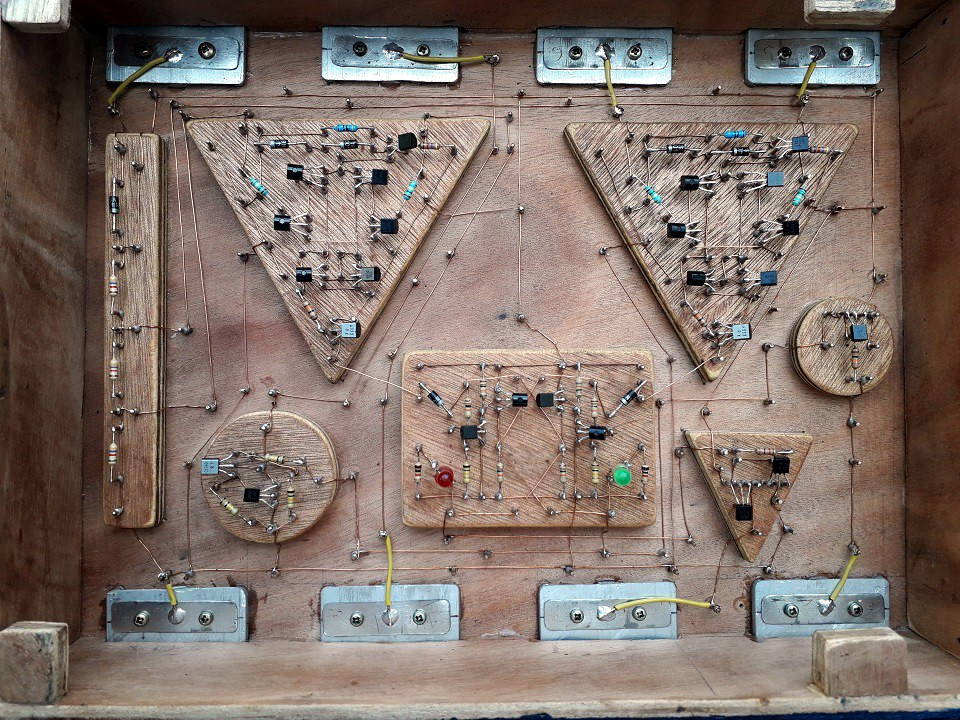
While it might not have gained the notoriety of the microcomputers it was designed to compete with, the Heathkit H8 is certainly not forgotten. Tucked away in a corner at the 2021 Vintage Computer Festival East was an impressive exhibit dedicated to the Society of Eight-Bit Heath Computerists (SEBHC) called Heathkit: Keeping the Legacy Alive. Presented by Glenn Roberts, this collection of original and modern hardware demonstrated the incredible lengths to which this group of passionate Heathkit owners have gone to not just preserve the memory of these often overlooked computers, but to continue to improve upon the kit’s unique design.

Continue reading “VCF East 2021: Preserving Heathkit’s 8-Bit Computers”

Modified Car Alternator Powers Speedy DIY E-Bike

Your garden variety automotive alternator is ripe for repurposing as is, but with a little modification, it can actually be used as a surprisingly powerful brushless motor. Looking to demonstrate the capabilities of one of these rebuilt alternators, [DIY King] bolted one to the back of a old bicycle and got some impressive, and frankly a bit terrifying, results.

We should say up front that the required modifications to the alternator are quite extensive, so before you get too excited about building your own budget e-bike, you should check out the previous guide [DIY King] put together. The short version is that you’ll need to machine a new rotor and fill it with the neodymium magnets salvaged from hoverboard motors.

A custom built alternator rotor is the key to the project.

Once you’ve got your modified alternator, the rest is relatively easy. The trickiest part of this build looks like it was cutting off the bike’s rear wheel mount and replacing it with a plate that holds the alternator and a pair of reduction gears pulled from a 125cc motorbike. Beyond that, it’s largely electronics.

Naturally, you’ll also need a pretty beefy speed controller. In this case [DIY King] is using a 200 amp water-cooled model intended for large RC boats, though interestingly enough, it doesn’t seem he’s actually running any water through the thing. He’s also put together a custom 1,500 watt-hour battery pack that lives in a MDF box mounted under the seat.

To test out his handiwork, [DIY King] took to the streets and was able to get the bike up to 70 km/h (43 MPH) before his courage ran out. He thinks the motor should be able to push it up to 85 km/h, but he says the bike started wobbling around too much for him to really open it up. In terms of range, he calculated that while cruising around at a more palatable 30 km/h (18 MPH), he should be able to get 100 kilometers (62 miles) off of a single charge.

If you like repurposed motors and suicidal bike speeds, you’ll love this build that uses a washing machine motor to push a rider to a claimed 110 km/h. If you’re not worried about speed or range, then this supercapacitor e-bike is certainly worth a look as well.

Continue reading “Modified Car Alternator Powers Speedy DIY E-Bike”

VCF East 2021: Novasaur TTL Computer Sets The Bar

There was certainly no shortage of unique computers on display at the 2021 Vintage Computer Festival East; that’s sort of the point. But even with the InfoAge Science and History Museum packed to the rafters with weird and wonderful computing devices stretching back to the very beginning of the digital age, Alastair Hewitt’s Novasaur was still something of an oddity.

In fact, unless you knew what it was ahead of time, you might not even recognize it as a computer. Certainly not a contemporary one, anyway. There’s nothing inside its Polycase ZN-40 enclosure that looks like a modern CPU, a bank of RAM, or a storage device. Those experienced with vintage machines would likely recognize the tight rows of Advanced Schottky TTL chips as the makings of some sort of computer that predates the 8-bit microprocessor, but its single 200 mm x 125 mm (8 in x 5 in) board seems far too small when compared to the 1970s machines that would have utilized such technology. So what is it?

Inspired by projects such as the Gigatron, Alastair describes the Novasaur as a “full-featured personal computer” built using pre-1980 components. In his design, 22 individual ICs stand in for the computer’s CPU, and another 12 are responsible for a graphics subsystem that can push text and bitmapped images out over VGA at up to 416 x 240. It has 512 K RAM,  256 K ROM, and is able to emulate the Intel 8080 fast enough to run CP/M and even play some early 80s PC games.

Continue reading “VCF East 2021: Novasaur TTL Computer Sets The Bar”

Vizio In Hot Water Over Smart TV GPL Violations

As most anyone in this community knows, there’s an excellent chance that any consumer product on the market that’s advertised as “smart” these days probably has some form of Linux running under the hood. We’re also keenly aware that getting companies to hold up their end of the bargain when it comes to using Linux and other GPL licensed software in their products, namely releasing their modified source, isn’t always as cut and dried as it should be.

Occasionally these non-compliant companies will get somebody so aggravated that they actually try to do something about it, which is where smart TV manufacturer Vizio currently finds itself. The Software Freedom Conservancy (SFC) recently announced they’re taking the Irvine, California based company to court over their repeated failures to meet the requirements of the GPL while developing their Linux-powered SmartCast TV firmware. In addition to the Linux kernel, the SFC also claims Vizio is using modified versions of various other GPL and LGPL protected works, such as U-Boot, bash, gawk, tar, glibc, and ffmpeg.

According to the SFC press release, the group isn’t looking for any monetary damages. They simply want Vizio to do what’s required of them as per the GPL and release the SmartCast source code, which they hope will allow for the development of an OpenWrt-like replacement firmware for older Vizio smart TVs. This is particularly important as older models will often stop receiving updates, and in many cases, will no longer be able to access all of the services they were advertised as being able to support. Clearly the SFC wants this case to be looked at as part of the larger Right to Repair debate, and given the terrible firmware we’ve seen some of these smart TVs ship with, we’re inclined to agree.

Now of course, we’ve seen cases like this pop up in the past. But what makes this one unique is that the SFC isn’t representing one of the developers who’s software has been found to be part of Vizio’s SmartCast, they’re actually the plaintiff. By taking the position of a consumer who has purchased a Vizio product that included GPL software, the SFC is considered a third-party beneficiary, and they are merely asking the court to be given what’s due to them under the terms of the license.

As firm believers in the open source movement, we have zero tolerance for license violators. Vizio isn’t some wide-eyed teen, randomly copying code they found from GitHub without understanding the implications. This is a multi-billion dollar company that absolutely should know better, and we’ll be happy to see them twist in the wind a bit before they’re ultimately forced to play by the rules.

An Open Source Game Boy Printer That Doesn’t Print

While we’ll admit seeing your Game Boy Camera shots come out on a little slip of thermal paper was pretty neat back in 1998, anyone who’s still using the Game Boy Printer these days is probably more interested in getting their images in digital form. Which is why the open source NeoGB Printer is so exciting.

A collaborative effort between [Rafael Zenaro], [Raphaël BOICHOT], and [Brian Khuu], the project combines an ESP32 development board and some common components with their GPLv3 firmware to fully emulate the Game Boy Printer hardware. Once plugged into your Game Boy, any of the 110 titles that support Nintendo’s paper-pushing peripheral will recognize the NeoGB Printer as the real deal and happily send along the image.

But rather than committing it to paper, the NeoGB Printer saves the image to an SD card. From there, you can put the card in your computer and do whatever you wish with the captured files. Incidentally, it turns out there’s already a commercial gadget on the market that does something very similar, but this DIY approach comes well under its $99 USD price tag. In fact, if you’ve got a Game Boy Link Cable you don’t mind cutting up, you’ve probably got everything you need to pull this off in the parts bin right now.

We particularly like how the team has went out of their way to support different hardware configurations for the NeoGB Printer. If you want to go all out and add status LEDs and an OLED display, go for it. But if you just plan on using the thing once to grab a copy of the Pokémon diploma you earned 20 years ago, then you can skip the bells and whistles.

If you’re only worried about getting your snaps out of the Game Boy Camera, we’ve covered projects that will extract them directly from the cartridge. But this approach certainly has its appeal, as works with a much wider variety of games. We’re glad this project exists, as it means a whole new generation can explore all the wacky ways developers came up with to utilize the Game Boy Printer back in the day.

Refining The Greatest Joystick Of The 1980s

The Competition Pro joystick is often considered to be the pinnacle of input devices, at least as far as the 1980s gaming goes. But the design isn’t perfect, and time hasn’t been kind to certain aspects of its mechanism. For example, the large rubber disc used to keep the stick centered on early generations of the hardware will invariably be hardened up on any surviving specimens. Looking to return these classic controllers to their former glory, and then some, [mageb] has released a number of 3D printed modifications for the Competition Pro that should be of great interest to the vintage gamer.

The new microswitches

First and foremost is the deletion of the original rubber disc for a new spring mechanism. Even if this is the only modification you do, [mageb] says you’ll already have a better and longer-lasting joystick to show for it. But if you want to continue with the full rebuild, be aware that there’s no going back to stock. Once you start cutting the original parts, you’re committed to taking it all the way.

Assuming you’re not afraid to get your hands dirty, the next step is cutting the metal contacts from the bottom of the face buttons so they’ll work with the new microswitch array he’s designed. Each button gets its switch, and four handle movement of the joystick. You can try out different switches to adjust the feel of the joystick, but [mageb] assures us that he’s already done the research and put the best quality switches in the bill of materials.

The end result is a Competition Pro joystick that looks more or less the same from the outside, but is considerably improved internally. That’s always a win in our books, though we’re sure somebody out there is going to get mad that the brittle old rubber disc wasn’t sent to the Smithsonian.

ESP32 Clock Pushes Outrun Graphics Over Composite

We’ve covered plenty of clocks powered by the ESP32, but this one from [Marcio Teixeira] is really something special. Rather than driving a traditional physical display, the microcontroller is instead generating a composite video signal of an animated digital clock. This could be fed into whatever device you wish, but given the 80’s synthwave style it’s pumping out, you’ll probably want to find a suitably retro CRT to do it justice.

Specifically this is a variant of the “Dali” clock, where each digit seems to melt and morph into its successor. Though his version doesn’t necessarily share code with all the previous iterations, [Marcio] does credit the developers who have pulled off similar visual tricks going all the way back to 1979. Given the vintage of this particular animation, the neon skyline and infinite scrolling grid certainly feel like a perfect fit.

Want to add a little vaporwave vibe to your own workbench? Assuming you’ve already got a 80s style CRT, all you need is an ESP32 and two wires stuck into the composite video port. One goes to ground, and the other goes to the chip’s analog pin. Once everything is powered up, you’ll be able to configure the clock with a web-based interface. It doesn’t get much easier than that.

In the documentation, [Marcio] calls out a few open source projects which were instrumental to getting his clock off the ground. The pioneering work [bitluni] did to get video out of the ESP32 is something of a given, but he also sends a hat tip to [rossumur] for his collection of 8-bit game console emulators written for the microcontroller. Projects like this are a fantastic example of what’s possible when a community works together to truly push the envelope.

Continue reading “ESP32 Clock Pushes Outrun Graphics Over Composite”