Bluetooth Shock Collar Keeps Wearer On Task

Like a lot of us [Liam Kloppers] had a problem with doomscrolling. Unwilling to go cold-turkey because he does find some utility in social media. He tried a number of things before deciding to say “Screw it” and just go full Pavlov on himself with some old-fashioned classical conditioning. Who needs willpower when you have electric shocks to dissuade you?

The key here was finding an electric-shock dog collar that could be controlled via a smartphone application, which meant he could reverse-engineer its Bluetooth protocol and get it linked up to his own software. The initial implementation ties his quick-and-dirty Python control program with a web server living on his laptop, which he’s configured MacroDroid to call on when his personal criterion for ‘doomscrolling’ is met.

With the shock collar wrapped around his leg, [Liam] was ready to test. It turns out dogs are a lot tougher than people, because even when set to a low level, the shock from the device made him toss his phone across the room and had him hesitant to even pick it up again.

Since he couldn’t bring himself to put the shock collar back onto his leg, he’s now thinking of an audible alarm, something we’ve seen work before. If you’re as unhappy with your habits as [Liam], perhaps consider a device like Commodore’s social-media-free phone before resorting to self-electrocution.
Building A Hammond Organ To Understand How They Work

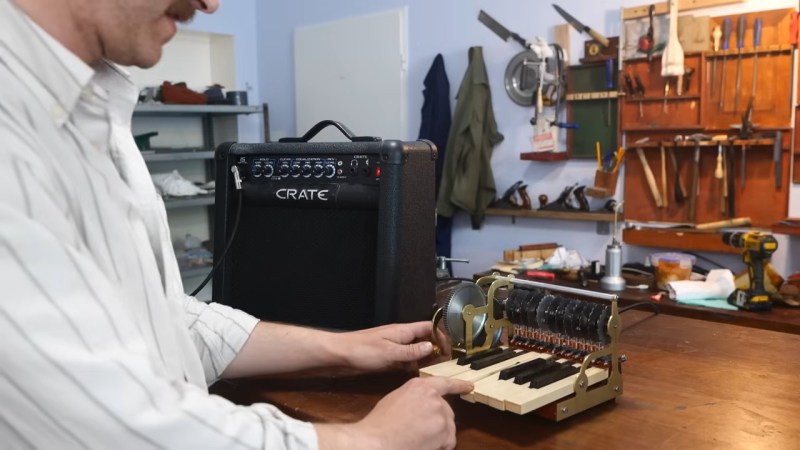
The Hammond organ is an early form of electronic– or perhaps electromechanical– musical instrument. It solved the very real problem of organs normally being the sort of thing you built into a cathedral, allowing a similar sound to fit into a piano-like form factor. Their workings are a so simple that it’s hard to wrap your head around it actually working– which is why [Uri Tuchman] built one on YouTube. Also for a gift exchange, but we’re not Santa, here– we’re here to learn, and [Uri] does not disappoint.

[Uri]’s organ is a bit smaller than what the Hammond corporation was putting out back in the day, just one hand-cranked octave– and it lacks the distinct spinning speaker in favour of plugging into any old guitar amp. It’s enough to get the idea across. Each of the twelve keys acts as a simple switch, wired to a pickup made from a coil of wire around a steel rod– much like a magnetic pickup on an electric guitar. The pickup faces the tone wheel, which is the part that feels like magic: the tonewheel spinning past the pickup acts exactly like the steel string vibrating in an electric guitar, its ferroelectric motions inducing a tiny current. The tonewheels smooth teeth are spaced to create sine waves at the frequencies corresponding to each key, so it has to be exact. That’s why while the rest of the brass-and-wood build is [Uri]’s beautiful craftsmanship, the iron tonewheels are CNC’d.

Aside from the amp it is plugged into, there are no electronics here. There’s nothing to double or otherwise alter the frequencies: one key means one tonewheel– twelve for this build– and if the RPMs are off everything is out of tune. Good thing [Uri] made it hand-cranked! Well, it is for a gift exchange. Maybe it’s a white elephant sort of thing, because we can only imagine that making it much harder to play. On the other hand, [Uri] demonstrates some neat effects by varying the RPM at the end of the video, so perhaps that’s a feature.

As nice as [Uri]’s work is, Hammond Organ Company filmed the construction themselves, back in the day if you want to see the true quill. Alternatively, you can get more of [Uri]’s craftsmanship with this square guitar.

Continue reading “Building A Hammond Organ To Understand How They Work” →

Thermoacoustic Stirling Engine Is Now Fully 3D Printable

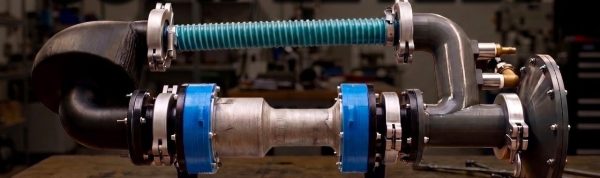
Would you like to make your own energy? Why, who doesn’t in this era of rising costs! A Stirling engine always looks like a good fit for that: highly efficient, with no risk of a boiler explosion. A thermoacoustic Stirling engine looks even better, since it has only one moving part at the output end. A thermoacoustic Stirling engine you can 3D print yourself looks best of all, and that’s what [my engines] has on offer, now that even the burner and hot end of his thermoacoustic engine are designed for SLA metal printing.

We previously reported on the open-source engine, but there’ve been some improvements worth talking about. For one thing, he’s integrated a biogas/methane burner directly inside the 3D-printable hotend. For another, that 3D-printed design allows for an excellent heat exchange geometry that would be very hard to get any other way. The whole thing is open source with plans available at OwnEnergy.org, where you can find links to the apparently mandatory Discord channel and now an old-style forum to actually collaborate on the design, which is open-source. The site is also now the home of all data and discussion about [my engines]’s homescale biogas plant, which is the power source for this little engine.

If you’d rather print a combustion engine, you can do that, too, but you’ll need more “vitamins” than this unit requires.

Continue reading “Thermoacoustic Stirling Engine Is Now Fully 3D Printable” →

Samsung Printer Is The Next Frontier Of Minecraft Servers

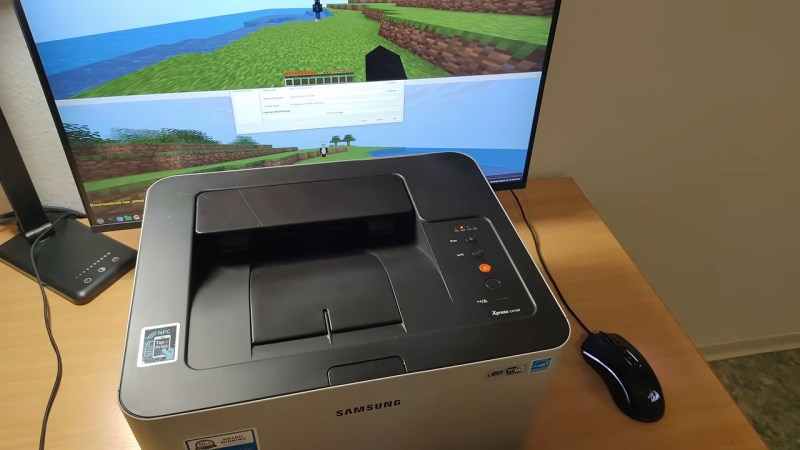
While DOOM remains the undisputed champion of ‘game you play on every piece of hardware’ it seems that the role of ‘game you play on everything just because you can’ is slowly being shifted to Minecraft, as we have yet another Minecraft server somewhere Minecraft has no business being served– in this case, a Samsung Printer.

The hack actually requires opening up the printer to get at the debug ports to bang your way in via serial, but as any security expert will tell you, once the black hats have physical access to a machine, they own it. That isn’t to say it’s easy– [vimpo] had to dump the firmware and find an exploit. Since it’s 2026 [vimpo] tried to get an LLM to do all that hard work for him, and while it helped with identifying functions in the dump, ultimately the hacking still fell upon [vimpo]’s human intelligence, though not before burning through millions of tokens.  Having found a good old fashioned UDP overflow exploit, he’s gets control of the printer and puts an improved version of his lightweight Minecraft server, UCraft, on it.  Like the server, the exploit is also on GitHub but you’ll very likely need the exact same printer to get it to work: a Samsung C410W with firmware V3.00.02.20, DEC-15-2015. One important caveat is that while you can still use the printer as intended after this hack, you cannot do so while playing Minecraft: it crashes the server if you try. Good to know.

In case you’re wondering, yes, this is the same guy who got a Minecraft server running on a light-bulb, which arguably more impressive. Where he might mine and/or craft next is anybody’s guess. Somebody else already did the ESP32-C3, and while we suspect nothing will ever beat the 1960s Univac implementation for sheer impracticality, we’re willing to be surprised.

Continue reading “Samsung Printer Is The Next Frontier Of Minecraft Servers” →

Historical Hack: Henri Giffard’s Steam Injectors

Here’s a historical hack for you: you have a big, rolling pressurized kettle, also known as a steam locomotive. It needs water to make up for the steam constantly chuff-chuff-chuffing away, or bad things happen. How do you get water from an unpressurized tender into a high pressure boiler with no moving parts? What you need is a some way to inject steam with no moving parts — a steam injector, if you will. [Marc Flint] found that the steam injectors were the hardest part of a loco to understand, so he made a video for all of us once he’d figured it out.

The steam injector isn’t a new idea. [Henri Giffard] came up with it back in the 1850s to replace expensive and maintenance-hungry pumps. It’s rather ingenious and uses the fluid mechanics uncovered by another European bloke by the name of Bernoulli. First, the high-pressure steam from the boiler goes through a converging-diverging nozzle to drop its pressure and speed its flow up, just as you’d guess if you’ve seen Bernoulli’s laws. Even more vacuum-inducing is the presence of water: the steam, already cooled by its expansion, hits the water in the pipe open to the tender, and condenses into it, shrinking a couple of orders of magnitude, creating a vacuum that draws in no small quantity of feed water. That one we did not expect from Bernoulli, but it makes sense. So how to get from below atmospheric pressure to the 180-odd PSI or more in the boiler?

Well, the water is now moving at a good clip, between the Venturi effect and the momentum gained from absorbing that steam, so another converging nozzle is the trick. Bernoulli’s law, once more! A one-way valve lets the now-pressurized water into the boiler, with a gap in between to dump water while the pressure builds up. It’s a clever trick, and since the steam coming from the boiler makes it back inside along with at least some of its heat energy, it’s much more efficient in both coal and water than running a pump. It’s also a bit of a head scratcher how it works unless someone sits you down to explain it, so we’re glad [Marc] did.

Not many of us are likely to use this knowledge directly — unless we’re firing up a 90 year old boiler or building a new steam locomotive — but seeing how great engineers of years past made use of basic physical laws can serve both as education and inspiration.

Continue reading “Historical Hack: Henri Giffard’s Steam Injectors” →

Compress Links For Optimal QR Codes

Link shorteners have been a staple of the online world for over two decades now, but they’ve got some issues– for one thing, it’s totally non-transparent where the link actually goes, leaving you open to all sorts of shenanigans, of which RickRolling is probably the best case. For two, your traffic is going through an external service who may have their own nefarious intent. [PortalRunner] had an idea: don’t shorten the link, but compress it.

You see, a traditional URL shortener like tinyurl just generates a random code and associates that with your original link in its database. That’s fine, but you’re relying on a third party database. The alternative is to take the URL, encode it in some way, and apply some compression algorithm to the data. If the encoding and compression are open-source– which [Portal ]’s absolutely are— then you can check yourself before following the link, and/or self-host the whole thing for piece of mind. As a bonus [Portal]’s Ha.mr– that’s pronounced Hammer– also gives you a QR code optimized for easy scanning. QR codes have a specific alphanumeric character set built in, and it isn’t the full UTF-8– if you naively use random text, you’re in byte mode, which needs a lot more QR real estate. Or inverting that, the fewer bits it has to store, the easier a qr code is to scan at the same size. The text version of the compressed links can use UTF-8– including emoticons– but they don’t have to.

The whole project has a “why isn’t everyone doing it this way” vibe about it. We’d probably want to self-host this if we were using it seriously– [Portal] put this together on a lark and makes no promises it will be online forever–but again, this is open source, so we can. [Portal] is using normal compression algorithms here, but if you really want to squeeze text, use a neural net. 

Continue reading “Compress Links For Optimal QR Codes” →

Store Tunes On Paper And Stream Them Over LoRA

Some projects seem too good to be true until you dig into it and find the secret magic that makes it all work. Take Paper Tunes by [Makestreame], a project which purports to store a song on a single sheet of paper via QR code and transmit the data over LoRA. If it was a MIDI sequence, maybe. But the promise of Paper Tunes is to take any MP3 and give it this treatment, and that just seems like an impossible level of compression at first glance.

The music is heavily compressed, make no doubt about that. There’s samples in the Instructables link above and in the video below, but it sounds far better than it has any right to. The secret is Meta’s EnCodec neural codec, which like you’d guess uses neural nets to squeeze the absolute minimum information needed to reconstruct a sample. With it [Makestreame] is able to get a 2.9 MB MP3 file down to just 21.44 kB.

Of course, that’s still not going to fit in a 3.3 kB QR code. But by simply making eight of them, [Makestreame] is able to fit the song onto the front and back of a piece of paper. Yes, each song has an “A” and a “B” side — and you thought flipping a record halfway through got old fast. Having to scan eight codes to get one song may strike some as a bit silly, but we do enjoy some silly things here.

The same EnCodec compression that gets the song so tiny as to fit in a brace of QR codes is obviously also what enables its transmission over LoRA. While it’s got far lower bandwidth than something like WiFi, 21 kB is well within its limits. It’s often said that LoRA isn’t suitable for audio, but this project is another example that one person’s “unsuitable” is another person’s “challenge accepted”.

We’ve seen other LoRA audio projects before. Speaking of things not suitable for audio, we once featured an entire album crammed onto a floppy disk. Continue reading “Store Tunes On Paper And Stream Them Over LoRA” →